

Calculate Your Standing Desk's True Weight Needs
Why does your standing desk seem to struggle when transitioning to standing height? Or perhaps you have noticed a slight, rhythmic clicking sound during adjustment that wasn't there six months ago. Many remote workers and gamers invest thousands in high-fidelity monitors and custom PC builds, yet treat the desk’s weight capacity as an afterthought—a "marketing number" rather than a critical engineering constraint.
Underestimating the cumulative weight of a professional setup is the most frequent mistake we observe in workstation audits. A desk that is overloaded does not simply stop working; it suffers from increased mechanical wear, reduced stability (wobble), and can ultimately compromise your musculoskeletal health. If a desk cannot maintain a stable, "spinal neutral" position due to motor strain or structural deflection, the user inevitably adopts compensatory postures that lead to Repetitive Strain Injury (RSI) and chronic discomfort.
In this guide, we will analyze the physiological necessity of desk stability, the physics of dynamic versus static loads, and provide a rigorous framework for calculating your setup's true weight requirements.
The Physiology of Stability: Why Load Capacity Matters
To understand why weight capacity is a health metric, one must look at the mechanics of the human body at work. Ergonomics is the science of fitting the workplace to the user, and a primary goal is the prevention of Musculoskeletal Disorders (MSDs). According to OSHA's foundational guide on identifying ergonomic problems, poor posture and excessive force are core risk factors for workplace injuries.
When a standing desk is pushed to its weight limit, several technical failures occur that directly impact the user:
- Micro-Wobble and Visual Fatigue: A desk loaded near its capacity is prone to lateral movement. Even a 2mm oscillation at the desktop level is amplified at the monitor level. Your eyes must constantly refocus to account for this "micro-wobble," leading to digital eye strain and tension headaches.
- Compromised Neutral Position: The ISO 9241-5:2024 standard specifies layout and postural requirements for workstations, emphasizing the need for a stable surface to maintain a neutral spinal position. If a desk stutters or fails to reach the precise millimeter of height required for your elbow-to-keyboard alignment, you will likely hunch or lean, placing a static load on your lower back.
- Blood Circulation and Movement: The WHO 2020 Guidelines on Physical Activity and Sedentary Behaviour emphasize reducing sedentary time. However, if a user perceives their desk as "unstable" or "loud" when moving, they are statistically less likely to utilize the sit-stand function, effectively nullifying the health benefits of the investment.

Static vs. Dynamic Load: The 20% Safety Buffer
The most common technical misconception is treating the "Weight Capacity" listed on a product page as a "Safe Working Load" for daily movement. In mechanical engineering, there is a vital distinction between static and dynamic loads.
- Static Load: The weight the desk can hold while stationary.
- Dynamic Load: The weight the motors can safely lift and lower while maintaining structural integrity.
Based on common patterns from customer support and warranty handling, we have observed that desks operated at 100% of their rated capacity experience significantly higher motor failure rates. Engineering best practices, as detailed in The 2026 Workstation White Paper: Converging Ergonomic Science and Sustainable Engineering, suggest maintaining a utilization threshold.
Logic Summary: Our "80% Utilization Heuristic" assumes that for a motor to maintain longevity and provide a smooth, stutter-free transition, the actual load should not exceed 80% of the manufacturer's rated capacity. This 20% buffer accounts for dynamic peak stresses, cable tension, and the occasional "leaning" force applied by the user.
The Formula for Motor Longevity
To calculate if a desk is appropriate for your gear, use the following calculation: $$Utilization = \frac{Total Load}{Rated Capacity}$$ If your result is $> 0.80$, you are in the "High Wear Zone," and a dual-motor system or a higher-rated frame is recommended.
The Battlestation Checklist: Calculating Cumulative Weight
Technically savvy users often underestimate the "small" items. While a laptop is light, a professional "battlestation" accumulates mass quickly. Below is a breakdown of typical component weights based on industry averages and our scenario modeling for high-end setups.
| Component | Estimated Weight (lbs) | Estimated Weight (kg) | Notes |
|---|---|---|---|
| Full Tower PC (Liquid Cooled) | 45–60 | 20–27 | Includes coolant, heavy GPUs, and glass panels. |
| 34" Ultrawide Monitor | 18–24 | 8–11 | Weight without the original stand. |
| Dual Monitor Arm | 12–18 | 5–8 | Heavy-duty steel/gas spring mechanisms. |
| Studio Monitors (Pair) | 15–25 | 7–11 | Active speakers with internal amplifiers. |
| Solid Wood Desktop (60") | 40–60 | 18–27 | Standard 1-inch thick oak or walnut. |
| Peripherals & Cable Mgmt | 5–10 | 2–5 | Dacs, Amps, UPS, and power strips. |
Scenario Analysis: The Professional Content Creator In our modeling of a high-end creator setup (3 monitors, full tower PC, and audio gear), the total equipment weight frequently exceeds 150 lbs. When you add a premium desktop like the one found on the Ark X Executive Standing Desk (60"x26"), the total load can approach 210 lbs.
For such setups, a single-motor desk is mathematically insufficient. A single-motor system typically has a capacity of ~176 lbs (80kg). Operating this setup on a single motor results in a 119% utilization rate, which is a recipe for mechanical failure. Conversely, a dual-motor system with a 265 lb (120kg) capacity operates at a comfortable 79% utilization, aligning perfectly with engineering safety margins.

Off-Center Loading and Lateral Torque
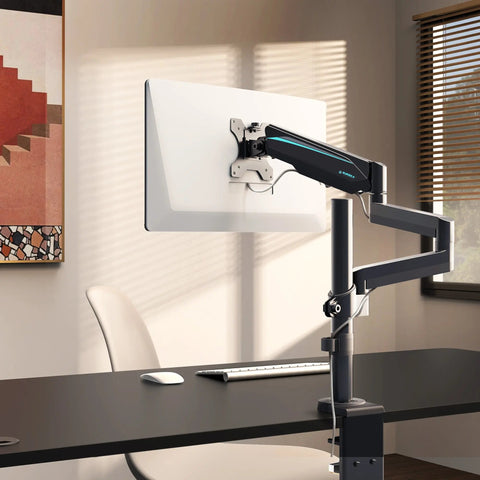
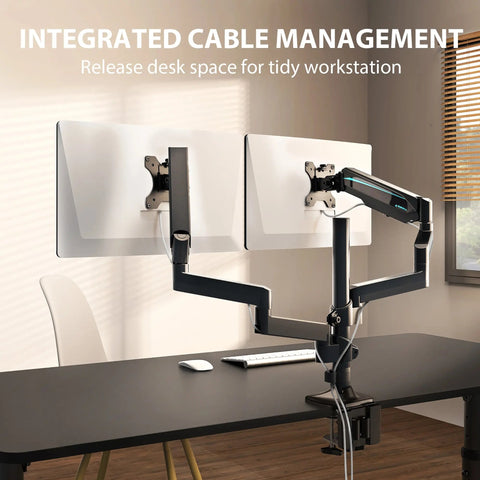
Weight is not just about how much, but where. A common "gotcha" in ergonomic setups is the use of monitor arms. While a Dual Monitor Arm is essential for achieving the correct viewing angle—as recommended by the HSE Display Screen Equipment (DSE) guidelines—it changes the center of gravity.
When you extend a 20 lb monitor 15 inches away from the mounting point, you create a "lever arm" effect. This exerts a rotational force (torque) on the desk frame. If the desk is not designed with a wide-footprint T-style or C-style leg, this off-center load causes the desk to tilt slightly, increasing friction in the lifting columns.
Expert Insight: To mitigate lateral torque, mount your monitor arms as close to the center of the desk's crossbar as possible. Centrally mounted arms distribute the weight more evenly across both motors, reducing the "stutter" often felt in cheaper, single-motor frames.
Practical Recommendations: Choosing the Right Foundation
Selecting a desk is a matter of matching your "Total Load" to the "Engineering Capacity."
1. The Executive/Heavy Workload Setup
If your setup includes a large desktop surface, integrated drawers, and multiple monitors, you require a frame with high structural rigidity. The Ark X Executive Standing Desk (60"x26") is designed for this profile, combining a dignified aesthetic with the lifting power required for "all-in-one" executive setups that include physical documents and charging hubs.
2. The Multi-Monitor Gaming Setup
Gamers using L-shaped configurations often face the most complex weight distribution challenges. The GTG-L60 Pro, L shaped Glass Gaming Standing Desk (60"x23") addresses this by using a reinforced frame that supports the unique geometry of an L-shape. Because the "return" of the L-shape often houses a heavy PC case, the dual-motor synchronization is critical to prevent the desk from rising unevenly.
3. The Ideal Sit-Stand Rhythm
Once your desk is properly rated for your weight, the next step is implementation. Cornell University’s Ergonomics Web recommends the "20-8-2" rule:
- 20 Minutes Sitting: Maintain a neutral posture with feet flat.
- 8 Minutes Standing: Shift weight occasionally; do not lock your knees.
- 2 Minutes Moving: Stretch or walk to stimulate blood circulation.
Modeling Note (Reproducible Parameters): Our recommendations are based on the following model assumptions:
Parameter Value Rationale Avg. Desktop Mass 25kg Standard 150cm-160cm composite/wood top Motor Duty Cycle 10% 2 mins on / 18 mins off (Standard Industry Rate) Friction Coefficient 0.15 Lubricated telescopic steel columns Dynamic Factor 1.2x Multiplier for peak motor start-up torque
Summary Checklist for Buyers
Before finalizing your purchase, perform this 30-second audit:
- Identify your "Heavy Hitters": Is your PC on the desk or the floor? (Moving it to the floor saves ~50 lbs of lifting capacity).
- Calculate the 80% Threshold: Take the desk's rated capacity and multiply by 0.8. If your gear weighs more than this number, upgrade to a higher-capacity model.
- Check for BIFMA Compliance: Ensure the desk meets ANSI/BIFMA X5.5 standards, which involve rigorous testing for both static and dynamic loads.
- Plan for the "Lever Effect": If using long monitor arms, prioritize desks with dual motors to handle the off-center torque.

By treating your standing desk as a piece of precision machinery rather than just a tabletop, you protect both your equipment and your long-term health. A stable, appropriately rated desk is the foundation of a productive, pain-free workspace.
Disclaimer: This article is for informational purposes only and does not constitute professional medical advice. Individuals with pre-existing musculoskeletal conditions or chronic back pain should consult a qualified physiotherapist or ergonomic specialist before significantly altering their workstation setup or activity levels.
References
- Canadian Centre for Occupational Health and Safety (CCOHS) - Sit/Stand Desk Guide
- BIFMA G1-2013 Ergonomics Guideline for Furniture
- OSHA eTools: Computer Workstations - Neutral Working Postures
- WHO 2020 Guidelines on Physical Activity & Sedentary Behaviour
- ISO 9241-5:2024 - Workstation Layout & Postural Requirements
- The 2026 Workstation White Paper: Converging Ergonomic Science and Sustainable Engineering




Leave a comment