

The Physics of Instability: Why Height Amplifies Wobble
It’s a frustratingly common experience: your standing desk feels perfectly solid at sitting height, but as you raise it to a standing position, a noticeable shake or wobble appears. This isn’t necessarily a sign of a faulty product. The issue is rooted in fundamental physics. Understanding these principles is the first step to diagnosing and fixing the problem.
The Science of Center of Gravity and Leverage
The core reason your desk becomes less stable when raised is the change in its center of gravity. Think of a short, sturdy flagpole versus a very tall, slender one. A small push at the base of the short pole does little, but the same force applied to the tall pole creates a significant sway at the top.
Your standing desk operates on the same principle. When lowered, its center of mass is close to the wide, stable base. As you raise the desktop, you are also raising the center of mass for the entire structure—including your monitors, computer, and anything else on the surface. This creates a longer lever arm. Any small horizontal force—from typing, leaning, or even a slight vibration—is magnified by this lever, resulting in the wobble you feel. The higher the desk, the greater the leverage, and the more pronounced the instability.
Understanding Mechanical Flex and Resonance
No material is perfectly rigid. The metal columns of your standing desk legs have a natural amount of flex. At low heights, this flex is negligible. However, as the telescoping sections of the legs extend, the structure becomes less rigid and more susceptible to bending forces. Small tolerances in the manufacturing of these sliding sections can also contribute to minor movements.
Furthermore, every object has a natural resonant frequency—the frequency at which it vibrates most easily. As you raise your desk, its resonant frequency changes. It can sometimes match the frequency of your movements, such as vigorous typing or writing. When this happens, each small motion adds energy to the system, amplifying the vibration and creating a persistent, distracting wobble.
The Critical Role of Frame Geometry and Design
The stability of a standing desk is heavily influenced by its underlying geometry. A key principle is the relationship between the base width and the maximum height. From years of field installations, a reliable heuristic is to aim for a base width that is at least 40-50% of the desk's maximum height. A wider, deeper base provides a larger footprint, distributing the load more effectively and resisting tipping forces.
Designs that incorporate robust cross-supports or have a lower, more centralized structural mass inherently offer better stability. This is why high-quality standing desks often feel more substantial; their design is engineered to minimize flex and manage the center of gravity effectively, adhering to principles outlined in industry standards like the BIFMA G1-2013 Ergonomics Guideline for Furniture.
Common Culprits: A Diagnostic Checklist for Desk Wobble
Before you can implement a fix, you need to pinpoint the source of the instability. While frame design plays a role, the most frequent causes of wobble are environmental factors and assembly issues that you can correct.
Issue 1: Uneven Flooring and Improper Leveling
The most fundamental cause of instability is an uneven foundation. If your floor is not perfectly level, the desk frame will be under uneven stress, causing it to rock. This is often subtle at low heights but becomes a major problem when the desk is extended. Carpeted floors present a unique challenge, as the soft padding can compress unevenly under the desk's feet, creating a soft, unstable base.
To diagnose this, use a simple level on your desktop. If it’s off, the floor is the likely culprit. Even a few millimeters of difference from one leg to another can translate into significant wobble at standing height.
Issue 2: Loose Fasteners and Assembly Errors
This is, by far, the most common and overlooked cause of standing desk wobble. A desk frame is a system of interconnected parts, and its stability depends entirely on how securely those parts are joined. Many users, in an effort to avoid over-tightening, leave fasteners slightly loose.
A mistake I often see is relying on the shipping packaging to align the legs during assembly, which can lead to misalignment. The most critical connections are the bolts securing the legs to the desktop and the fasteners holding the frame's cross-supports. Over time and with the micro-vibrations of daily use, these can loosen further. A desk that was stable on day one can develop a wobble by the end of the first week as the components settle.
Issue 3: Asymmetrical Load Distribution
How you arrange the equipment on your desktop has a significant impact on stability. Placing all heavy items—like multiple monitors, a computer tower, and speakers—on one side or far to the back edge creates an unbalanced load. This uneven weight distribution puts more strain on one leg of the desk, causing it to flex and twist more than the other.
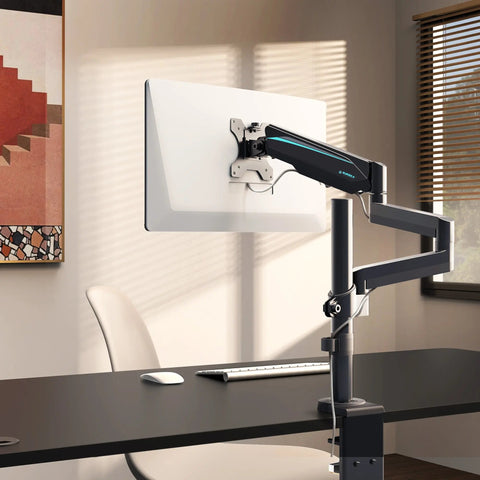
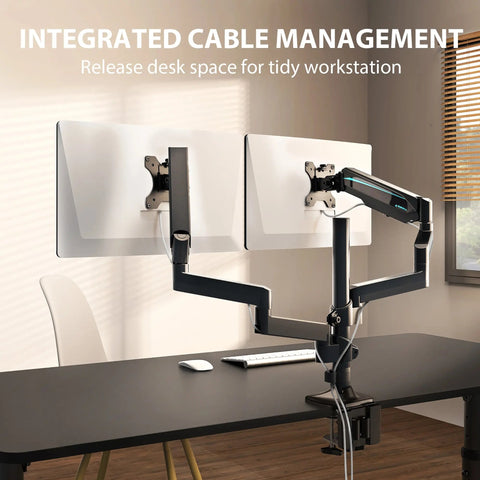
Ergonomic Workspace With Carbon Fiber Dual Monitor Stand and Modern Accessories for Comfortable Home Office Setup.
A simple diagnostic test involves placing a 5–10 kg weight first at the center of the empty desk, and then at a far edge. If the wobble dramatically increases when the weight is at the edge, you have an issue with load balance. The goal is to keep the majority of the mass centered over the frame's support columns.
Actionable Solutions for a Rock-Solid Workstation
Now that you've diagnosed the potential causes, it's time to implement targeted solutions. These practical steps address the most common stability issues and can transform a shaky desk into a solid, dependable workstation.
The Foundation: Leveling and Floor Adaptation
Always start with the base. Most standing desks come with adjustable leveling feet. Use a level and adjust each foot until the desktop is perfectly even in all directions. If the floor is significantly irregular, you may need to use thin plastic or metal shims under the feet for a more precise adjustment.
For carpeted floors, the small default feet can sink into the pile. Using larger-foot disks or a solid chair mat underneath the desk can distribute the load over a wider area, creating a much more stable foundation.
The Frame: A Mechanical Tightening Checklist
Ensuring every fastener is properly torqued is the single most effective fix for wobble. Follow this systematic process to secure your desk's frame.
| Step | Action | Why It's Important |
|---|---|---|
| 1. Empty the Desk | Remove all monitors, computers, and accessories from the desktop. | Working on an empty desk is safer and allows you to feel the frame's stability without interference from your equipment. |
| 2. Check Leg-to-Top Bolts | Systematically tighten all the bolts that attach the legs and frame to the underside of the desktop. | These are the most critical connection points. Even a quarter-turn can make a significant difference in reducing side-to-side sway. |
| 3. Secure Cross-Supports | Inspect and tighten any fasteners on the central crossbars or support structures of the frame. | These components are designed to prevent the legs from twisting or moving independently. Their integrity is key to overall stability. |
| 4. Verify Sensor Clearance | Before the final torque, ensure anti-collision sensors are not pinched or obstructed by wires. | This prevents false positives from the safety system and ensures smooth operation. |
| 5. Re-Torque After One Week | After 24-72 hours of initial use, go back and re-tighten all fasteners. | Materials can settle and compress slightly after initial assembly. A second tightening pass ensures a long-lasting, secure fit. |
Ergonomic Workspace With Carbon Fiber Dual Monitor Stand and Modern Accessories for Comfortable Home Office Setup.
The Load: Balancing Your Desktop for Peak Stability
Properly arranging your equipment can dramatically reduce wobble by centering the desk's center of gravity. Strive to place the heaviest items directly over the central support beam or as close to the center line between the two legs as possible.
If you use multiple monitors, a dual monitor stand is an excellent tool for consolidating mass in the center. For example, a product like the Carbon Fiber Dual Monitor Stand not only helps with ergonomics by raising screens to eye level, as recommended by the Canadian Centre for Occupational Health and Safety (CCOHS), but also centralizes the weight of both displays. Move heavy computer towers from the desktop to a dedicated under-desk holder that travels with the frame, keeping that mass low and centered.
Advanced Stability and Debunking Myths
For most users, the steps above will resolve any wobble issues. However, in some cases, you may need to consider additional measures or re-evaluate the source of the problem.
Debunking a Common Misconception: "It's a Motor Problem"
A persistent myth is that desk wobble is caused by a weak or faulty motor. In reality, this is almost never the case. The electric motors in a standing desk are responsible for the vertical lift; they do not provide horizontal stability. Wobble is a mechanical and geometric issue related to the frame, fasteners, and load distribution. If your desk raises and lowers smoothly, your motors are doing their job correctly. Focusing on the mechanical structure is the key to solving the problem.
Long-Term Maintenance for Lasting Stability
A standing desk is a piece of mechanical furniture that benefits from occasional check-ups. Just as you might tighten the legs on a chair, it's good practice to check the key fasteners on your desk every six months. This simple habit ensures that vibrations from daily use don't lead to a gradual return of instability. Keeping the lifting columns clean and free of debris also ensures smooth and consistent operation for years to come.
Wrapping Up: Key Takeaways for a Stable Standing Experience
A wobbly standing desk can disrupt your focus and undermine the ergonomic benefits you invested in. However, the solution is usually straightforward and requires no special tools. By understanding the physics at play and following a systematic approach, you can achieve a rock-solid workstation.
Remember the core principles:
- Start with a Level Foundation: Ensure your desk is perfectly level, adapting for uneven floors or soft carpets.
- Secure the Structure: Methodically tighten every fastener, especially where the legs meet the desktop, and remember to re-torque after a week of use.
- Balance Your Load: Center your heaviest equipment to maintain a stable center of gravity.
- Perform Regular Check-ups: A quick tightening every few months prevents future issues.
By addressing these mechanical factors, you can eliminate instability and enjoy a productive, wobble-free experience at any height.
Disclaimer: This article is for informational purposes only and does not constitute professional engineering or assembly advice. Always consult the manufacturer's instructions for your specific standing desk model. If you have pre-existing health conditions, such as chronic back pain, consult a qualified medical professional or physiotherapist before changing your workspace setup.
References
- BIFMA G1-2013 Ergonomics Guideline for Furniture: https://www.bifma.org/news/119419/Updated-BIFMA-Ergonomics-Guideline-Now-Available.htm
- CCOHS: Office Ergonomics - Sit/Stand Desk: https://www.ccohs.ca/oshanswers/ergonomics/office/sit_stand_desk.html
- OSHA eTools: Computer Workstations - Desks: https://www.osha.gov/etools/computer-workstations/components/desks




Leave a comment