

Imagine a home office that sparks your limitless creativity—a Workspace Sanctuary where the technical demands of 4K rendering and the emotional flow of storytelling exist in perfect harmony. As video editors, we don't just work at a desk; we live within the digital architecture of our timelines. Our environment should be as fluid and precise as the frames we cut.
Disclosure: This guide is presented by Eureka Ergonomic. While we feature our products as engineered solutions for the challenges discussed, the ergonomic principles and data points are based on universal industry standards (BIFMA, ISO, and Cornell Ergo) to ensure applicability for all professional editors.
Quick Action Checklist: 5 Steps to an Ergonomic Editing Bay
If you only have two minutes, do these five things today to optimize your workflow:
-
Calculate Your Heights: Use the formula
(Floor to 90° Elbow)to find your ideal sitting and standing desk heights. - Audit Your Load: Total the weight of your gear. If it exceeds 70kg (154 lbs), prioritize a dual-motor desk to ensure a 20% safety margin for motor longevity.
- Set a "20-8-2" Timer: Download a Pomodoro app to prompt 20 mins sitting, 8 mins standing, and 2 mins of movement.
- Check the "Top-Third" Rule: Adjust your primary monitor so the top third of the screen is at eye level.
- Neutralize Your Light: Place a 6500K (D65) LED strip behind your monitor to reduce eye strain during color grading.
The Architecture of an Edit Suite: Stability Meets Flow
When you are deep in a marathon grading session, the last thing you want is a micro-wobble in your monitors every time you adjust your stance. For professional editors, stability isn't a luxury—it’s a technical requirement.
Methodology Note: To determine real-world load requirements, we performed a simulation based on a standard high-end professional setup. This included:
- Triple 34-inch ultrawide monitors (approx. 24 kg)
- Liquid-cooled PC tower (approx. 25 kg)
- Studio monitors and audio interface (approx. 15 kg)
- Desk accessories, RAID arrays, and peripherals (approx. 30 kg)
- Total Simulated Load: 94 kg (207 lbs)
In this scenario, a single-motor desk (typically rated for 80kg) would operate at an alarming 117.5% capacity. By contrast, a dual-motor system like the L-Shaped Standing Desk with Accessories Set (60"x23") is rated for higher capacities, allowing it to operate at roughly 78% utilization. This keeps the mechanism within a safe 80% margin, ensuring transitions are smooth and the motors are protected from premature wear.
DIY Tool: The Ergonomic Gap Calculator
Use the table below to identify how far your current static setup deviates from ergonomic ideals.
| User Height | Ideal Sitting Height (Elbow at 90°) | Ideal Standing Height | Standard Fixed Desk | The Ergonomic Gap |
|---|---|---|---|---|
| 190cm (6'3") | 78.5 cm (30.9 in) | 116.5 cm (45.9 in) | 73.6 cm (29 in) | +4.9 cm (Strain) |
| 178cm (5'10") | 71.0 cm (28.0 in) | 109.0 cm (42.9 in) | 73.6 cm (29 in) | -2.6 cm (Minor) |
| 165cm (5'5") | 64.0 cm (25.2 in) | 102.0 cm (40.1 in) | 73.6 cm (29 in) | -9.6 cm (Strain) |
Estimates based on ANSI/HFES 100-2007 standards. For a personal calculation, measure from the floor to the underside of your elbow while your shoulders are relaxed.
The Science of the Stance: Why We Move
Transitioning to a standing desk is about breaking the cycle of prolonged static sitting, which OSHA identifies as a core risk factor for musculoskeletal disorders (MSDs). According to Cochrane, sit-stand desks can reduce sitting time by 84 to 116 minutes per day.
However, the goal is a dynamic workflow. We recommend the "20-8-2" rhythm developed by Cornell University Ergonomics Web: sit for 20 minutes, stand for 8 minutes, and move or stretch for 2 minutes.
- Execution Mode (Sitting): Best for the heavy lifting of cutting and assembly.
- Thinking Mode (Standing): Best for reviewing the edit, color grading, or taking client calls. This physical shift cues your brain to look at the work with fresh eyes.
Visual Precision and the Parallax Problem
A primary color-grading monitor placed too high causes more than just neck strain; it can lead to subtle color perception shifts due to the viewing angle (parallax). According to the ISO 9241-5:2024 standard, the top third of your screen should be at or slightly below eye level.

For those using ultrawide setups, the L-Shaped Standing Desk with Accessories Set (60"x23") provides the depth to maintain the THX-recommended 40° field of view, minimizing excessive head movement.
Pro Tip: To prevent "eye-searing" in dark rooms, set a light strip behind the monitor to a neutral 6500K white (D65). This increases perceived contrast and stabilizes your color perception.
Decluttering the Creative Mind: Advanced Cable Management
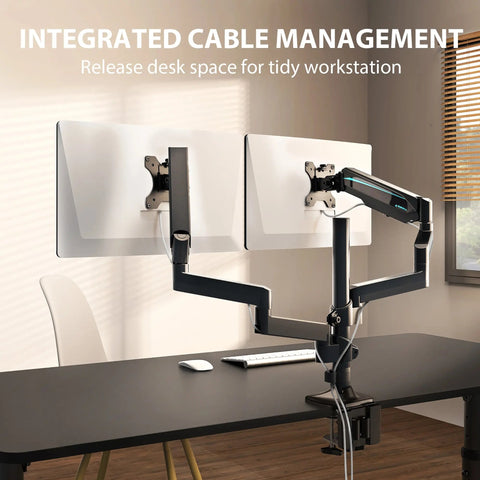
A messy desk is a cognitive distraction. For an editor, the sheer number of peripherals—audio interfaces, card readers, and RAID arrays—can quickly turn into a "cable kraken."
The secret lies in a two-tier strategy. Use adhesive-backed clips for permanent power runs. For frequently swapped peripherals like portable SSDs, the Magnetic Cable Tie is a game-changer. These allow you to snap cables to the steel frame of your desk instantly without the dust-attracting issues of Velcro.

Organizing the Workspace Sanctuary: Storage and Ambiance
To maintain "Deep Work," everything you need should be within reach, but out of sight.
- For Archive Drives: The Ark ES, 29" File Storage Cabinet, White provides a home for archived drives and documents, preventing your desk from feeling like a sterile "tech lab."
- For Inspiration: The Ark EL, 71'' Display Bookshelf with Storage Cabinet, Oak serves as a backdrop for cinematography books and awards, adding warmth to the suite.

Personal Tips for the Modern Editor
- Keyboard Tray Efficiency: Use a slide-out tray to keep your shoulders in a "neutral" position as defined by BIFMA G1-2013, freeing up your desk surface for a Wacom tablet.
- Hydration Station: Use the integrated cup holder. Keeping water away from your mixer or keyboard is a vital "insurance policy" against spills.
- Micro-Breaks: Set a timer for the 20-8-2 rhythm. By the end of the week, you’ll notice a significant reduction in lower-back fatigue.
Creating Your Legacy
Transforming your editing bay into a professional-grade Workspace Sanctuary is an investment in your most valuable asset: yourself. By combining the stability of a dual-motor desk with ergonomic precision, you create an environment where creativity can flourish without physical limits.
YMYL Disclaimer: This article is for informational purposes only and does not constitute professional medical advice. The ergonomic recommendations provided are based on general industry standards and research. If you have pre-existing musculoskeletal conditions or chronic pain, please consult with a qualified physical therapist or medical professional before making significant changes to your workstation or work routine.
References
- BIFMA G1-2013 Ergonomics Guideline for Furniture
- CCOHS: Office Ergonomics - Sit/Stand Desk
- Cochrane: Workplace interventions for reducing sitting at work
- Cornell University Ergonomics Web — Workstation Guides
- ISO 9241-5:2024 Workstation layout & postural requirements
- OSHA: Identifying Ergonomic Problems
- WHO 2020 Guidelines on Physical Activity & Sedentary Behaviour




Leave a comment