
The Three-O'Clock Chill: Why Remote Workers Struggle with Winter Comfort
For many remote professionals in North America and Europe, the workday in January follows a predictable, frustrating pattern. Despite the central heating being active, a deep chill often sets into the feet and hands by mid-afternoon. This sensation persists even when the room temperature is technically adequate. The common response—turning up the thermostat or adding a space heater—often leads to a stuffy environment and high energy bills without solving the underlying issue.
The problem is rarely the air temperature alone; it is the physiological consequence of prolonged static sitting. When you sit for hours, your body enters a state of low metabolic activity. More importantly, the lack of lower-body movement causes blood to pool in the extremities. According to the Occupational Safety and Health Administration (OSHA), poor posture and static loading are core risk factors for musculoskeletal disorders (MSDs), but they also serve as the primary catalyst for poor thermal regulation.
In a cold home office, the body prioritizes core temperature by constricting blood vessels in the skin and extremities—a process known as peripheral vasoconstriction. Without the mechanical assistance of muscle contractions to push blood back to the heart, your feet become "heat sinks," radiating warmth away while receiving very little fresh, oxygenated blood from the core.
The Physiology of Peripheral Circulation and the "Muscle Pump"
To understand how a standing desk functions as a thermal tool, we must examine the "skeletal muscle pump." Unlike the arterial system, which relies on the heart's pressure to distribute blood, the venous system in the lower limbs relies heavily on the contraction of calf and thigh muscles.
When these muscles contract, they squeeze the deep veins, forcing blood upward through one-way valves. Research cited in the Skeletal Muscle Pump and Body Posture explains that this mechanism is essential for maintaining venous return and preventing edema. In a winter context, this "pump" is your internal furnace's distribution system.
However, a critical distinction must be made: simply standing still is not enough. Data indicates that the metabolic increase from standing versus sitting is relatively minor—approximately 0.15 kcal/minute, as noted in a Cochrane systematic review (2018). This equates to only about 38 extra calories over a four-hour period, which is insufficient to significantly raise core body temperature.
The thermal benefit of a standing desk comes not from calorie burning, but from hemodynamic efficiency. A study on femoral vein blood flow found that active calf movements significantly outperform passive standing in promoting circulation. Specifically, the flow rate during active movement was measured at approximately 288 mL/min, compared to 286 mL/min during passive states—a small but significant difference when compounded over an hour of work (PubMed 40471005).
The Winter Protocol: The 20/10 Ratio for Thermal Regulation
Most ergonomic guidelines, such as those from Cornell University, suggest a "20-8-2" rhythm: 20 minutes of sitting, 8 minutes of standing, and 2 minutes of moving. While excellent for general musculoskeletal health, this ratio may be insufficient for thermal regulation in a poorly insulated home office.
In cold conditions, practitioners observe that a modified Winter 20/10 Protocol is more effective:
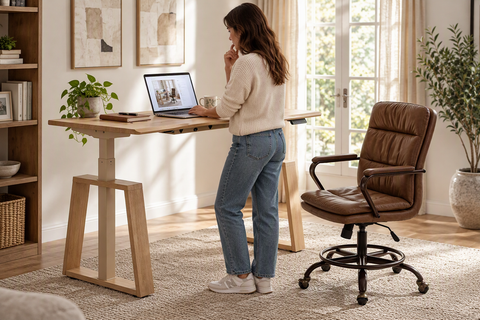
- 20 Minutes of Active Standing: Use a height-adjustable workstation to transition to a standing position. During this time, incorporate subtle calf raises or weight shifts every few minutes.
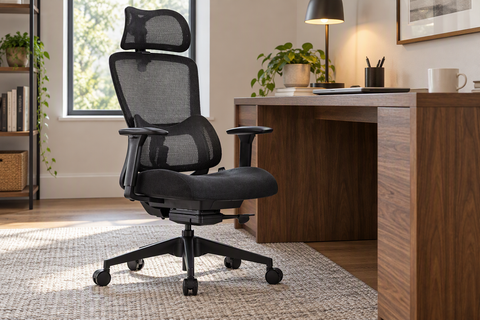
- 10 Minutes of Seated Recovery: Return to a seated position in a high-quality ergonomic chair that supports a neutral spinal posture.
This shorter, more frequent cycle creates a potent "muscle pump" effect. It forces blood back to the core before the extremities have a chance to cool significantly. It typically takes 10–15 minutes of active standing before a user feels a noticeable warming effect in the toes and fingers. Consistency during the first two hours of the workday is critical to establishing a stable thermal baseline.

Engineering the Thermal Workspace: Desk Materials and Setup
The physical components of your workstation also play a role in heat retention. Conductive heat loss occurs when your skin comes into contact with cold surfaces. For example, a metal desk frame or a thin laminate surface can feel significantly colder than wood.
The Blossom Dynamics® Office Standing Desk (70"x46") addresses this through its construction. The durable alloy steel base provides the stability required by BIFMA G1-2013 Ergonomics Guidelines, while the wood veneer finish offers a lower thermal conductivity than glass or metal. This means the surface feels warmer to the touch, reducing the "shock" of cold contact on the forearms and wrists.
For those who prefer a more modern aesthetic, the GTG-G55, Glass Desktop Gaming Standing Desk (55"x23") utilizes thick tempered glass. While glass is traditionally a cooler material, the integration of RGB lighting can provide a psychological "warmth" to the space, and the smooth surface is easily paired with a large, insulated desk mat to mitigate conductive heat loss.
The Role of Monitor Placement in Circulation
It may seem counterintuitive, but your monitor height affects how warm you feel. According to the UK Health and Safety Executive (HSE), improper screen height leads to neck flexion or "turtling," which can compress the vasculature and nerves in the cervical spine. This restriction can interfere with blood flow to the head and upper extremities.
Using a Single Monitor Arm or a Dual Monitor Arm allows you to maintain a neutral head position. By aligning the top of the screen with your eye level, you ensure that the major vessels in the neck remain uncompressed, supporting optimal circulation to the brain and hands.

Comparative Analysis: Static vs. Active Standing for Warmth
To maximize the benefits of your standing desk during the winter months, consider the following data-driven comparison of standing methods:
| Feature | Static Standing | Active Standing (Recommended) |
|---|---|---|
| Primary Mechanism | Gravity-based vertical load | Skeletal muscle pump activation |
| Venous Return | Moderate (risk of pooling) | High (efficient core return) |
| Thermal Benefit | Negligible after 15 mins | Sustained peripheral warmth |
| Musculoskeletal Risk | Lower back strain (static load) | Reduced risk via micro-movements |
| Recommended Accessory | Anti-fatigue mat | Tilted footrest (10-15 degrees) |
Table 1: Estimated comparisons based on physiological principles of venous hemodynamics.
Professional Guidelines and Compliance
When selecting a standing desk for health and thermal regulation, it is essential to look for furniture that meets international standards. The ISO 9241-5:2024 standard specifies layout and postural requirements that ensure a desk can accommodate the 5th to 95th percentile of the population. This adjustability is not just about comfort; it is about ensuring that every user can achieve the specific joint angles required to keep blood flowing freely.
Furthermore, the BIFMA X5.5 standard ensures the mechanical safety of height-adjustable desks. A desk that wobbles or moves jerkily will discourage frequent transitions, negating the thermal benefits of the sit-stand rhythm. High-performance models like the Blossom Dynamics® Office Standing Desk (70"x46") utilize dual-motor systems to provide the smooth, quiet transitions necessary for a professional environment.
For a deeper dive into the engineering behind these standards, refer to The 2026 Workstation White Paper: Converging Ergonomic Science and Sustainable Engineering.
Practical Recommendations for a Warmer Winter Workday
To transform your standing desk into an effective thermal regulation tool, follow these actionable steps derived from ergonomic best practices:
- Optimize Your Monitor Height: Use a Single Monitor Arm to ensure your neck remains in a neutral position. This prevents the "turtling" posture that can restrict circulation to the upper limbs.
- Use a Tilted Footrest: When seated, place your feet on a footrest set to a 10–15 degree upward tilt. According to the Canadian Centre for Occupational Health and Safety (CCOHS), this reduces venous pressure in the lower legs, a major factor in "cold feet" syndrome.
- The "Calf Raise" Habit: Every time you transition to standing, perform 10 slow calf raises. This immediately engages the skeletal muscle pump and kickstarts the warming process.
- Manage Conductive Loss: If using a glass-top desk like the GTG-G55, use a large wool or felt desk mat. This provides an insulating layer between your skin and the cold surface.
- Monitor Your Rhythm: Avoid the common mistake of standing for hours at a time. Prolonged static standing can lead to blood pooling just as much as sitting does. Adhere to the 20/10 ratio to keep the blood moving.
Addressing Common Pitfalls
A frequent "gotcha" for new standing desk users is the tendency to stand perfectly still. In a cold room, this can actually lead to increased discomfort as the body struggles to move blood against gravity without muscular assistance. If you find your legs feeling heavy or cold while standing, it is a sign that you are being too static.
Another pitfall is improper cable management. In winter, we often use additional peripherals like heated mouse pads or foot warmers. Ensure your cables have enough slack to accommodate the full range of the desk's height adjustment (typically 29.5" to 48"). Tensioned cables can create a trip hazard or damage the desk's motor system, as cautioned in UL 962 safety guidelines.
Summary of Thermal Ergonomics
The integration of height-adjustable furniture into a winter work-from-home routine offers more than just posture correction. By leveraging the skeletal muscle pump through active standing, remote workers can significantly improve peripheral circulation and maintain body heat. This approach treats the human body as an active participant in the office's thermal environment, rather than a passive recipient of HVAC systems.
When choosing equipment, prioritize stability, smooth motor function, and surface materials that minimize conductive heat loss. By following the Winter 20/10 Protocol and maintaining a neutral ergonomic setup, you can overcome the "Three-O'Clock Chill" and remain productive throughout the coldest months of the year.
Disclaimer: This article is for informational purposes only and does not constitute professional medical advice. Individuals with pre-existing circulatory conditions, such as Raynaud's disease, or chronic musculoskeletal issues should consult a qualified healthcare professional before significantly altering their workstation habits or adopting new physical protocols.
References
- BIFMA G1-2013 Ergonomics Guideline for Furniture
- CCOHS: Office Ergonomics - Sit/Stand Desk
- Cochrane: Workplace interventions for reducing sitting at work (2018)
- Cornell University Ergonomics Web — Workstation Guides
- HSE: Working safely with display screen equipment (DSE)
- ISO 9241-5:2024 Workstation layout & postural requirements
- OSHA eTools: Computer Workstations - Neutral Working Postures
- PubMed: Venous hemodynamics in active and passive calf movements
- Skeletal Muscle Pump and Body Posture - Springer
- UL 962 — Safety of Height-Adjustable Desks




Leave a comment