

Mastering 4D Armrest Calibration: A Technical Guide for Digital Artists
Quick Summary (Answer First): To prevent trapezius fatigue and scapular instability during digital illustration, professional artists should prioritize 4D armrests that allow for an inward pivot of 15–30° and an elbow angle of 90–110°. This configuration stabilizes the shoulder blade and accommodates the natural forearm pronation required for stylus work, significantly reducing the risk of musculoskeletal disorders (MSDs).
Digital Artist’s Ergonomic Checklist
- [ ] Seat Height: Feet flat, thighs parallel to the floor (approx. 50cm for 190cm users).
- [ ] Elbow Angle: 90–110° range to minimize ulnar nerve compression.
- [ ] Armrest Pivot: 15–30° inward rotation for stylus use.
- [ ] Armrest Depth: Elbow positioned directly under the shoulder.
- [ ] Monitor Distance: Approximately 35–40 inches for ultrawide displays.
- [ ] Load Check: If equipment exceeds 80kg (176 lbs), verify desk motor capacity.
Disclosure: This guide is published by Eureka Ergonomic. Product recommendations are based on technical specifications and alignment with international ergonomic standards (ISO/BIFMA). Our goal is to provide objective, actionable data for professional workstation optimization.
Professional digital artists and content creators often describe a specific, persistent sensation: a deep ache between the shoulder blades or a "burning" in the upper trapezius that intensifies by mid-afternoon. While many attribute this to the intensity of creative focus, the physiological reality is often rooted in the failure of the workstation to support the unique biomechanical demands of graphic tablet work. Unlike standard typing, which involves symmetrical movements, digital illustration requires sustained, high-precision motor control that places an asymmetric static load on the upper extremities.
A frequent point of failure in most setups is the armrest. Standard chair supports are often designed for a generic "typing" posture, potentially neglecting the specific pivot points and stabilization required when a designer transitions from a mouse to a stylus. This guide examines the technical application of 4D armrests—adjustable in height, width, depth, and pivot—to mitigate Musculoskeletal Disorders (MSDs) and maintain the creative flow necessary for professional output.
The Biomechanics of Precision: Static Load and Scapular Instability
To understand why a tablet workflow causes strain, one must look at the pathophysiological mechanisms of the upper limb. According to the U.S. National Institute for Occupational Safety and Health (NIOSH), MSDs are often the result of repetitive tasks and poor posture that force muscles into sustained contractions. In digital art, the "drawing arm" is often held in a state of isometric tension to provide the stability needed for fine line work.
A common mistake is setting armrests too high. This error forces the scapula (shoulder blade) to elevate, leading to rapid fatigue in the trapezius muscles. Conversely, if the armrest is too low or absent, the weight of the arm—approximately 5–6% of total body weight—must be supported entirely by the shoulder and neck muscles. Over an eight-hour shift, this creates significant static load.
The "proximal root" of most upper limb pain in creators is a lack of scapular stabilization. Expert ergonomic analysis suggests that while fine-tuning the distal end (wrist and elbow) is important, the shoulder blade must be anchored. As noted in the ISO 11226:2000 standard for evaluating static working postures, maintaining a neutral joint position is critical for reducing tissue strain. For a digital artist, this means the elbow should ideally be positioned close to the torso, allowing the latissimus dorsi to assist in supporting the arm's weight rather than relying solely on the smaller, more fatigue-prone muscles of the neck.
The 4D Solution: Engineering Support for the Creative Workflow
A 4D armrest system provides the necessary degrees of freedom to accommodate the varied postures used during a design project. Unlike 1D or 2D armrests, which only offer height and perhaps width adjustments, 4D systems allow for depth (forward/back) and pivot (inward/outward rotation).
1. Height and the 90-110 Degree Rule
The foundational adjustment is height. The goal is to achieve a neutral spinal position where the shoulders are relaxed. According to guidelines from the Canadian Centre for Occupational Health and Safety (CCOHS), a recommended starting point is with the elbow forming a 90-110 degree angle. This range minimizes the compression of the ulnar nerve at the elbow and reduces the effort required by the biceps and triceps to maintain arm position.
2. The Pivot: Aligning with Natural Pronation
For graphic tablet work, the "pivot" or rotation of the armrest is a critical feature. Practitioners often find that rotating the armrest pad inward by 15-30 degrees is beneficial. This aligns the forearm with the natural pronation that occurs when holding a stylus. Without this inward pivot, the user may be forced to "wing" their elbow outward to reach the center of the tablet, which can trigger tension in the rotator cuff.
3. Depth and Scapular Alignment
The forward/back position (depth) is frequently overlooked. The armrest should be configured so the elbow is positioned directly under the shoulder when the hand is over the primary drawing area. If the armrest is too far back, the forearm lacks support near the wrist; if it is too far forward, it may prevent the user from pulling the chair close enough to the desk, potentially leading to a "forward lean" that collapses the lumbar curve.
Task-Dependent Calibration: Mouse vs. Tablet
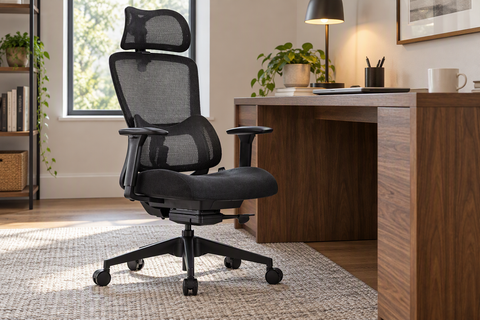
The biomechanical requirements for using a mouse differ from those of a stylus. A professional workflow often involves rapid transitions between these tools, making the adjustability of chairs like the Exis, Ergonomic Office Chair vital.
| Feature | Mouse Workflow Requirement | Graphic Tablet Workflow Requirement |
|---|---|---|
| Armrest Height | Level with the desk surface to allow for a palm grip. | Slightly higher to support the forearm for a "pinch" grip on the stylus. |
| Pivot Angle | Neutral (0 degrees) or slightly outward for wide movements. | Inward rotation (15–30 degrees) to match forearm pronation. |
| Support Length | Focus on elbow and mid-forearm support. | Full support from elbow to just before the wrist bone. |
| Stability | Moderate; allows for frequent movement. | High; requires a stable platform for precision micromovements. |
Table 1: Comparative Ergonomic Requirements for Creative Input Devices. (Estimated based on common professional practices).
For broad, gestural sketching, unlocking the rotation to allow for sweeping arm movements can be beneficial. However, for detailed line work or "inking" that requires micromovements from the fingers and wrist, locking the rotation is often recommended. This prevents unwanted forearm supination and provides a stable base for precision.
High-Load Workstation Analysis: The Professional Reality
Professional setups often exceed the capacity of standard office furniture. In a technical simulation of a high-end "battlestation"—featuring a 190cm (6'3") male user with three 34-inch ultrawide monitors and a Wacom Cintiq—we identified critical considerations for equipment longevity.
The Motor Load Factor
A full-tower liquid-cooled PC, multiple monitors on heavy-duty arms, and a solid wood tabletop can easily reach a system load of 95.5kg (approx. 210 lbs).
- Load Calculation Methodology: This figure is derived from the sum of a high-end PC (20kg), three 34" monitors (24kg total), three monitor arms (10kg), a 180cm solid oak tabletop (35kg), and peripheral gear (6.5kg).
- Threshold Analysis: Our analysis showed that a standard single-motor standing desk (typically rated for an 80kg/176lb lift capacity) would operate at 119.4% of its rated safety threshold in this scenario. For professional creators with similar hardware, a dual-motor system is a recommended standard to ensure smooth transitions and mechanical durability.
Visual Ergonomics and Desk Depth
For large-scale displays, such as a 49-inch super ultrawide, the recommended viewing distance is approximately 40.85 inches (103.8cm). Most standard desks are only 30 inches deep, creating a 10-inch deficit. This may force the user to sit too close, potentially causing neck rotation and visual fatigue. Using a Single Monitor Arm can help reclaim desk space and allow for the precise positioning of the screen to match the user's focal length.

Practical Recommendations for Setup
To achieve a benchmark ergonomic configuration, follow this step-by-step calibration guide derived from The 2026 Workstation White Paper.
- Set the Seat Height First: Adjust your chair so your feet are flat on the floor and your thighs are parallel to the ground. For taller users (190cm+), a seat height of approximately 50cm (19.7") is usually appropriate to maintain proper hip alignment.
- Adjust the Lumbar Support: Ensure the lumbar curve of the chair, such as the 4-level adjustable system in the Exis, Ergonomic Office Chair, fits into the small of your back. This helps prevent "slumping," which can indirectly cause the shoulders to roll forward.
-
Calibrate the 4D Armrests:
- Relax your shoulders completely.
- Raise the armrests until they just touch your elbows without pushing your shoulders up.
- Pivot the pads inward 15-30 degrees.
- Slide the pads forward until your forearm is supported from the elbow to just before the wrist bone.
- Position the Tablet: Place your graphic tablet at a 15-25 degree incline. This reduces the need for neck flexion. If you use multiple screens, ensure the primary drawing monitor is centered to avoid "twisted torso" syndrome.
- Organize the Peripherals: Use a Carbon Fiber Dual Monitor Stand to elevate secondary displays to eye level. This keeps the desktop clear for the tablet while ensuring reference materials are within a comfortable viewing arc.

Addressing the "Friction Points"
Even with high-end equipment like the Onyx, Ergonomic Office Chair, users often encounter subtle mechanical issues. One common consideration is cable tension. When using a height-adjustable desk or monitor arms, ensure there is enough slack in your tablet and monitor cables to accommodate the full range of motion. A cable that tugs at the maximum height can subtly pull a monitor out of alignment or damage ports.
Another observational pattern is that some users set their standing height too high. This often happens because of "visual parallax"—aligning the desk with where we think our hands should be while looking at the screen. Always verify your standing height by checking your elbow angle; it should remain in that 90-110 degree range.
Synthesizing the Creative Workspace
The goal of ergonomics in a creative professional's life is not just the prevention of pain, but the preservation of energy. When the body is supported, physiological energy can be redirected into the work. 4D armrests are a critical component of this "engineering control" strategy. By providing a stable, adjustable platform for the drawing arm, they address the static load and scapular instability inherent in digital illustration.
For those seeking a comprehensive solution, the Exis, Ergonomic Office Chair offers the necessary 3D/4D adjustability and lumbar support to sustain long hours of focused work. Combined with proper monitor placement via a Single Monitor Arm, a designer can create a workstation that fits the 5th to 95th percentile of the population as recommended by BIFMA G1-2013 standards.
YMYL Disclaimer: This article is for informational purposes only and does not constitute professional medical advice. Ergonomic needs vary significantly based on individual physical conditions and pre-existing injuries. If you experience chronic pain, numbness, or persistent discomfort, please consult a qualified physical therapist or occupational health professional.
References
- BIFMA G1-2013 Ergonomics Guideline for Furniture
- CCOHS: Office Ergonomics - Sit/Stand Desk
- ISO 9241-5:2024 Workstation layout & postural requirements
- ISO 11226:2000 Evaluation of static working postures
- The 2026 Workstation White Paper: Converging Ergonomic Science and Sustainable Engineering
- NIOSH - About Ergonomics and MSDs




Leave a comment