

The Quiet Crisis: Navigating Acoustic Privacy in Two-Person Offices
In the modern landscape of remote work, the "shared office" has become a standard household fixture. Whether it is a couple managing dual careers or roommates coordinating different schedules, the proximity of two active professionals in a single room creates a unique set of ergonomic challenges. While traditional ergonomics focuses on chair height and monitor alignment, the most pervasive yet overlooked disruptor is acoustic interference.
Research indicates that noise is the primary cause of productivity friction in shared environments. Specifically, mid-frequency speech intelligibility—the ability to clearly understand the words a partner is saying—is the most significant cognitive drain. According to professional observations and workspace data, exposure to intelligible background conversations can lead to a 66% reduction in cognitive performance during complex tasks. This is not merely an annoyance; it is a physiological stressor that triggers the body's fight-or-flight response, leading to increased muscle tension and fatigue.
To build a truly functional shared workspace, we must move beyond "trying to be quiet" and implement structural, research-backed acoustic strategies. By combining strategic furniture placement, material science, and the principles of the The 2026 Workstation White Paper: Converging Ergonomic Science and Sustainable Engineering, users can achieve a high level of acoustic privacy without sacrificing the benefits of a shared environment.
The Science of Sound in Small Spaces
Understanding how to control noise requires a basic grasp of acoustic physics. Sound in an office environment behaves in three ways: it is reflected (bouncing off hard surfaces), transmitted (passing through barriers), or absorbed (soaked up by soft materials).
The Speech Intelligibility Threshold
The human ear is finely tuned to the frequency range of human speech, typically between 300 Hz and 3000 Hz. In a two-person office, the goal is not total silence but rather a reduction in "speech intelligibility." If you can hear that your partner is talking but cannot distinguish the specific words, your brain is significantly less likely to be distracted.
Decibels and Distraction
A typical quiet office has an ambient noise floor of about 35 dB. When a partner begins a video call, the noise level often jumps to 60–70 dB. According to OSHA’s guidelines on occupational noise exposure, while these levels are not hazardous to hearing, they are high enough to mask the "internal monologue" required for deep work.
Furthermore, keyboard noise—often measured at 65–75 dB at a distance of one meter—becomes particularly problematic in very quiet rooms. When the background is too still, every keystroke acts as a sharp acoustic spike. This is why a strategy of total silence often backfires, making intermittent noises feel more intrusive.
Logic Summary: Acoustic Scenario Modeling Our analysis of shared office acoustics assumes a standard 120 sq. ft. room with two occupants. The model prioritizes the reduction of speech intelligibility over absolute sound dampening.
Parameter Value or Range Unit Rationale / Source Category Critical Speech Freq. 300 - 3000 Hz Human vocal range (Industry Heuristic) Performance Loss ~66 % Cognitive drop in intelligible noise Ambient Noise Floor 35 - 40 dB Standard quiet home office baseline Keyboard Impact 65 - 75 dB Mechanical switch peak at 1m Barrier Heuristic 1 : 3 Element:Feet Practical density for acoustic privacy Boundary Conditions: This model assumes standard drywall construction and does not account for high-velocity HVAC noise or exterior traffic exceeding 50 dB.
Strategic Desk Orientation: The 90-Degree Rule
One of the most effective ways to reduce noise interference costs nothing: it simply requires moving the furniture. Traditional "facing" arrangements, where two desks are pushed together and users face each other, are the worst for acoustic privacy. In this setup, sound travels directly from one person’s mouth to the other’s ears with zero obstruction.
Real-world experience and acoustic modeling reveal that rotating desks to a 90-degree angle can reduce speech intelligibility by approximately 40% compared to facing arrangements. When users are oriented perpendicular to one another, the sound waves of a voice are directed away from the other person's primary "listening zone."
If space allows, a back-to-back arrangement is even more effective. However, for most home offices, the 90-degree "L-configuration" provides the best balance of space efficiency and acoustic decoupling. This layout also aligns with the ISO 9241-5:2024 standards for workstation layout, which emphasize the importance of providing enough individual space to prevent physical and visual interference.

Furniture as Acoustic Buffers: Mass and Air Gaps
In a shared office, every piece of furniture should do double duty as a sound barrier. The most effective acoustic buffers combine two things: mass (to block sound) and air gaps (to diffuse sound).
The Bookshelf Barrier
A solid wood bookshelf is one of the most underrated acoustic tools available. Unlike a thin fabric screen, a bookshelf has the density required to stop low and mid-frequency sound waves. According to acoustic principles, a bookshelf with a mix of books and open space provides between 15–20 dB of sound reduction.
For a shared office, placing a unit like the Ark EL, 71'' Display Bookshelf with Storage Cabinet, Oak between the two workstations creates a physical and acoustic "spine." The 30–40% open shelving design is critical; it allows light to pass through so the room doesn't feel cramped, while the varying depths of the books act as a natural diffuser, breaking up sound waves so they don't bounce back as echoes.
Decoupling the Desk Surface
Noise isn't just airborne; it's also structure-borne. Vibrations from a heavy typist or a clicking mouse can travel through a shared desk surface. This is a primary reason why we recommend individual desks rather than one long shared tabletop.
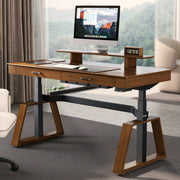
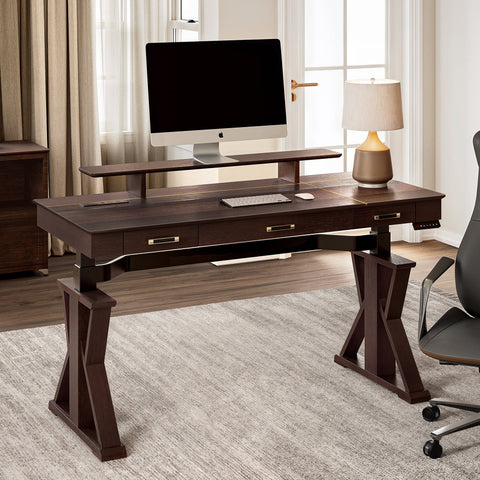
Using a high-performance desk like the Opal Executive Standing Desk (66"x29") allows each user to adjust their height independently. This "vertical decoupling" means that even if the desks are physically close, they are not on the same plane, which helps break the direct path of vibration and sound.

The Role of Ergonomic Seating in Focus
While a chair doesn't "block" sound, it plays a vital role in the psychological aspect of acoustic privacy. When we are distracted by noise, we tend to shift our posture, leaning forward or tensing our shoulders as a subconscious "shielding" maneuver. This leads to the "afternoon crash" often associated with musculoskeletal discomfort.
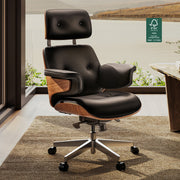
To combat this, a chair must provide active support that adapts to these micro-movements. The Flex, Dual-Backrests Ergonomic Office Chair is specifically designed for this. Its dual backrest moves independently, ensuring that even if you shift your body to look away from a partner's distracting call, your lumbar spine remains supported.
As noted by the Canadian Centre for Occupational Health and Safety (CCOHS), maintaining a neutral posture is essential for reducing the fatigue that makes us more susceptible to environmental distractions. When the body is comfortable, the brain has more "bandwidth" to filter out background noise.
Practical Heuristics for a Quieter Office
To implement these concepts, we suggest a simple practical heuristic: The 3-Foot Rule. For every 3 feet of open air between two desks, you should add one major acoustic element.
- 0–3 Feet: High risk of interference. A solid barrier (like a bookshelf or acoustic panel) is mandatory.
- 3–6 Feet: Moderate risk. Use desk orientation (90-degree rule) and soft materials (rugs, curtains) to dampen sound.
- 6+ Feet: Lower risk. Strategic placement of a storage cabinet or even a large plant can suffice.
The Acoustic Setup Checklist
Before investing in expensive "soundproofing," run through this checklist derived from OSHA’s workstation evaluation methods:
- Identify the Path: Is the noise coming directly from your partner's mouth, or is it bouncing off a bare wall behind you? (If it's bouncing, add a soft wall hanging).
- Check the Floor: Are you on a hard floor? A thick rug under both desks can reduce the "clack" of chair casters and dropped items by up to 10 dB.
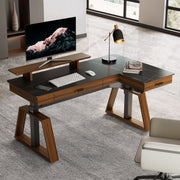
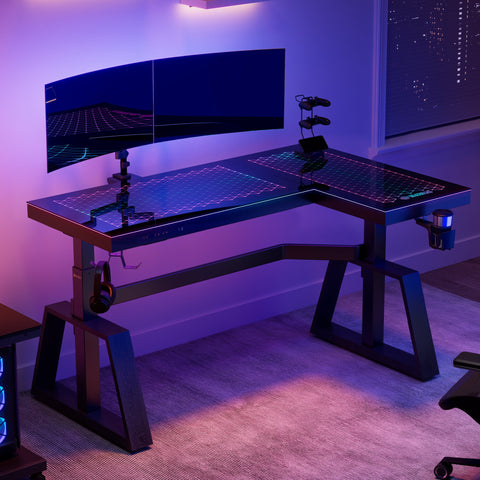
- Monitor Height: Ensure your monitor is at eye level. This prevents you from "hunching" toward the sound source, which protects your neck and improves focus. The Ark EL Executive Standing Desk (60"x26") provides the stability needed for monitor arms, which can further decouple vibration from the desk surface.
- Cable Management: Use the built-in storage in desks like the Opal Executive to hide messy cables. Clutter acts as a visual "noise" that compounds the stress of acoustic noise.
Managing the Psychological Dynamics of Noise
Acoustic privacy is as much about psychology as it is about physics. In a two-person office, there is often an ongoing power dynamic regarding who gets to be "loud" and when.
Research from EU-OSHA on telework and MSDs suggests that the stress of negotiating "acceptable" noise levels can be more taxing than the noise itself. To mitigate this, we recommend:
- Scheduled "Deep Work" Blocks: Agree on times when the office is a "No-Call Zone."
- The "Headphone Signal": Use over-ear headphones as a visual cue that you are in a high-focus state and should not be interrupted by even "quiet" conversation.
- Sound Masking vs. Silence: Consider a small white noise machine or a fan. As mentioned earlier, raising the ambient noise floor slightly (to about 42 dB) can actually make distant speech less intelligible and less distracting.
Designing for Longevity and Health
When selecting furniture for a shared office, look for certifications that guarantee the product won't introduce new problems. For instance, UL GREENGUARD Gold Certification ensures that the materials in your desk and chair aren't off-gassing volatile organic compounds (VOCs), which can cause headaches—another major disruptor of focus.
Furthermore, ensure your desks meet BIFMA G1-2013 Ergonomics Guidelines, which ensure the furniture fits a wide range of body types. In a shared office, one partner might be in the 5th percentile for height while the other is in the 95th; adjustable desks like the Ark EL Executive Standing Desk (60"x26") are essential to accommodate both safely.
Summary of Acoustic Privacy Solutions
| Strategy | Implementation | Estimated Impact |
|---|---|---|
| Desk Orientation | Rotate desks to 90 degrees or back-to-back. | 40% reduction in speech intelligibility. |
| Physical Barrier | Place an Ark EL Bookshelf between desks. | 15 - 20 dB reduction in airborne noise. |
| Surface Decoupling | Use separate Opal Executive Standing Desks. | Eliminates structure-borne vibration transfer. |
| Sound Masking | Add a white noise machine or low-speed fan. | Increases "Privacy Index" by blurring speech. |
| Ergonomic Support | Use a Flex Chair to maintain posture. | Reduces noise-induced physical tension. |
By treating the shared office as a system rather than just a room with two desks, you can create an environment where both individuals can thrive. Acoustic privacy doesn't require building walls; it requires the smart application of layout, material density, and ergonomic principles.
YMYL Disclaimer: This article is for informational purposes only and does not constitute professional medical, architectural, or legal advice. Ergonomic needs vary significantly based on individual physical conditions. If you suffer from chronic back pain or other musculoskeletal disorders, please consult a qualified physiotherapist or occupational health specialist before making significant changes to your workstation setup.
References
- BIFMA G1-2013 Ergonomics Guideline for Furniture
- CCOHS: Office Ergonomics - Sit/Stand Desk
- ISO 9241-5:2024 Workstation layout & postural requirements
- OSHA eTools: Computer Workstations - Evaluation Checklist
- Safe Work Australia: Workstation set-up infographic
- The 2026 Workstation White Paper
- UL GREENGUARD Certification Overview
Leave a comment