

The Challenge of Universal Design in Public Sector Workspaces
Why does a standard "ergonomic" desk often fail to meet the needs of a diverse workforce in a government agency or public institution? Many procurement officers assume that purchasing furniture labeled as "adjustable" automatically satisfies legal obligations under the Americans with Disabilities Act (ADA). However, in a professional environment, accessibility is not a binary checkbox; it is a spectrum of engineering requirements that must accommodate the 5th to 95th percentile of the population.
For public sector decision-makers, the stakes are high. Failing to provide adequate workstations can lead to increased rates of Work-related Musculoskeletal Disorders (MSDs), reduced productivity, and potential legal non-compliance. According to the U.S. Occupational Safety and Health Administration (OSHA), core risk factors for MSDs include poor posture and repetitive tasks, which are often exacerbated by furniture that cannot be tailored to the individual's physical dimensions. The goal is to move beyond "one-size-fits-all" and toward a framework of universal design that supports every employee, regardless of mobility or stature.
Navigating the Regulatory Landscape: Title I vs. Title III
A common misconception in workplace procurement is that the ADA provides a single, rigid set of dimensions for every employee's desk. In reality, the legal framework is more nuanced.
- ADA Title III (Public Accommodations): This section applies to fixed elements in areas accessible to the general public. It mandates specific technical standards, such as a minimum knee clearance of 27 inches and a clear floor space of 30 by 48 inches, as detailed in the 2010 ADA Standards for Accessible Design.
- ADA Title I (Employment): This title governs "reasonable accommodations" for employees. It does not prescribe fixed furniture dimensions but instead requires an "interactive process" to identify the specific needs of an individual. As noted in the EEOC Technical Assistance Manual, the focus is on removing barriers to performance.
For most modern offices, the most effective way to bridge the gap between these two titles is through high-range adjustable workstations. By implementing desks that exceed the minimum standards of ISO 9241-5:2024, agencies can provide "equivalent facilitation"—a standard where the adjustable nature of the furniture provides equal or superior access compared to a fixed ADA-compliant desk.

The Physiology of Static Load and Blood Circulation
To understand why adjustability is mandatory for health, we must look at the physiological impact of the "static load." When an employee sits or stands in a fixed position for hours, their muscles are under continuous tension. This restricts blood circulation, leading to localized fatigue and the accumulation of metabolic waste products in the tissues.
The World Health Organization (WHO) 2020 Guidelines emphasize reducing sedentary time to mitigate cardiovascular risks. However, standing all day is not the solution either. EU-OSHA research indicates that prolonged static standing can lead to lower limb disorders and venous insufficiency.
The scientific consensus, supported by the Cochrane Library, suggests that sit-stand desks are highly effective at reducing total sitting time (by an estimated 84–116 minutes per day). By frequently transitioning between positions, users maintain better blood circulation and reduce the "spinal neutral position" deviations that lead to chronic back pain.
Engineering for Stability: The "Extreme Position" Factor
In B2B and public sector environments, durability is a primary procurement criterion. A frequent failure point in "consumer-grade" standing desks is stability at maximum height. For a user transferring from a wheelchair to an office chair, the desk often serves as a secondary support point. If the desk exhibits significant lateral wobble, it becomes a safety hazard.
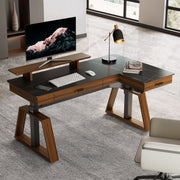
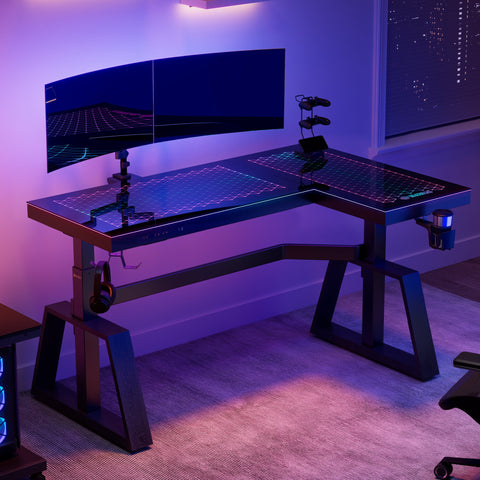
Experienced facilities managers prioritize desks with dual-motor systems and reinforced leg columns. A dual-motor system, such as that found in the L-Shaped Standing Desk with Accessories Set (60"x23"), ensures that the lifting mechanism remains synchronized even under uneven loads, such as triple-monitor setups or heavy CPU units.
Modeling Note: Stability Thresholds Our analysis of workstation stability in high-traffic institutional environments assumes a "worst-case" lateral force of 15 lbs applied at a height of 45 inches.
Parameter Value Unit Rationale Max Front-to-Back Deflection < 0.5 Inches User comfort/visual focus Lifting Capacity 220 Lbs Multi-monitor & hardware load Adjustment Speed ~1.0 In/Sec Efficiency in shared spaces Noise Level < 50 dB Minimize office disruption Motor Count 2 Units Reliability & sync accuracy Boundary Condition: These parameters apply to desks on level, commercial-grade flooring. Stability may decrease on high-pile carpeting without a chair mat.
The "Closed Fist" Test and Control Accessibility
Accessibility isn't just about height; it’s about the interface. ADAAG Section 309 specifies that operable parts must be usable with one hand and must not require tight grasping, pinching, or twisting of the wrist. This is often referred to in occupational therapy as the "closed fist" test.
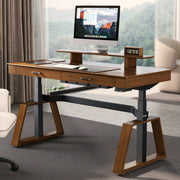
Many ergonomic desks utilize small, recessed buttons that require fine motor precision. In a public sector setting, control panels should be prominent, tactile, and located within the "reach range" of 15 to 48 inches from the floor. The GTG-G55, Glass Desktop Gaming Standing Desk (55"x23"), while designed with a modern aesthetic, features a front-mounted controller that is easily accessible to users in a seated position, satisfying the reach requirements.
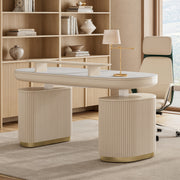
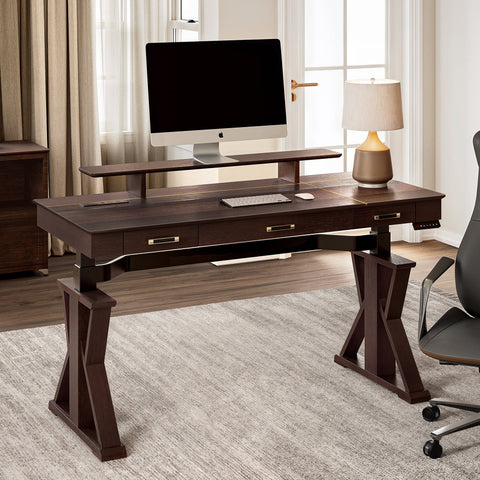
Furthermore, desks like the Zen Pro Series, 87"/72" Executive Standing Desk with Cabinets Set provide the expansive surface area required for "reach zones." According to BIFMA G1-2013 Ergonomics Guidelines, frequently used items should be within 10–14 inches of the user, a feat easily accomplished with L-shaped or executive-sized desktops.
Practical Recommendations for Institutional Deployment
When equipping a government agency or large office, the following framework ensures both compliance and employee well-being:
1. The Ideal Sit-Stand Rhythm
Avoid the "standing marathon." We recommend the 20-8-2 rule popularized by Cornell University Ergonomics Web:
- 20 Minutes: Sitting in a neutral posture.
- 8 Minutes: Standing (moving slightly).
- 2 Minutes: Stretching or walking.
2. Monitor and Accessory Alignment
Proper height adjustment is negated if the monitor is poorly positioned. Per Safe Work Australia, the top of the screen should be at or slightly below eye level. Using an Adjustable Ergonomic Footrest is critical for shorter users to ensure their feet are supported when the desk is at its lowest seated height, preventing pressure on the underside of the thighs.
3. Cable Management and Safety
In an adjustable environment, "cable tension" is a genuine risk. If cables are too short, they can pull equipment off the desk or damage ports during height transitions. Integrated socket holders and cable trays are essential for public sector safety compliance to prevent tripping hazards.
4. Procurement Ratios for Hot-Desking
In modern flexible workspaces, it is often unnecessary to provide a 1:1 ratio of adjustable desks. A common heuristic for public sector deployments is one adjustable workstation per three to five employees, provided there is a reservation system that prioritizes individuals with documented medical needs.
Comparison of Standards: ADA vs. International Ergonomics
| Feature | ADA (Fixed/Public) | BIFMA G1 (Adjustable) | ISO 9241-5 (Global) |
|---|---|---|---|
| Min Height | 28" (Surface) | 22.6" (Seated) | ~24" (Variable) |
| Max Height | 34" (Fixed Max) | 48.7" (Standing) | ~46" (Standing) |
| Knee Width | 30" | Based on 95th Percentile | ~31" |
| Knee Depth | 19" | ~17" to 20" | ~18" |
Note: These ranges are estimated based on common industry interpretations of the 5th and 95th percentile populations.
For a deeper dive into how these standards are evolving, refer to The 2026 Workstation White Paper: Converging Ergonomic Science and Sustainable Engineering.
Conclusion: A Proactive Approach to Inclusion
Meeting ADA standards with adjustable workstations is more than a legal necessity; it is a strategic investment in the workforce. By selecting furniture that meets ANSI/BIFMA X5.1 for durability and UL 962 for safety, government agencies can create an environment where every employee—regardless of physical ability—can thrive.
The transition to an accessible workspace requires a focus on stability, interface accessibility, and a commitment to the interactive process of accommodation. When these elements align, the result is a more inclusive, productive, and resilient public service environment.
Disclaimer: This article is for informational purposes only and does not constitute legal or medical advice. For specific ADA compliance inquiries, consult with a qualified legal professional or an ADA coordinator. Individuals with pre-existing musculoskeletal conditions should consult a healthcare provider before significantly altering their workspace habits.
References:
Leave a comment