

Often, the workday begins with a sense of focus that gradually dissolves into a dull ache between the shoulder blades or a persistent tightness in the lower back by mid-afternoon. For the millions transitioning to remote work or content creation, the traditional desk setup is frequently traded for the perceived comfort of a sofa or a standard armchair. However, this shift often introduces a new set of physiological challenges. Is the lounge chair a viable tool for professional productivity, or is it a silent contributor to long-term musculoskeletal strain?
The modern home office is no longer confined to a rigid 90-degree upright posture. As work becomes more fluid—encompassing deep-focus writing, video conferencing, and creative brainstorming—the demand for versatile seating has surged. Yet, the "comfort" of a traditional lounge chair can be deceptive. Without the precision of ergonomic adjustment, these seats often force the body into "static loading," where muscles must remain contracted to maintain a posture that the furniture does not naturally support.
The Physiology of Seated Work: Understanding Static Load
The human body is not designed for prolonged stillness. According to the Occupational Safety and Health Administration (OSHA), poor posture and repetitive tasks are primary risk factors for Musculoskeletal Disorders (MSDs). When you sit in a non-adjustable chair, your spine often loses its natural "S" curve, collapsing into a "C" shape. This misalignment increases intradiscal pressure and strains the posterior ligaments.
A critical concept in ergonomic science is the "Neutral Working Posture." As defined by OSHA's eTools on Neutral Working Postures, this is a comfortable working position where joints are naturally aligned, reducing stress on muscles, tendons, and the skeletal system. In a standard lounge chair, the lack of adjustable lumbar support often leads to "slouching," which compresses the abdominal organs and restricts the diaphragm, potentially impacting breathing efficiency and cognitive focus.
Furthermore, ISO 11226:2000 provides a quantitative basis for evaluating static working postures. It emphasizes that the duration of a held position is as critical as the angle itself. Prolonged static sitting leads to reduced blood circulation, particularly in the lower limbs, which can manifest as fatigue or even more serious vascular issues over time. The World Health Organization (WHO) 2020 Guidelines reinforce this by recommending that adults reduce sedentary time and interrupt long periods of static behavior with movement.
The Adjustable Lounge Chair as an Ergonomic Solution
The primary limitation of traditional lounge furniture is its "one-size-fits-all" geometry. An adjustable lounge chair, however, serves as a bridge between leisure and labor by allowing the user to tune the environment to their specific anthropometric needs.
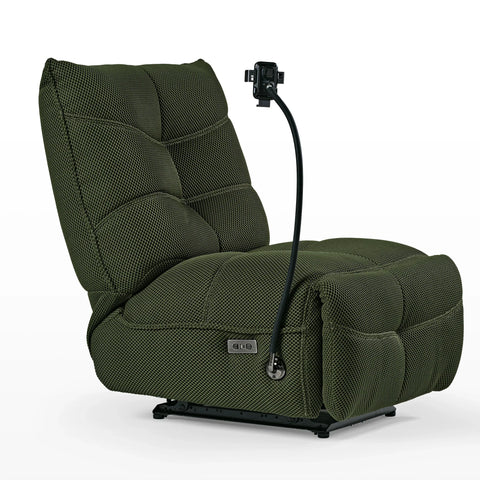
For instance, the Lounge Chair-Red Yellow & Blue Yellow Stripe incorporates adaptive lumbar zones and weight-distributing seat contours. These features are not merely for aesthetic appeal; they are scientifically calibrated to support the spine’s natural curvature across different body types. By using pressure-mapping technology, such designs ensure that weight is distributed evenly, preventing the "hot spots" of pressure that lead to discomfort during marathon creative sessions.
The Role of Recline and Dynamic Movement
One of the most significant advantages of an adjustable lounge chair is the ability to vary the recline angle. Research suggests that a slight recline is often superior to a rigid 90-degree upright position for reducing spinal pressure. According to industry observations and ergonomic recline studies, different tasks require different angles:
| Task Type | Recommended Recline Angle | Ergonomic Rationale |
|---|---|---|
| Short Laptop Tasks | 90° (Upright) | Maximizes core engagement and keeps the gaze level with the screen. |
| Reading / Thinking | 100° – 110° | Reduces pressure on the lumbar discs while maintaining visual focus. |
| Rest / Brainstorming | 130°+ (Full Recline) | Transfers body weight to the chair back, allowing muscles to recover. |
The Lucia,Swivel Rocking Manual Recliner exemplifies this versatility. Its manual recline lever allows for seamless transitions between these states. Perhaps more importantly, its 360° swivel and rocking motion facilitate "micro-movements." These small, frequent changes in position help maintain blood circulation and prevent the stiffness associated with static load, aligning with the HSE guidelines on DSE (Display Screen Equipment) which emphasize the importance of breaking up long periods of sitting.

Case Study: The "Petite Worker" and the Ergonomic Gap
To demonstrate the necessity of adjustability, consider the specific needs of a petite remote worker (approximately 155cm or 5'1"). Most standard office furniture is designed for the 50th percentile of the population, often leaving those at the 5th percentile—like petite individuals—in a state of ergonomic "mismatch."
In a simulated setup for a 155cm user, the ideal seat height is approximately 41.3cm (16.3"). However, a standard fixed desk usually sits at 73.7cm (29"). This creates a 3.6-inch ergonomic gap. If the chair is not adjustable or the desk is too high, the user is forced to shrug their shoulders or reach upward, leading to chronic strain in the trapezius and neck muscles.
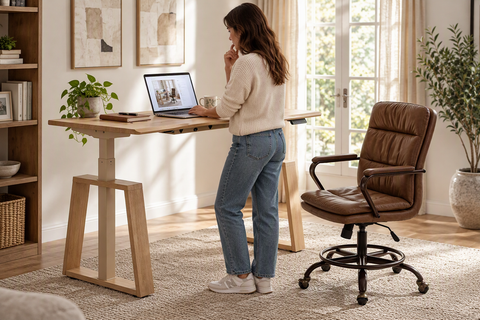
For this user, an adjustable lounge chair combined with a height-adjustable surface is not a luxury—it is a requirement. By lowering the work surface to align with the elbow height (roughly 64.5cm for this individual), the "ergonomic gap" is closed. This setup, supported by the BIFMA G1-2013 Ergonomics Guideline, ensures that the user can maintain a neutral wrist position, preventing Repetitive Strain Injuries (RSI).
The "True Cost" and ROI of Ergonomic Versatility
When evaluating adjustable lounge chairs, it is essential to look beyond the sticker price and consider the "True Cost" of a functional setup. A lounge chair used for work usually requires an ecosystem:
- The Chair: An adjustable model like the Lounge Chair-Red Yellow & Blue Yellow Stripe.
- The Surface: A mobile laptop stand or adjustable side table.
- The Peripherals: A footrest and potentially external shelves like Convertible Desktop Shelves, set of 2 to manage equipment.
While the initial investment may be higher than a standard chair, the Return on Investment (ROI) is measurable. Based on metabolic calculations (MET values), standing or moving for just two hours a day can result in a modest but consistent increase in caloric expenditure. More significantly, a conservative 10% uplift in productivity—driven by reduced pain and fewer breaks needed to "stretch out" an aching back—can translate to significant annual value. For a professional, the payback period for high-quality ergonomic gear is often less than one year.
Practical Recommendations for the Hybrid Workspace
To maximize the benefits of an adjustable lounge chair, users should adopt a structured approach to their workday rhythm.
1. The "20-8-2" Rhythm
Developed by Cornell University's Ergonomics Web, this rule suggests that for every 30 minutes of work, you should:
- Sit for 20 minutes in a neutral position.
- Stand for 8 minutes (using a height-adjustable desk or simply standing up).
- Move for 2 minutes (stretching or walking).
2. The 20-20-20 Rule Adaptation
Traditionally used for eye strain, you can adapt this for physical movement: every 20 minutes, use your chair's swivel or recline feature to change your posture for 20 seconds. This prevents the "freezing" of soft tissues that occurs during static sitting.
3. Seat Depth: The "Two-Finger" Test
A common mistake is choosing a seat that is too deep. If the seat pan is too long, it will press against the back of your knees, restricting circulation, or force you to slouch to reach the backrest. An ideal fit allows 2 to 4 fingers of space between the edge of the seat and the back of your knees when sitting fully back.
4. Supporting the Lower Extremities
In a reclined position, the feet often lose solid contact with the floor. This can cause the pelvis to tilt and strain the lower back. Utilizing an Adjustable Ergonomic Footrest is vital. According to the CCOHS guide on office ergonomics, a footrest helps maintain the correct angle of the hips and knees, promoting healthy circulation even when in a relaxed recline.

Addressing Common Pitfalls
The most frequent error in remote work is using a lounge chair as a primary "typing chair" for 8 consecutive hours without a proper work surface. If the chair is low and the laptop is on your lap, your neck is forced into a steep downward angle, creating "tech neck."
To solve this, ensure your screen is at a height where the top line of text is at or slightly below eye level. This is a standard recommendation from the HSE Checklist for DSE. If you are using a lounge chair, this almost always requires a specialized laptop stand or a height-adjustable monitor arm.
Navigating the Future of Work-from-Home Comfort
The transition to a hybrid or remote work model requires a shift in how we view furniture. It is no longer just about "decor"; it is about health infrastructure. An adjustable lounge chair, when selected with attention to BIFMA and ISO standards, offers a sophisticated solution for the modern professional. It provides the flexibility to move between deep focus and restorative rest without compromising spinal integrity.
By understanding the physiological mechanisms of sitting and implementing a scenario-based approach to your setup—considering your height, tasks, and space—you can transform a simple corner of your home into a high-performance sanctuary.
YMYL Disclaimer: This article is for informational purposes only and does not constitute professional medical advice. The ergonomic recommendations provided are based on general industry standards. Individuals with pre-existing musculoskeletal conditions, chronic back pain, or other health concerns should consult a qualified physician or physical therapist before making significant changes to their workstation or seating habits.
Sources
- BIFMA: Ergonomics Guideline for Furniture
- OSHA: Computer Workstations - Neutral Working Postures
- CCOHS: Office Ergonomics - Sit/Stand Desk
- ISO 11226:2000 - Evaluation of static working postures
- WHO 2020 Guidelines on Physical Activity and Sedentary Behaviour
- Cornell University Ergonomics Web — Workstation Guides
- HSE: Working safely with display screen equipment (DSE)




Leave a comment