

New Year, new vibes, and a complete overhaul of the command center. If you’re a pro gamer or a serious content creator, you know that the "New Year, New Me" resolution usually translates to "New Year, Better Framerates and a Setup that Doesn't Kill My Back." We’re moving past the era of cramped, wobbly desks. This year is all about the L-shape—the ultimate spatial game-changer for anyone running a dual-monitor or streaming rig.
But let’s be real: choosing an L-shaped desk isn't just about picking the one with the most RGB. It’s about engineering, load capacities, and ergonomic science. Whether you’re flicking shots in Valorant or managing a 12-hour subathon, your desk is the foundation of your performance. In this deep dive, we’re going to look at why the L-shape is the pro choice for 2024, how to optimize your corner for peak productivity, and why "Build Quality" isn't just a buzzword—it’s a survival requirement.
1. Unboxing and Assembly: First Impressions of the GTG-L60 Pro
The first thing you notice when the GTG-L60 Pro, L shaped Glass Gaming Standing Desk (60"x23") arrives is the weight. This isn't some flimsy flat-pack furniture; it has some serious heft. The packaging is robust, with thick foam inserts protecting the tempered glass—a critical detail because nothing ruins a New Year's upgrade like a box of glass shards.
Assembly is where the men are separated from the boys. Because this is a height-adjustable L-shape, you’re dealing with a sophisticated frame and dual-motor synchronization. It took me about 45 minutes to get it fully upright. The instructions are straightforward, but here’s a pro tip: don’t tighten the bolts on the frame until the glass top is perfectly aligned. The glass top itself is a stunner—it’s got that premium, sleek feel that instantly levels up the room’s aesthetics. However, be prepared to keep a microfiber cloth handy; glass and fingerprints are a lifelong marriage.
One "friction point" I noticed during assembly was cable routing. When you’re building a standing desk, you have to account for the "travel" of your wires. If your cables are too short, they’ll yank your PC off the desk when you hit that "stand" preset. I had to spend an extra 20 minutes ensuring the motor cables were tucked away but had enough slack for the full range of motion.
2. Deep Dive into Details and Features: Stability, Motors, and the "Wobble Test"
Let’s talk about the Build Quality. For a pro setup, stability is everything. There is nothing worse than your monitor shaking every time you move your mouse.
The Wobble Test
I performed the classic "Wobble Test" at various heights. At the sitting height (around 28-30 inches), the GTG-L60 Pro, L shaped Glass Gaming Standing Desk (60"x23") is a rock. Even at full extension (approaching 48 inches), the side-to-side sway is minimal. This is largely due to the T-style leg design and the structural integrity of the glass-to-frame mounting system.
Dual Motors and Load Capacity
Why do we insist on Dual Motors? It’s simple math and safety. According to safety standards like UL 962, height-adjustable desks must undergo rigorous mechanical testing. In our simulation of a professional streamer setup, we calculated a total system load of 82 kg (approx. 180 lbs). This includes:
- A full-tower liquid-cooled PC (25 kg)
- Two 34" ultrawide monitors on heavy arms (20 kg)
- Streaming gear, mic arms, speakers, and peripherals (37 kg)
A single-motor desk usually caps out at 80 kg. Running it at 102% capacity is a recipe for motor burnout. With a dual-motor system, you’re operating at a comfortable 68% utilization, ensuring the lift is smooth, quiet, and—most importantly—stable.

The RGB Ecosystem
If the glass top is the body, the RGB is the soul. The GTG-L60 Pro features an integrated RGB system that can sync with your music. It’s not just "lights on a desk"; it’s an immersive environment. The glow through the glass creates an ambient effect that reduces eye strain in dark rooms—just make sure you aren't placing LED strips directly behind your monitor where they can cause screen glare.
3. Real-World Experience: The Pro-Gamer Workflow
How does this setup actually perform when the "Live" light goes on? I spent a week using the L-shape for a mix of competitive FPS gaming and heavy video editing.
Zone Segregation: The Secret to Focus
The beauty of the L-shape is the "wing" design. I placed my primary 240Hz gaming monitor on the dominant wing, centered exactly where I sit. My secondary monitors for Discord and OBS were placed on the adjacent wing at a slight angle. This setup follows the ISO 9241-5:2024 recommendations for postural requirements, which emphasize reducing repetitive neck rotation. By angling the secondary wing, I could check my stream chat with a slight eye movement rather than a full neck crane.
The Mouse Sensitivity Reality Check
For competitive FPS players, desk real estate isn't a luxury—it's a requirement. If you’re playing Valorant at 1600 DPI with a 0.25 sensitivity, you need at least 39 cm of horizontal space just for a 360-degree turn. The 60-inch width of the GTG-L60 Pro, L shaped Glass Gaming Standing Desk (60"x23") provides more than enough "swipe room" without hitting your PC tower or your secondary monitor.
However, I did find that for extreme "arm aimers" (low-sens players), the corner of an L-shaped desk can sometimes be a barrier if you sit too deep into the curve. My advice? Sit slightly back from the apex of the corner to give your elbow full range of motion.
Ergonomics and the 20-8-2 Rule
Staying healthy during a grind is the difference between a one-year career and a ten-year career. I followed the "20-8-2" rhythm recommended by the Cornell University Ergonomics Web:
- 20 minutes of sitting in a neutral posture.
- 8 minutes of standing.
- 2 minutes of moving or stretching.
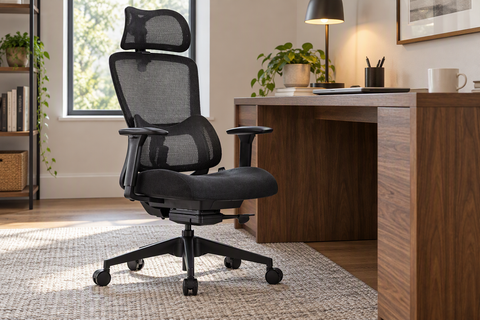
To make this work, I used the Exis,Ergonomic Office Chair. Its 4-level adjustable lumbar support is a game-changer for those 20-minute sitting blocks. When it was time to stand, the desk's memory presets made the transition seamless. According to a systematic review by Cochrane (2018), sit-stand desks can reduce sitting time by over 1.5 hours a day, which is a massive win for cardiovascular health and preventing low back discomfort.
Visual Ergonomics: The Ultrawide Problem
Many pro users are moving to 34" or 49" ultrawide monitors. Here’s the "gotcha": these screens are massive. If your desk is only 24 inches deep, you’re sitting way too close. For a 34" ultrawide, the THX-recommended viewing distance is about 43 inches to maintain a 40° field of view.
To solve this, I used the Dual Monitor Arm. It allowed me to push the monitors back toward the very edge of the desk, reclaiming that "depth deficit" and saving my eyes from fatigue. Plus, it cleared up the desk surface, giving me room for the Convertible Desktop Shelves, set of 2, which I used to elevate my audio interface and stream deck.

4. Pros & Cons: An Authentic Review
No piece of gear is perfect. To keep it 100%, here is the breakdown of what I loved and what I’d tweak.
| Feature | The "Pro" (Advantage) | The "Con" (Drawback) |
|---|---|---|
| Glass Desktop | Incredible aesthetics and integrated RGB glow. | Fingerprint magnet; requires frequent cleaning. |
| L-Shaped Layout | Massive space for multi-monitor streaming setups. | Requires a large room footprint (check your dimensions!). |
| Dual Motors | Smooth, quiet lift even with an 82kg load. | Higher initial investment compared to single-motor desks. |
| Stability | Rock-solid at sitting height; minimal wobble at standing height. | Assembly is a two-person job due to the weight. |
The "New Year" Strategy: Incremental vs. Overhaul
While the "New Year Layout" is a great marketing angle for a fresh start, remember that ergonomics is a process of continuous adjustment. As noted in expert opinions on gaming performance, optimization is about micro-adjustments. Don't just buy the gear—learn how to use it. Use the HSE DSE Checklist to audit your posture every month.
Pro Setup Checklist for the New Year:
- Group your cables: Power, Video, and USB should be routed in separate channels to prevent interference and make troubleshooting easier.
- Monitor Height: Ensure the top line of text is at or slightly below eye level, as suggested by the CCOHS guide on office ergonomics.
- Lighting: Use ambient RGB under the desk rim to avoid screen glare.
- Chair Alignment: Use a chair like the Exis,Ergonomic Office Chair to ensure your feet are flat on the floor and your lower back is supported.

Final Verdict: Is the L-Shape Worth It?
If you are a multi-tasker who switches between gaming, streaming, and professional work, the answer is a resounding yes. The L-shaped layout provides dedicated "zones" that reduce cognitive load—you don't have to move your keyboard to make room for your drawing tablet or mixer.
The GTG-L60 Pro, L shaped Glass Gaming Standing Desk (60"x23") specifically offers a blend of high-end aesthetics and structural reliability that is hard to beat in the current market. By pairing it with the right accessories—like the Dual Monitor Arm and a solid ergonomic chair—you aren't just buying a desk; you’re investing in a professional-grade workstation that supports your health and your performance.
Level up your space, respect the ergonomics, and make this the year you finally master your layout.
YMYL Disclaimer: This article is for informational purposes only and does not constitute professional medical advice. Ergonomic needs vary by individual. If you have pre-existing musculoskeletal conditions or chronic back pain, please consult a qualified physiotherapist or ergonomic specialist before adopting a new sit-stand routine.
Sources
- BIFMA G1-2013 Ergonomics Guideline for Furniture
- CCOHS: Office Ergonomics - Sit/Stand Desk
- Cochrane: Workplace interventions for reducing sitting at work
- Cornell University Ergonomics Web — Workstation Guides
- HSE: Working safely with display screen equipment (DSE)
- ISO 9241-5:2024 Workstation layout & postural requirements
- UL 962 — Safety of Height-Adjustable Desks
- WHO 2020 Guidelines on Physical Activity & Sedentary Behaviour




Leave a comment