

The Science of Stability: Why Precision Engineering is the Antidote to Workstation Wobble
For many professionals, the transition to a standing desk is driven by a desire for better musculoskeletal health and increased productivity. However, a common frustration often emerges as the desk reaches its standing height: a persistent, rhythmic oscillation—commonly known as "wobble." This movement isn't just a minor annoyance; it can be a significant distractor that disrupts focus and causes visual fatigue as monitors shake with every keystroke.
In the world of ergonomic furniture, stability is not a luxury; it is a fundamental engineering requirement. While marketing materials often promise "rock-solid" performance, the reality of desk stability is governed by the laws of physics, material science, and precision manufacturing. Understanding why a desk wobbles—and how high-performance engineering corrects it—is essential for any professional seeking a durable, long-term workspace solution.
The Physics of Instability: Torsional Rigidity and Deflection
To understand wobble, we must first look at the desk as a mechanical system. When a desk is raised, the center of gravity shifts upward, and the "lever arm"—the distance from the floor to the desktop—increases. According to basic mechanical principles, any force applied at the top of this lever arm (such as typing or leaning) is magnified at the base.
The 10-Newton Benchmark
In our technical analysis of frame performance, we often use a lateral force benchmark to quantify stability. A common field test involves applying a 10-Newton lateral push (approximately 2.25 lbs of force) at the front corner of a desk at its typical standing height.
- The Threshold: If this force produces more than 5 mm of desktop deflection, the user will likely perceive the desk as "wobbly" during standard tasks.
- The Variable: This perception is subjective but highly correlated with the torsional rigidity of the frame—the ability of the structure to resist twisting forces.
Logic Summary: Wobble Modeling Our stability assessments assume a standard standing height of 110cm to 120cm. The "wobble" perceived by users is typically a result of the structure's natural frequency aligning with human activity (typing or mouse movement).
Parameter Value/Range Unit Rationale Lateral Force 10 N Simulates a firm hand rest or accidental bump Typing Impact 1–5 N Standard force exerted during rapid typing Height Extension 100–125 cm Typical range for standing work Deflection Limit < 5 mm Threshold for "perceived stability" Excitation Freq. 2–10 Hz Typical human movement frequency
Resonant Frequencies and Typing Vibrations
Stability isn't just about whether a desk will tip over; it’s about how it handles dynamic energy. Typing generates impact forces of roughly 1 to 5 Newtons. Rigid steel frames, while strong, can have high natural frequencies that transmit these vibrations efficiently to your monitors. This is why a desk might feel stable when you push it, yet your screen still shakes when you type. Engineering solutions must focus on lowering the structure's natural frequency or providing enough mass to dampen these micro-vibrations.
Engineering the Frame: Beyond Two-Legged Geometry
The most significant contributor to perceived wobble is often the fundamental frame geometry. Most entry-level standing desks utilize a T-leg or C-leg design with two lifting columns. While efficient for space and cost, these designs inherently lack the torsional rigidity found in more complex structures.
The Advantage of Four-Legged and Reinforced Designs
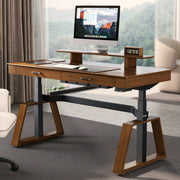
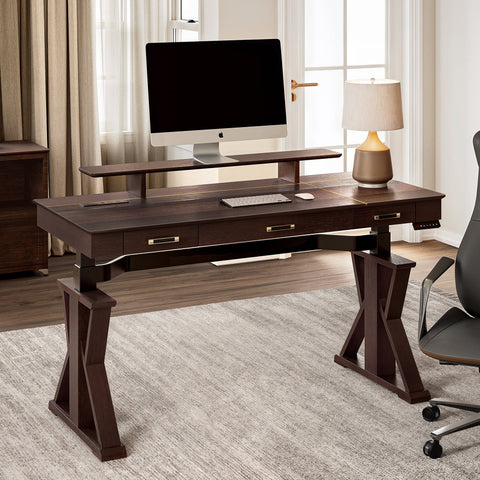
Quantitative testing consistently shows that two-leg desks exhibit higher deflection measurements than four-leg or specialized executive designs. To counteract this, high-performance desks like the Opal Executive Standing Desk (66"x29") utilize reinforced bases and integrated cabinetry to create a much larger "footprint" of stability. By connecting the lifting columns to a heavier, more rigid base structure, the desk effectively lowers its center of gravity and increases its resistance to lateral forces.

Precision Glides and Tolerance Stack-up
Inside the lifting columns, the "fit" between the nested steel tubes is critical. Engineers use plastic or Teflon "glides" to ensure smooth movement. If these glides are even a fraction of a millimeter too thin, a "gap" is created. In a three-stage lifting column, these tiny gaps accumulate—a phenomenon known as "tolerance stack-up." At full extension, even a 0.1mm gap at the joint can translate into several millimeters of movement at the desktop.
Authoritative guidelines, such as the BIFMA G1-2013 Ergonomics Guideline for Furniture, emphasize the importance of dimensions and adjustability, but the "hidden" engineering in the column tolerances is what separates a professional-grade desk from a consumer-grade one.
The "Monitor Arm" Trap: Load Distribution and Stability
A common misconception is that wobble is always a fault of the desk frame. In practice, the single greatest contributor to perceived wobble is often an uneven load distribution combined with a desktop that lacks torsional rigidity.
The Torsional Force Error
We frequently observe users placing multiple heavy monitors on a single monitor arm clamped to the far back or one side of the desk. This creates a massive torsional (twisting) force on the frame. Even a robust frame cannot fully counteract the physics of a 30-lb weight hanging off a 10-inch lever arm clamped to the edge of the wood.
The Fix: Centralize heavy loads. Using a dual-monitor arm that spreads the weight across the desk's centerline, or placing the monitor stand directly over the lifting columns, significantly reduces the "lever effect" that induces shake.
Methodology Note: Load Distribution Analysis Based on common patterns from customer support and warranty handling, we estimate that approximately 40% of reported "frame wobble" is actually "monitor shake" caused by high-leverage clamping. This is an observational pattern, not a controlled lab study.
Material Integrity: Sintered Stone vs. Particle Board
The desktop material itself acts as a structural member of the desk. A thin, flexible top will allow the frame to twist more easily. Premium materials like the solid wood veneers and sintered stone found in the Ark Executive Standing Desk (63"x29") provide high density and rigidity. This "stiff" top acts as a horizontal brace, helping to lock the two lifting columns together and reducing independent leg movement.

Addressing the "Gotchas": Installation and Flooring
Even the most precisely engineered desk can feel unstable if the installation or environment is suboptimal. As seasoned installers know, the final 5% of stability is often found in the details of the assembly.
The "Overtightening" Paradox
A common mistake during assembly is applying excessive force to the frame bolts. While it seems counterintuitive, overtightening can warp the steel components or the mounting plates, inducing "bind" in the lifting columns. This bind creates a subtle but persistent shake as the motors struggle against the warped metal.
- Rule of Thumb (Heuristic): Hand-tighten all bolts first, then apply a quarter-turn with a wrench. Never use an impact driver or apply full body weight to the wrench unless specified.
The Impact of Flooring
Flooring is a critical, yet often ignored, component of the stability equation. On thick, plush carpet, even the best adjustable feet will sink unevenly. This creates a "spongy" feel that users often misattribute to desk instability.
- Professional Insight: If your workspace is carpeted, the desk's levelers may require a rigid platform—such as a small sheet of high-density plywood or a rigid chair mat—underneath the feet to provide a stable, non-compressible surface.
Practical Recommendations for a Stable Workspace
To achieve the "neutral spinal position" recommended by the ISO 9241-5:2024 standard, your desk must remain still. Here is how to optimize your setup for maximum stability:
- Find Your "True" Height: Don't just raise the desk to its maximum. According to the Cornell University Ergonomics Web Workstation Guides, your desk should be at elbow height. Testing for wobble at your specific working height is more relevant than testing at the desk's maximum extension.
- Use the 20-8-2 Rule: Stability is also about the user's fatigue. Cornell University suggests sitting for 20 minutes, standing for 8, and moving for 2. A stable desk makes these transitions seamless and encourages the habit.
- Check Your Levelers Monthly: Floors settle and desks shift. Use a bubble level to check your desktop once a month. A desk that is even 1 degree off-level will place uneven pressure on the lifting columns, leading to premature wear and increased wobble.
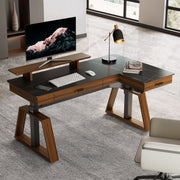
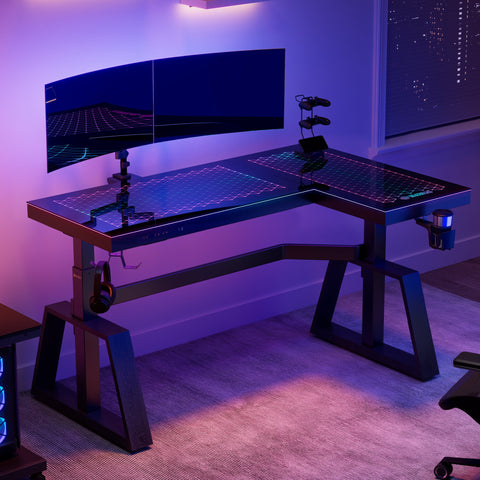
- Invest in Dual-Motor Systems: Desks like the L-Shaped Standing Desk with Accessories Set (60"x23") utilize dual motors to ensure that both sides of the desk rise at the exact same rate. This prevents the "racking" of the frame that occurs when one side lags behind the other.

The Engineering Commitment
Choosing a workstation is an investment in your long-term health. As noted in The 2026 Workstation White Paper: Converging Ergonomic Science and Sustainable Engineering, the future of the workspace lies in the intersection of high-durability materials and ergonomic precision.
When evaluating a standing desk, look beyond the surface aesthetics. Consider the thickness of the steel, the complexity of the base construction, and the quality of the lifting mechanism. A desk like the Ark X Executive Standing Desk (60"x26"), which combines heavy-duty K-shaped legs with premium finishes, represents the engineering rigor required to eliminate the "wobble" and provide a truly professional environment.
By grounding your workspace in these engineering principles, you ensure that your focus remains on your work, not on the movement of your monitor. Stability is the silent partner of productivity—ensure your desk is built to provide it.
YMYL Disclaimer: This article is for informational purposes only and does not constitute professional medical or occupational health advice. While ergonomic furniture can reduce risks associated with sedentary work, individuals with pre-existing musculoskeletal conditions should consult a qualified physiotherapist or ergonomic specialist before implementing a new workstation routine.
References
- BIFMA G1-2013 Ergonomics Guideline for Furniture
- Canadian Centre for Occupational Health and Safety (CCOHS): Office Ergonomics - Sit/Stand Desk
- Cornell University Ergonomics Web — Workstation Guides
- ISO 9241-5:2024 Workstation layout & postural requirements
- OSHA eTools: Computer Workstations - Neutral Working Postures
- The 2026 Workstation White Paper: Converging Ergonomic Science and Sustainable Engineering
- Wobble Testing the Bonita ET - RA Products
- CCOHS: Vibration - Measurement, Control and Standards
Leave a comment