

The Budget Ergonomics Paradox: Why Your Chair Choice Matters
Quick Summary: The 4 Budget Essentials To get the most value from a budget ergonomic chair, prioritize these four features: adjustable seat depth (to protect circulation), robust tilt tension (for movement), anatomically contoured backrests, and high-density foam (>3.0 lbs/ft³).
- Quick Check: Use the "Three-Finger Rule"—ensure a 2-inch gap between the seat edge and your calves to prevent leg swelling.
Many remote professionals encounter a recurring frustration: a mid-afternoon dull ache in the lower back or a persistent tension in the shoulders, despite sitting in what was marketed as an "ergonomic" chair. A common misconception is that effective ergonomic support is a luxury reserved for high-end corporate offices. In reality, achieving a neutral spinal position and reducing musculoskeletal strain is often less about the price tag and more about the presence of specific, high-functioning mechanical features.
When shopping on a budget, the challenge is not necessarily finding a chair with the most features, but finding one with the right features implemented correctly. Some entry-level products prioritize aesthetics or a high number of "adjustments" that can be flimsy. To secure a better investment in your health, we recommend looking past marketing jargon to evaluate the mechanical integrity of the components that interface with your physiology.
The Science of the Static Load: Understanding MSDs
To understand why certain chair features are fundamental, we must first examine the physiological impact of prolonged sitting. The human body is not designed for static postures. According to the World Health Organization (WHO) 2020 Guidelines, reducing sedentary behavior is critical for cardiovascular health and the prevention of chronic conditions.
When you sit, your body is subject to a "static load." Unlike dynamic movement, which promotes blood circulation and nutrient exchange in the spinal discs, static sitting can cause muscles to remain in a state of constant contraction. This potentially leads to:
- Reduced Blood Circulation: Compressed tissues receive less oxygen, which may lead to the accumulation of metabolic waste products like lactic acid.
- Spinal Disc Compression: In a slumped or poorly supported position, the pressure on the intervertebral discs often increases compared to standing.
- Musculoskeletal Disorders (MSDs): Over time, these stresses can manifest as discomfort in the neck, back, and upper limbs. The U.S. Occupational Safety and Health Administration (OSHA) identifies poor posture and repetitive tasks as core risk factors for these injuries.
The primary goal of an ergonomic chair is to facilitate a "neutral position." As defined by OSHA's eTools for Computer Workstations, this involves keeping the joints naturally aligned to help reduce stress on the muscles and skeletal system.
Essential Feature 1: Seat Depth and the "Three-Finger Rule"
A frequent mistake in budget chair selection is prioritizing a high-back design over proper seat depth. If a seat pan is too deep, it can create pressure against the back of the knees (the popliteal area), which may restrict blood flow. Conversely, a seat that is too shallow often fails to provide adequate thigh support, increasing the load on the sit bones.
For a budget chair to be effective, it should ideally offer seat depth adjustment or a fixed depth that accommodates your specific leg length.
Expert Insight (The Three-Finger Rule): When sitting fully back against the lumbar support, there should be a gap of approximately two to three fingers (roughly 1 to 2 inches) between the front edge of the seat and the back of your calf. This is a practical heuristic to ensure thigh support without impeding circulation.
Based on our internal product testing and customer feedback, chairs like the Lira, Ergonomic Office Chair (a Eureka Ergonomic model) are effective because they include seat depth adjustment—a feature sometimes removed from budget models to reduce manufacturing costs.
Essential Feature 2: Robust Tension Control vs. Recline Locks
In the budget market, manufacturers often highlight "multi-position tilt locks." However, based on common patterns observed in our repair workshops, these locking mechanisms can be prone to failure if constructed from lower-grade alloys.
A more valuable feature for a budget-conscious buyer is a robust, easily adjustable tilt tension knob. Instead of locking your body into a single static position, a quality tension system allows for "dynamic sitting." This enables you to move and recline slightly throughout the day while the chair provides consistent resistance.
According to the 2026 Workstation White Paper (an internal Eureka Ergonomic research publication), durability in moving parts is a primary indicator of long-term value. We've observed that a chair maintaining its tension over an estimated three years of daily use provides a higher practical return than one with a mechanical lock failure within the first year.
Essential Feature 3: The Lumbar Support Reality Check
While adjustable lumbar support is often preferred, the quality of these components in the budget tier varies significantly. Budget adjustable lumbar pads can sometimes be unstable or create localized pressure points.
In many cases, a chair with a fixed, well-contoured mesh back can be a more reliable choice. If the frame is anatomically curved to follow the natural S-curve of the spine, it can provide consistent support without the mechanical fragility of low-cost adjustable sliders.
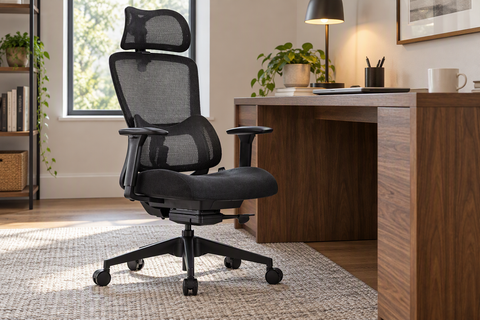
For example, the Flex, Dual-Backrests Ergonomic Office Chair (internal brand example) utilizes a dual-backrest design. This system is designed to move independently to adapt to user movement, providing targeted support to the lower back.
Material Science: Balancing Durability and Comfort
When evaluating materials on a budget, you are typically choosing between mesh, fabric, and PU leather. Each has trade-offs regarding the "cost per year of effective use."
| Material | Primary Benefit | Durability Concern (Budget Tier) | Best Use Case |
|---|---|---|---|
| Mesh | High breathability. | Low-quality mesh may sag over 2-3 years. | Hot environments; users prioritizing airflow. |
| Fabric + Foam | Consistent support. | Can trap heat; fabric may wear over time. | Long-term seat pan cushioning. |
| PU Leather | Easy to clean. | May peel if quality is low; lacks breathability. | Executive styles; "wipe-clean" surfaces. |
For a balanced approach, we often recommend a hybrid. A high-quality mesh back provides airflow, while a fabric-covered seat with high-density foam—such as the Onyx, Ergonomic Office Chair (internal brand example)—helps the seat pan maintain its shape.
Methodology: How We Model Budget Ergonomic Value
To determine what constitutes a "high-value" budget feature, we use a scenario-based modeling approach. We assume a standard 8-hour workday for a user in the 50th percentile of height and weight.
Logic Summary: Our internal analysis utilizes a 3-year estimated lifespan for mechanical components as a benchmark for ROI. We prioritize features that reduce "bracing"—a state where the user tenses their muscles because the chair feels unstable.
| Parameter | Budget Baseline | High-Value Target | Rationale (Shop Heuristics) |
|---|---|---|---|
| Tilt Mechanism | Simple upright lock | Tension-adjustable | Promotes micro-movements |
| Lumbar Support | Rigid plastic strip | Anatomical contour/Mesh | Reduces localized pressure |
| Armrests | Fixed height | 2D or 3D adjustable | Aligns with keyboard height |
| Seat Foam | < 2.5 lbs/ft³ density | > 3.0 lbs/ft³ (Molded) | Based on ASTM-style compression tests to prevent "bottoming out" |
| Base Material | Nylon | Reinforced Nylon/Steel | Ensures structural safety |
Note: This is a scenario model based on internal industry heuristics and workshop observations, not a controlled laboratory study. Individual results may vary based on user weight and usage patterns.
Practical Recommendations: Setting Up Your Budget Workstation
Even a well-engineered budget chair requires correct adjustment. Following Canadian Centre for Occupational Health and Safety (CCOHS) guidelines, use this checklist:
- Monitor Height: The top of your screen should be at or slightly below eye level to help prevent neck strain.
- Elbow Angle: Armrests should be at a height where shoulders are relaxed and elbows are at approximately 90 degrees.
- Feet Placement: Feet should be flat on the floor. If the chair is too high, a footrest can help prevent pressure on the underside of the thighs.
- The 20-8-2 Rhythm: Adopt the Cornell University Ergonomics recommendation: sit for 20 minutes, stand for 8 minutes, and move/stretch for 2 minutes.
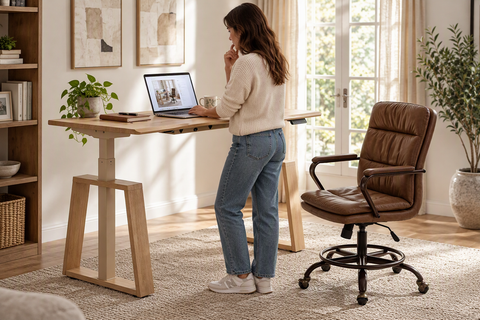
For those who prefer a classic aesthetic, the Regal, PU Leather Home Office Chair (internal brand example) offers a mid-century design while maintaining the structural integrity needed for professional use.
Addressing the "Tall vs. Small" User Gap
A limitation of many budget chairs is their "fit range." Most are designed for the "average" user. According to BIFMA G1-2013 guidelines, furniture should ideally accommodate the 5th to 95th percentile of the population.
- For Petite Users: Look for a chair with a low minimum seat height (under 16 inches) and a shallow seat depth to ensure you can reach the lumbar support.
- For Tall Users: Prioritize a high maximum seat height and a backrest that reaches at least the mid-scapula (shoulder blades) to prevent hunching.
Moving Beyond the Chair: The Role of the Sit-Stand Desk
While this guide focuses on chairs, the "best" sitting posture is often the next posture. A systematic review by Cochrane (2018) suggested that sit-stand desks can help reduce sitting time in the workplace.
When your budget allows, pairing an ergonomic chair with a height-adjustable desk creates a more complete system, allowing you to interrupt prolonged static positions.
Summary of Findings
Investing in ergonomics on a budget involves focusing on fundamental engineering rather than luxury materials:
- Prioritize Seat Depth: Use the "three-finger rule" to protect circulation.
- Value Tension Over Locks: A robust tension knob is often more durable and promotes better movement.
- Seek Anatomical Contours: A well-shaped backrest can outperform low-quality adjustable parts.
- Choose High-Density Foam: Look for densities above 3.0 lbs/ft³ for better long-term support.
By focusing on these features, you can create a workspace that supports your health and productivity. For further reading, see our guide on what makes an office chair truly ergonomic.
Disclaimer: This article is for informational purposes only and does not constitute professional medical advice. If you suffer from chronic back pain or a pre-existing musculoskeletal condition, please consult a qualified healthcare professional or a certified ergonomist before making significant changes to your workstation.
References
- Agarwal, S., et al. (2018). Sit-Stand Desks & Low Back Discomfort: A Systematic Review. PubMed
- BIFMA. (2013). G1-2013 Ergonomics Guideline for Furniture. BIFMA
- CCOHS. (2023). Office Ergonomics - Sit/Stand Desk. Canadian Centre for Occupational Health and Safety
- Cochrane Library. (2018). Workplace interventions for reducing sitting at work. Cochrane
- Cornell University. Workstation Setup Guides. Cornell ErgoWeb
- OSHA. Computer Workstations eTool. Occupational Safety and Health Administration
- WHO. (2020). Guidelines on Physical Activity and Sedentary Behaviour. World Health Organization
- Eureka Ergonomic. (2026). The 2026 Workstation White Paper. [Internal Source]




Leave a comment