

The Hidden Cost of the "Standard" Office: Why Bulk Audits Matter
In large-scale corporate environments, the decision to refresh office furniture is often viewed through the lens of aesthetics or initial capital expenditure. However, a common misconception among facilities managers and procurement officers is that a "standardized" workstation—one size fits all—is the most efficient way to manage a bulk order. The reality is that this approach often leads to significant long-term costs.
When employees spend eight hours a day at a workstation that does not align with their physical dimensions, the result is not just discomfort; it is a measurable decline in productivity. This phenomenon, known as "presenteeism," occurs when employees are physically present but cognitively distracted by localized pain or fatigue. According to the EU-OSHA 2019 Report on Musculoskeletal Disorders, MSDs are the most common work-related health problem in Europe, resulting in billions of euros in lost productivity and healthcare costs.
A rigorous, 60-minute ergonomic audit conducted before a bulk purchase can mitigate these risks. By identifying the diverse physical needs of a workforce—ranging from the 5th percentile petite user to the 95th percentile tall executive—organizations can ensure high adoption rates and reduce the risk of expensive retrofits or workers' compensation claims.
The Physiology of Static Load and Musculoskeletal Health
To understand why a bulk audit is necessary, one must understand the physical principles of Musculoskeletal Disorders (MSDs). The human body is not designed for prolonged static sitting. When a person remains in a fixed position, they experience a "static load" on their muscles and spinal discs.
The Mechanism of Spinal Compression
In a seated position, the natural "S-curve" of the spine often collapses into a "C-curve," especially if the chair lacks adequate lumbar support. This increases intradiscal pressure and restricts blood circulation to the lower extremities. Over time, this leads to repetitive strain injuries (RSI) and chronic back pain. The ISO 11226:2000 standard for evaluating static working postures specifies that static positions should be interrupted frequently to allow for tissue recovery.
The Role of Neutral Posture
The goal of any ergonomic intervention is to maintain a "Neutral Position." This is a posture where the joints are naturally aligned, reducing stress on the muscles, tendons, and skeletal system.
- Elbows: Bent at 90 to 120 degrees, close to the body.
- Wrists: Straight and neutral (not bent up or down).
- Hips/Knees: Thighs parallel to the floor with knees at approximately hip level.
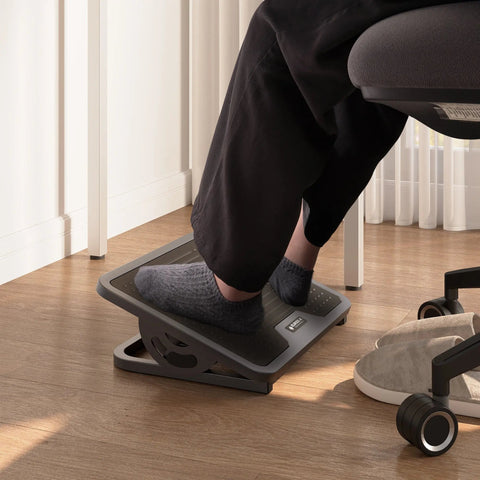
- Feet: Resting flat on the floor or a footrest.
According to the OSHA eTools for Computer Workstations, achieving this neutral posture requires highly adjustable furniture that can accommodate the specific anthropometric data of the individual user.
Logic Summary: Our analysis of musculoskeletal health assumes that static loads are the primary driver of workplace fatigue. We utilize the "Hierarchy of Controls" model, positioning ergonomic furniture as an "Engineering Control"—a more effective solution than simply encouraging breaks (Administrative Control).
Phase 1: Anthropometric Mapping for a Diverse Workforce
The first step in a bulk audit is mapping the physical dimensions of the employee population. A common oversight in bulk procurement is failing to account for "edge case" users.
The 95th Percentile Challenge
Based on our scenario modeling for a 195cm (approx. 6'5") male user, a standard 29-inch fixed-height desk creates a significant ergonomic deficit.
| Parameter | Value | Unit | Rationale |
|---|---|---|---|
| User Stature | 195 | cm | 95th percentile male |
| Recommended Seat Height | ~51 | cm | Popliteal height + shoe correction |
| Recommended Sit Desk Height | ~80.5 | cm | Elbow height in neutral position |
| Standard Fixed Desk Height | 73.7 | cm | Industry standard (29 inches) |
| Ergonomic Deficit | ~7 | cm | The "Gap" causing slumped posture |
For a user of this stature, a fixed-height desk forces the individual into a slumped-shoulder position or an elevated chair position where the feet do not touch the floor, creating pressure on the underside of the thighs and restricting blood circulation. This highlights why height-adjustable desks are a legal and financial imperative for modern employers, a trend noted in the 2024 Amazon-OSHA settlement regarding workstation safety.
The Solution: Dynamic Adjustability
For large-scale offices, we recommend chairs with independent seat pan depth adjustment and 4D armrests. The Exis, Ergonomic Office Chair is a prime example of a professional-grade solution, featuring a 4-level adjustable lumbar support system that adapts to various spinal curvatures. In shared or "hot-desking" environments, the most critical feature is intuitive, tool-free adjustability. If an employee cannot adjust their chair within 30 seconds, they will likely remain in a sub-optimal position, negating the ergonomic investment.
Phase 2: Functional Requirements and Task-Specific Triage
An audit must also categorize workstations by the specific tasks performed. An administrative assistant has different requirements than a financial trader or a CAD engineer.
The Trading Desk Visual Crisis
In financial sectors, the use of super ultrawide monitors (e.g., 49-inch displays) is common. However, our modeling reveals a "Vision-Quest" deficit when these monitors are placed on standard 30-inch deep desks.
- The Problem: A 49-inch monitor requires approximately 88 inches of viewing distance to maintain a SMPTE-standard 30° field of view.
- The Deficit: On a 30-inch desk, the user sits nearly 4.3 feet too close to the screen.
- The Impact: This proximity causes "tunnel vision," where peripheral data is lost, and significant eye strain (visual fatigue).
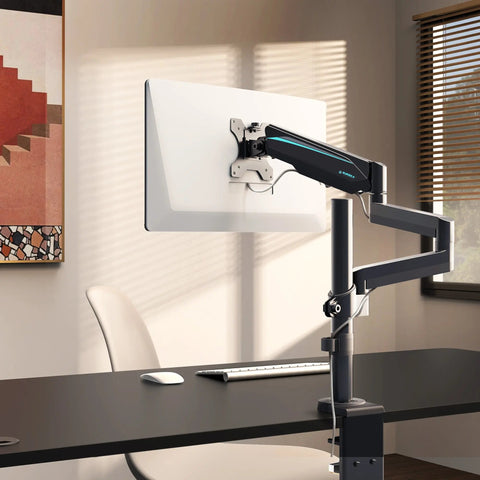
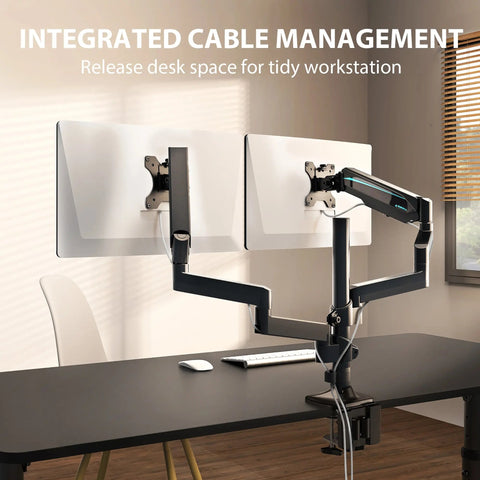
To solve this, procurement should specify deeper desk surfaces or high-performance monitor arms. The Dual Monitor Arm allows for a max extension of 27.3 inches, providing the flexibility to push screens back or pull them forward depending on the task, thereby optimizing the focal length and reducing neck rotation.
The Engineering Workstation Load
For R&D and engineering departments, the weight of the equipment is a safety factor. A typical CAD station—consisting of a liquid-cooled full tower, three 34-inch ultrawide monitors, and heavy-duty arms—can reach a system load of ~94kg.
Modeling Note: Standard single-motor standing desks typically have a capacity of 80kg. In our engineering scenario, a single-motor desk would operate at 117.5% capacity, leading to motor burnout and safety risks. A dual-motor desk (120kg capacity) operates at a safe 78% utilization.
For these high-load environments, we recommend specifying dual-motor lifting mechanisms to ensure longevity and compliance with BIFMA X5.5 standards for desk products.
Phase 3: Technical Safety and Durability Standards
When placing a bulk order, facilities managers must look beyond ergonomics and evaluate safety certifications. These certifications are the "Trust Marks" that protect the organization from liability.
- BIFMA (Business and Institutional Furniture Manufacturers Association): The ANSI/BIFMA X5.1 standard is the gold standard for office chair durability. It involves rigorous testing for backrest strength, base stability, and swivel cycles. For budget-conscious bulk orders, the Onyx, Ergonomic Office Chair offers a minimalist design that meets essential ergonomic needs while maintaining high durability standards.
- UL 962: This certification covers the safety of height-adjustable desks, specifically focusing on electrical components and mechanical pinch points. Ensuring your desks are UL 962 certified is vital for fire safety and insurance compliance.
- GREENGUARD Gold: Indoor air quality is a key component of workplace wellness. Products with UL GREENGUARD Certification have low chemical emissions (VOCs), which is essential for large offices with high-density seating.
As detailed in the industry white paper, The 2026 Workstation White Paper: Converging Ergonomic Science and Sustainable Engineering, the convergence of safety, sustainability, and ergonomics is the new baseline for corporate procurement.
Practical Recommendations for Implementation
Once the audit is complete and the furniture is selected, the implementation phase determines the actual Return on Investment (ROI).
The Ideal Sit-Stand Rhythm
Simply providing a standing desk is not enough. The Cornell University Ergonomics Web recommends the "20-8-2" rule:
- 20 Minutes Sitting: In a neutral posture.
- 8 Minutes Standing: To encourage blood circulation.
- 2 Minutes Moving: Gentle stretching or walking.
Monitor and Accessory Setup
A common post-audit complaint is insufficient desktop real estate. A practical heuristic for procurement is to add 15-20% to the perceived necessary desk size during the specification phase. This accounts for the space lost to monitor arms, docking stations, and document holders.
To further optimize space, consider accessories like the Carbon Fiber Dual Monitor Stand. This riser elevates monitors to eye level—reducing the "tech neck" caused by looking down—while creating storage space underneath for keyboards or notebooks, which is critical for maintaining an organized, low-stress environment.
Employee Education
According to Safe Work Australia, even the best furniture fails if the user does not know how to set it up. We recommend providing a "Quick Start" guide or a 30-second instructional video for every new chair and desk deployed.
Summary of Audit Triage
| Audit Factor | Threshold / Goal | Action for Bulk Procurement |
|---|---|---|
| User Height Variance | 5th to 95th Percentile | Specify desks with 65cm to 125cm range. |
| Desk Depth | Viewing Distance | Use 30"+ depth or high-extension monitor arms. |
| Load Capacity | 80% Safety Margin | Dual-motor desks for engineering/heavy setups. |
| Adjustability Speed | < 30 Seconds | Intuitive, tool-free controls for hot-desking. |
| Certifications | BIFMA / UL / GREENGUARD | Mandatory for risk mitigation and insurance. |
Appendix: Modeling Methodology & Assumptions
The quantitative insights presented in this article are derived from deterministic scenario modeling designed for enterprise-scale office environments.
Modeling Parameters:
| Parameter | Value / Range | Unit | Rationale |
|---|---|---|---|
| Stature Data | ANSI/HFES 100-2007 | - | US population anthropometric standards |
| Viewing Distance | SMPTE EG-18-1994 | - | 30° Field of View for professional displays |
| Load Safety Factor | 0.8 | ratio | Standard mechanical engineering safety margin |
| Room Clearance | ADA 2010 / OSHA 1910.37 | - | Legal requirements for egress and accessibility |
Boundary Conditions:
- These models assume standard office footwear (2.5cm correction).
- Load calculations assume static, distributed weight; dynamic impacts (e.g., leaning on the desk) may require higher safety margins.
- Productivity gains are estimated based on industry heuristics regarding the reduction of "presenteeism" and are not guaranteed for every individual.
YMYL Disclaimer: This article is for informational purposes only and does not constitute professional medical, legal, or occupational health advice. Ergonomic requirements vary significantly based on individual health history and pre-existing conditions. Always consult with a qualified occupational therapist or healthcare professional before making significant changes to your workstation or physical routine.
References
- BIFMA G1-2013 Ergonomics Guideline for Furniture
- CCOHS: Office Ergonomics - Sit/Stand Desk
- Cochrane: Workplace interventions for reducing sitting at work (2018)
- ISO 9241-5:2024 Workstation layout & postural requirements
- WHO 2020 Guidelines on Physical Activity & Sedentary Behaviour
- OSHA eTools: Computer Workstations - Neutral Working Postures
- The 2026 Workstation White Paper: Converging Ergonomic Science and Sustainable Engineering




Leave a comment