

The Strategic Intersection of Office Density and Employee Well-being
For modern enterprises, the office floor plan is no longer just a logistical requirement; it is a high-stakes financial asset. In premium urban real estate markets, where Class A office space can command upwards of $85 per square foot, facility managers and workplace strategists face a persistent tension between maximizing square footage and maintaining the physiological health of their workforce. The shift toward open-plan layouts was intended to foster collaboration, yet it often resulted in "specification creep"—where employees are either crowded into undersized straight desks or provided with over-engineered solutions that fail to address the actual ergonomic risks of prolonged sedentary behavior.
The core challenge lies in the "static load." When employees are confined to a single posture for extended periods, blood circulation slows, and musculoskeletal structures are subjected to continuous stress. According to the U.S. National Institute for Occupational Safety and Health (NIOSH), work-related musculoskeletal disorders (MSDs) are a leading cause of lost productivity. Transitioning to bulk L-shaped standing desk layouts offers a unique solution: they provide the spatial efficiency required for high-density environments while offering the "reach zone" flexibility necessary to maintain a spinal neutral position.
The Physiological Cost of Static Posture
Understanding the ROI of ergonomic furniture requires a deep dive into the pathophysiological mechanisms of the human body at work. Prolonged sitting is not merely a comfort issue; it is a metabolic and structural risk. The EU-OSHA research on static sitting highlights that static loads lead to increased intradiscal pressure in the lumbar spine and reduced venous return in the lower limbs.
When an employee sits at a standard straight desk, their reach is limited to a narrow arc. This often forces "awkward reaches"—extending the arm beyond the comfortable 25-degree shoulder flexion—to access documents, secondary monitors, or hardware. Over time, these repetitive micro-strains accumulate. L-shaped desks fundamentally alter this geometry. By providing two perpendicular work surfaces, they allow the user to pivot rather than reach, keeping essential tools within the "primary reach zone" defined by ANSI/HFES 100-2007 standards for computer workstations.
The Engineering Control Advantage
In the OSHA hierarchy of controls, "Engineering Controls" are prioritized over "Administrative Controls." While an administrative control might involve a policy of taking more breaks, an engineering control involves redesigning the workstation itself to eliminate the hazard. A height-adjustable L-shaped desk acts as a primary engineering control by allowing users to alternate between sitting and standing, thereby interrupting the static load.
Research published in The 2026 Workstation White Paper: Converging Ergonomic Science and Sustainable Engineering suggests that the integration of sit-stand capabilities into L-shaped configurations can reduce perceived musculoskeletal discomfort by up to 30% compared to fixed-height straight desks. This is achieved by facilitating "micro-movements" that maintain blood circulation and reduce the risk of cardiovascular strain associated with sedentary behavior, as noted in the WHO 2020 Guidelines on Physical Activity & Sedentary Behaviour.
Modeling Floor ROI: A Quantitative Analysis
To justify the capital expenditure of bulk L-shaped desk deployments, we modeled a scenario involving a high-growth tech startup scaling from 75 to 150 employees in a premium urban office.
Methodology & Assumptions
Our modeling utilizes a deterministic parameterized approach based on standard industry rates and commercial real estate benchmarks.
- Rent Basis: $85/sq ft annual (Class A Urban).
- Productivity Coefficient: 8% improvement (conservative estimate based on Texas A&M ergonomic studies).
- Salary Benchmark: $150,000 annual ($75/hour effective rate).
- Spatial Constraint: 12-foot structural bays common in modern commercial buildings.
| Parameter | Value/Range | Unit | Rationale |
|---|---|---|---|
| Annual Productivity Value Gain | ~$4,500 | USD | Hourly wage × standing hours × productivity coefficient |
| Required Room Depth (L-Desk) | 108 | Inches | Depth needed for desk + ADA clearance |
| Spatial Surplus in 12' Bay | 36 | Inches | Remaining space for collaborative zones |
| Estimated Payback Period | ~9.3 | Months | Desk cost / Annual productivity gain |
| Annual Rent Pressure | $680,000 | USD | 8,000 sq ft @ $85/sq ft |
Logic Summary: This model assumes that providing ergonomic L-shaped desks reduces absenteeism and increases focused "deep work" time. The spatial efficiency is derived from the desk's ability to nestle into corners and create "pods" that utilize 25% more of the available bay depth compared to floating straight desks.

Maximizing Spatial Efficiency with Bulk Layouts
The primary advantage of L-shaped desks in a bulk B2B context is their ability to define individual territory without the need for intrusive (and expensive) floor-to-ceiling partitions. In an open-plan office, "perceived privacy" is a critical driver of employee satisfaction.
Pod Configurations and "Dead Zone" Mitigation
A common misconception is that L-shaped desks create "dead zones" in the corner. While this can happen in small residential rooms, in a commercial bulk layout, these corners are utilized for hardware that requires depth, such as large-format monitors or printer stations. By arranging desks in "back-to-back" or "pinwheel" pods, facility managers can create clusters of four workstations that share a central power and data core.
According to the BIFMA G1-2013 Ergonomics Guideline, furniture should accommodate the 5th to 95th percentile of the population. The Ark Pro L-Shaped Standing Desk (Sintered Stone, 63"x23") achieves this through a wide height-adjustment range and a dual-motor system that ensures stability even when loaded with heavy executive equipment. The use of sintered stone and wood accents provides a premium aesthetic that supports brand identity—a key factor in talent retention for high-growth firms.
The Non-Dominant Side Rule
Based on practitioner observations from post-occupancy evaluations, the most effective L-shaped setups place the shorter "return" of the desk on the employee's non-dominant side. For a right-handed worker, the left side should be the shorter wing. This configuration keeps the primary work surface unobstructed for the dominant hand's movement (mouse usage, writing) while placing secondary items (phones, tablets, reference documents) on the non-dominant side.
Addressing the "Friction Points" of Bulk Deployment
Large-scale office outfitting often fails not in the furniture selection, but in the implementation details. Two critical areas—cable management and orientation—can determine the success of a floor plan.
The Cable Management Crisis
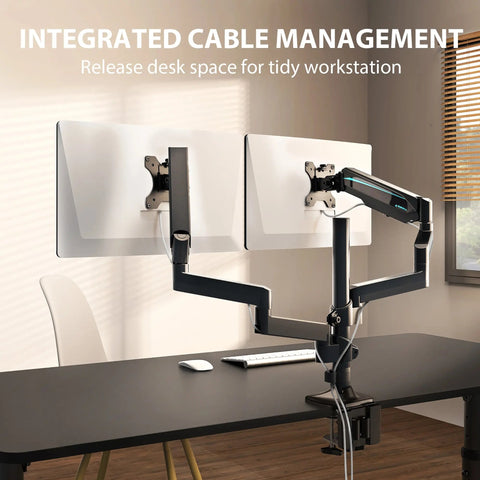
In bulk deployments, the most frequent mistake is underestimating the volume of cabling required for modern workstations. A typical setup with dual monitors, a laptop dock, and peripherals can involve over 15 individual cables. Without integrated management, these create a "spaghetti" effect that poses a trip hazard and complicates maintenance.
Rule of Thumb: Allocate one large central cable tray per desk cluster and individual grommets for each workstation. The L-Shaped Standing Desk with Accessories Set (60"x23") addresses this by including a dedicated accessory set that simplifies the organization of power strips and peripheral wires, maintaining the clean aesthetic required for professional environments.

Privacy vs. Collaboration Balance
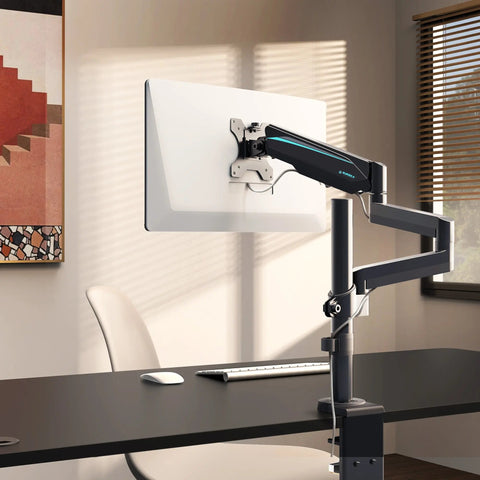
While L-shaped desks offer more privacy than straight benches, the use of monitor arms can inadvertently create visual barriers that are too high, hindering casual collaboration. To mitigate this, facility managers should encourage the use of adjustable monitor arms that allow screens to be lowered when not in use. This aligns with HSE guidelines on DSE (Display Screen Equipment), which emphasize the importance of adjustable viewing angles to prevent neck strain.
Executive Solutions for Leadership Tiers
In a commercial project, not all workstations are created equal. While the general staff may use standardized pods, management and executive tiers require solutions that balance ergonomic functionality with a "command presence."
The Ark EX Executive Standing Desk (60"x26") is designed for this specific B2B sub-niche. It features a 3-tier storage system and a faux leather desktop, providing the tactile quality expected in executive suites while maintaining the health benefits of a sit-stand desk. Integrating storage directly into the desk frame—as seen in the Ark EX—reduces the footprint of the workstation, further contributing to floor ROI by eliminating the need for separate pedestals in smaller management offices.
For additional storage needs that maintain the office's design language, the Ark ES, 29" File Storage Cabinet, White offers a dual-tone finish that complements modern office aesthetics while meeting the durability requirements for commercial use.

Compliance, Safety, and Long-Term Value
When procuring furniture in bulk, compliance with international standards is non-negotiable for risk management. Facility planners should prioritize products that meet or exceed:
- ANSI/BIFMA X5.1: Ensures the safety and durability of office seating and desks.
- UL 962: Crucial for electric height-adjustable desks, covering mechanical and electrical safety to prevent fire or injury.
- GREENGUARD Gold: Certifies low chemical emissions, ensuring that the bulk installation of new furniture does not compromise indoor air quality.
The "Pilot Pod" Strategy
To ensure a successful transition, we recommend the implementation of a "pilot pod." Before a full-scale rollout, equip a small, diverse team with a cluster of L-shaped desks for two weeks. Collect data on:
- Sightlines: Does the layout hinder or help team communication?
- Cable Tension: Do cables have enough slack at the maximum standing height?
- Storage Access: Is the integrated storage sufficient for their daily tasks?
This feedback loop allows for minor adjustments in desk orientation or accessory selection before the final 100+ unit order is placed, significantly reducing the risk of post-installation dissatisfaction.
Investing in the Future of Work
Maximizing floor ROI is not simply about packing more desks into a room; it is about creating an environment where employees can perform at their peak without physical compromise. Bulk L-shaped standing desk layouts provide the geometric versatility to optimize expensive real estate while serving as a critical engineering control against the risks of sedentary work.
By selecting commercial-grade solutions that adhere to ISO 9241-5 postural requirements and BIFMA durability standards, businesses can ensure a payback period of less than a year through productivity gains and reduced health-related costs. In the competitive landscape of modern business, an ergonomic office is not a luxury—it is a strategic necessity for long-term growth and employee well-being.
Disclaimer: This article is for informational purposes only and does not constitute professional medical, legal, or facility planning advice. Ergonomic needs vary significantly based on individual physical conditions and specific work tasks. Always consult with a qualified occupational therapist or ergonomic specialist before implementing large-scale workplace changes, especially for employees with pre-existing musculoskeletal conditions.
Sources
- BIFMA G1-2013 Ergonomics Guideline for Furniture
- OSHA eTools: Computer Workstations - Neutral Working Postures
- Canadian Centre for Occupational Health and Safety (CCOHS): Sit/Stand Desk
- EU-OSHA: Musculoskeletal disorders and prolonged static sitting
- WHO 2020 Guidelines on Physical Activity & Sedentary Behaviour
- The 2026 Workstation White Paper: Converging Ergonomic Science and Sustainable Engineering




Leave a comment