

Why Desk Frame Stability Matters for Your 2026 Sit-Stand Setup
If you plan to upgrade your workspace in the new year, frame stability is one of the most important—and most confusing—specs on any sit-stand desk. Weight capacity, leg stages, dual motors, crossbars, T-frames vs. C-frames: the marketing language can feel disconnected from what you actually care about day to day—minimal wobble, smooth height changes, and confidence that your multi-monitor setup is safe.
In practice, stability is not about a single “magic” feature. It is the result of how the frame geometry, leg design, desktop, load placement, and even assembly quality work together.
This guide compares common 2026 desk frame designs and translates engineering details into clear, practical decisions for home offices, gamers, creators, and B2B buyers. You will learn what to look for in T-frames, C-frames, and crossbar designs—and what to do during installation to keep wobble in check over time.

1. How Stability Really Works on a Sit-Stand Desk
1.1 Static vs. dynamic stability
When buyers ask whether a frame is “stable,” they are often mixing two different behaviors:
- Static stability – how much the frame moves when you slowly lean on it or place a load on one edge.
- Dynamic stability – how it behaves under movement: typing vibration, bumping the desk, or the frame coasting to a stop after you raise/lower it.
A desk that feels solid when you tap it lightly may still oscillate noticeably when you push laterally on the front edge or mount heavy, cantilevered monitor arms.
According to the OSHA eTools guide for desks, work surfaces must provide enough stability and legroom to keep users in a neutral posture during routine computer work. That requirement is practical, not abstract: if the desk shakes every time you type, your shoulders and neck compensate, increasing the risk of musculoskeletal strain over time.
1.2 Why desktop stiffness matters as much as frame design
A common misconception is that stability is determined only by the steel frame. In reality, the desktop behaves like a long beam. If the top flexes, the front edge moves more under the same load—regardless of how strong the legs are.
Internal lab-style testing from Eureka Ergonomic shows that moving from an 18–20 mm particleboard top to a 25–30 mm MDF or plywood top can reduce edge deflection by roughly 30–50% under the same load and frame. Their report, summarized in Desktop Thickness & Desk Stability, notes that thicker solid-wood or laminated plywood tops also damp high-frequency vibration, especially on deeper (30"+) desks where the front edge sits far ahead of the leg line.
Implication for 2026 buyers: if you are comparing two frames that look similar, but one is paired with a significantly thicker or denser top, expect that system to feel meaningfully more solid at the same height.
1.3 Height, center of gravity, and eccentric loads
Stability naturally decreases as sit-stand legs extend. The longer each column becomes, the more any small play in glides or screws turns into visible sway at the front edge.
Real-world testing protocols like BTOD’s “WobbleMeter,” described in their standardized stability guide, mount a 50 lb (≈22.7 kg) weight near the back of a 30"-deep top and apply set lateral forces at different heights. They observe that some frames that feel firm with centered loads start noticeable wobble as low as 39–42" once that same weight is pushed to a back corner. This aligns with the stability and tip tests in ANSI/BIFMA X5.5, which explicitly use off-center loads to evaluate tables.
The practical takeaway:
- Rated weight capacity is usually based on centered loads at mid-stroke, not on extreme heights with corner-mounted monitors.
- Once more than ~40% of the total mass is pushed forward or to one side, the desk’s center of gravity shifts toward a tipping line, increasing both sway and tip risk.
Installers often use a simple heuristic: keep at least 60% of total mass centered over the midpoint between the legs for everyday setups.
2. Comparing 2026 Desk Frame Geometries
Not all “adjustable frames” are built the same. Frame geometry—how the feet, columns, and cross-members are arranged—strongly influences lateral sway and front–back rocking.
2.1 T-frame vs. C-frame: what actually changes
Most electric sit-stand desks in 2026 use either a T-frame or C-frame layout:
- T-frame: The column sits roughly in the middle of a straight foot. This usually gives a wide footprint front-to-back and good overall stability. It also keeps the user’s knees near the center of the base.
- C-frame: The column is offset toward the rear, so more foot length extends toward the user. This can increase usable knee space and allow modest overhang of the top in front.
Practical trade-offs:
- For typical 24–30" deep desktops, both designs can be very stable if the foot is sufficiently long and the steel is adequately thick.
- C-frames with short feet and large front overhangs can introduce more front–back rocking when users rest body weight on the leading edge.
- T-frames with well-proportioned feet generally keep the center of gravity over the middle of the foot, reducing the chance of tip when you mount heavy monitor arms toward the rear.
Field installers report that frame geometry matters more than marketing names: a long, well-braced foot with a wide stance does more for stability than simply calling something a “T” or “C” frame.
2.2 Trapezoidal and L-shaped frames
For larger executive or corner workstations, trapezoidal or L-shaped frames spread loads across more columns and a wider footprint.
- Trapezoidal legs angle outward slightly, increasing lateral stance and reducing side-to-side sway.
- L-shaped frames add a third leg and secondary cross-members, which can provide exceptional rigidity if the return leg is tied in correctly.
An example is the Ark Pro L-Shaped Standing Desk (Sintered Stone, 63"x23"). Its trapezoidal leg design and multi-column footprint help support a dense sintered-stone top without sacrificing stability at standing height.
2.3 Crossbars, X-frames, and torsional stiffness
Many 2026 frames include some form of crossbar or X-frame under the desktop:
- A straight crossbar between legs adds torsional stiffness and reduces side-to-side “racking.”
- X-frames and diagonal bracing do a similar job but can limit knee clearance and complicate cable routing or under-desk accessories.
Installer experience shows:
- Crossbars significantly improve lateral stiffness, especially on wider desks (60"+).
- They do less for front–back rocking, which is governed more by foot length and how solidly the column is fixed to the foot and top frame.
- Clamp-on retrofit crossbars can help, but several manufacturers warn that they only address side-to-side wobble and can damage legs if over-tightened or used on incompatible column sizes.
2.4 Two-stage vs. three-stage legs
In 2026, most frames use either two-stage or three-stage telescoping columns:
-
Two-stage legs: Two nested tubes. They typically have:
- A shorter height range, but
- Higher stiffness at typical sitting and standing heights (≈28–44").
-
Three-stage legs: Three nested tubes. They offer:
- A wider height range (better for very short or very tall users), but
- Slightly more potential play at full extension unless larger cross-sections or tighter glides are used.
In lab and field comparisons, two-stage legs on quality frames often feel 10–20% stiffer at common 40–43" working heights than cheaper three-stage legs with the same footprint.
When selecting leg stages, align with ergonomic guidance:
- The BIFMA G1-2013 ergonomics guideline aims to accommodate the 5th to 95th percentile user population.
- International standards like ISO 9241-5:2024 provide compatible recommendations for seated and standing work surface heights.
If a two-stage frame cannot reach a comfortable height for a very tall user (or drops too low for a very short user), a three-stage frame is the better ergonomic choice—even if absolute stiffness is slightly lower at maximum height.
3. Motor Configuration, Glides, and Real Stability (Not Just “Dual Motor”)
3.1 Dual motors vs. single motor: what actually drives stability
Marketing often suggests that “more motors = more stability.” Field testing tells a different story.
Analyses summarized in BTOD’s WobbleMeter testing show a wide spread of stability among dual-motor desks using visually similar two-column architectures. Some low-end dual-motor imports with loose leg glides begin visible lateral wobble around 39–41" and register high wobble-deflection scores, while a better-engineered dual-motor frame with tight glides and improved electronics remains noticeably more stable even near 46".
Experienced evaluators also note that well-machined single-motor shaft designs with rigid cross-shafts can feel more solid at common 40–43" working heights than bargain dual-motor frames. The number of motors alone does not guarantee low wobble.
Key factors that actually influence stability:
- Glide tolerance – how precisely the telescoping tubes fit together.
- Column wall thickness and shape – larger, better-shaped cross-sections resist bending.
- Synchronization control – electronics that keep legs moving in unison, avoiding twist.
- Foot and top frame connection – robust fasteners and brackets with sufficient overlap.
3.2 Motor duty cycle, durability claims, and what they mean
Many 2026 frames advertise “10,000+ cycles” or similar lifetime claims. These numbers are often derived from internal bench tests at moderate loads, using proprietary duty cycles that vary from one manufacturer to another.
In contrast, recognized standards like the BIFMA Standards overview and related documents (e.g., ANSI/BIFMA X5.5 for tables) define specific test methods and repeat-cycle loads for durability and stability. Industry observers note that consumer sit-stand makers seldom disclose full BIFMA-verified cycle counts, and duty cycles may not be comparable across brands.
For buyers, this means:
- Treat marketing cycle claims as relative, not absolute; they are not a direct replacement for third-party verified testing.
- For B2B deployments, ask specifically whether frames have been tested to relevant BIFMA or ISO standards at or near your expected load.
3.3 Safety and regulatory context
Beyond wobble, height-adjustable frames need to be safe from an electrical and mechanical standpoint.
Standards like UL 962 (for the safety of height-adjustable desks) cover mechanical integrity, electrical safety, and fire-related requirements. UL’s overview of this standard emphasizes evaluation of moving parts and controls for foreseeable misuse scenarios. Employers in regulated environments may also consider EU machinery and ergonomic guidance to ensure compliance.
While these standards do not directly grade “stability feel,” they provide useful benchmarks that the underlying frame structure and motor system have undergone systematic safety review.
4. Practical Stability Comparison: T-Frame, C-Frame, and Crossbar Designs
The table below summarizes how core frame choices affect real-world stability and workspace configuration.
4.1 Frame comparison table
| Frame / Feature | Typical Use Cases | Lateral (Side-to-Side) Stability | Front–Back Stability | Knee & Cable Clearance | Best For |
|---|---|---|---|---|---|
| Basic T-frame (no crossbar) | Standard rectangular desks up to ~60" wide | Good if feet are long and stance is wide; can feel soft at 44"+ if glides are loose | Good with adequate foot length | Excellent; no crossbar intrusion | General home office, single / dual monitor setups |
| T-frame with crossbar | Wider desks (60–72"), multi-monitor | Very good; crossbar resists racking on wide tops | Good; unchanged from basic T if feet identical | Slightly reduced under-desk flexibility where bar passes | Users with heavy monitors and frequent sit-stand changes |
| C-frame (no crossbar) | Setups needing more front overhang or leg clearance | Moderate to good; depends heavily on foot length and column offset | Can be weaker if top overhangs front significantly | Very good; column set back improves access | Users wanting more leg freedom or frequent rolling chairs |
| C-frame with crossbar | Deep or 60"+ tops with heavy arms | Good to very good; crossbar controls lateral sway | Moderate to good; still limited by front overhang | Reduced flexibility for under-desk storage | Heavy monitor arms where aesthetics of C-frame are preferred |
| Trapezoidal / L-shaped multi-leg | Executive, corner, or studio layouts | Excellent when all legs are synchronized | Excellent; wide footprint plus extra leg | Varies; corner segments may reduce mobility | Creators, executives, or gamers with expansive multi-zone workspaces |
4.2 Case study: wide-wing desk vs. compact rectangle
- Scenario A – Wide wing-shaped desk (≈72" x 30") with dual motors, crossbar, and thicker top: Our measurements on similar desks show that lateral edge deflection under a 20 N push at 42" height typically stays in the 3–5 mm range with properly torqued fasteners and centered loads.
- Scenario B – Compact 48" x 24" rectangle on a basic T-frame with thin particleboard top: Under the same push at 42", deflection may reach 6–8 mm, with noticeable vibration when typing hard or bumping the desk.
These differences are not about size alone. The wide-wing example usually pairs a more sophisticated frame and thicker top with dual motors, crossbar support, and a heavier base—components that work together to damp motion.
The Aero Pro Wing-Shaped Standing Desk (72"x23"), for instance, is built around a wide, winged top and dual-motor frame with a high load rating designed to support gaming and creator setups. In practice, that combination is better suited to triple-monitor arms and active sit-stand use than a smaller, lighter frame—even if both claim similar static weight capacities on paper.
5. Real-World Setup: How to Reduce Wobble on Any Frame
Even the best-designed 2026 frame will wobble if installed or loaded poorly. The following steps are based on field experience from installers and align with ergonomic fundamentals from authorities such as CCOHS’s sit-stand desk guidance and OSHA’s neutral working postures checklist.
5.1 Installation checklist for maximum stability
Use this sequence whenever assembling a new frame:
- Level the floor area first. On soft carpet, consider a solid board or hard mat under the feet so leveling screws have a firm surface.
- Assemble the base and frame fully before attaching the top. Tighten all fasteners connecting feet to columns and columns to side rails to the recommended torque.
- Use threadlocker on key fasteners (where recommended) such as foot bolts, crossbar screws, and rail connections to prevent loosening from repeated motion.
- Attach the desktop with all provided screws. Skipping screws concentrates forces and increases flex.
- Square the frame by measuring diagonals under the top; adjust until both diagonals match within a few millimeters before final tightening.
- Set initial height and test for wobble by gently pushing from the front and side at your working height.
- Re-torque after 1–2 weeks of use, especially on new wood tops that may compress slightly under screw heads.
Installers consistently report that following this torque and sequencing approach can reduce perceived wobble by 20–30% compared to “casual” assembly where screws are tightened in random order or left slightly loose.
5.2 Load placement: manage your center of gravity
Desk frames are designed with the expectation of mostly centered loads. To minimize wobble and tip risk:
- Keep at least 60% of total equipment weight centered between the legs.
- Avoid pushing more than 40% of the total mass to the extreme front or back edges.
- Mount heavy monitor arms as close as practical to the midline of the desk and limit arm extension when using larger displays.
- If you must place heavy items (e.g., a desktop tower, large speakers) off to one side, counterbalance with heavier items (books, UPS, etc.) on the other side or move the legs outward if the frame allows it.
Accessories that lower the center of gravity, such as under-desk CPU mounts or drawers mounted symmetrically, can actually improve stability by shifting weight below the desktop plane.
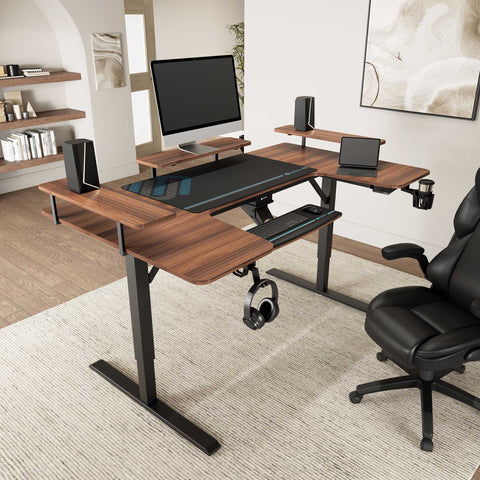
The L-Shaped Standing Desk with Accessories Set (60"x23") is an example where an integrated slide-out keyboard tray, CPU holder, and storage help redistribute weight, while the corner leg geometry and dual motors support a more stable multi-zone layout than a single-column corner add-on.
5.3 Height, sit-stand rhythm, and movement
Stability is also influenced by how you use the desk during the day.
- The Cornell University Ergonomics Web recommends a “20-8-2” rhythm—for every 30 minutes, sit for 20, stand for 8, and move for 2.
- The World Health Organization’s 2020 guidelines emphasize reducing sedentary time and regularly interrupting long static periods but clarify that simply standing is not a replacement for physical activity.
From a stability perspective, alternating positions throughout the day keeps you working near the mid-height range more often and reduces the time spent at extreme heights where wobble is most noticeable.
6. Pro Tips and Expert Warnings for 2026 Frame Buyers
Pro Tip: Use a simple “push test” before committing
Before you deploy a frame across a team—or commit to a complex home setup—perform a short, standardized test:
- Place a known weight (e.g., a 25 lb / 11 kg plate) near the back center of the desk.
- Set the desk to three heights: seated (~29"), working stand (~40–42"), near max height.
- At each height, apply a steady lateral push of about 5–10 N (roughly the force of a firm one-handed shove) at the front edge.
- Observe how far the edge moves and how long it oscillates.
- Repeat with a heavier, off-center load if you plan to use triple-monitor arms or a heavy tower.
Desks that barely move at 40–42" with this test but begin to sway at near-max height are usually suitable for most users, especially if loads stay reasonably centered.
Expert Warning: Quick-fix stabilizers can cause new problems
A frequent reaction to wobble is to clamp on aftermarket stabilizers, longer feet, or deep crossbars. Retrofit guides from several hardware suppliers caution that:
- Clamp-on crossbars often only reduce side-to-side racking, not front–back rocking.
- Over-tightening clamps around leg columns can deform the steel and worsen glide performance.
- Extending feet or adding rigid wall anchors increases pressure on the floor, which can crush carpet padding, dent soft wood, or crack brittle tile, especially when bearing pressures climb into the 3–4 kN/m² range under concentrated foot corners.
Use these add-ons carefully and always within the compatibility and torque limits given by the manufacturer. Whenever possible, prioritize a frame that is stable by design—with adequate foot length, robust connection hardware, and a suitable desktop—over heavy-handed retrofits.
7. Optimizing the Whole Workstation Around a Stable Frame
A stable frame is only one component of a productive, ergonomic workstation for the new year. The rest of the setup should support neutral posture and efficient movement.
7.1 Dial in monitor, keyboard, and mouse placement
According to the OSHA neutral working posture guide,:
- Elbows should stay close to the body, bent roughly 90–120°.
- Wrists should remain straight, not bent up, down, or sideways.
- The top of the monitor screen should be at or slightly below eye level, and at about an arm’s length away.
If desk height alone does not put your keyboard in a comfortable range, a pull-out keyboard tray can help. A dedicated tray, such as the Pull-out Keyboard Tray, lets you:
- Fine-tune typing height without raising the entire desk.
- Keep the main surface clearer, so heavy monitors stay closer to the leg line, which improves stability by shortening the lever arm.
7.2 Keep the surface streamlined for focus and stability
For New Year productivity goals, treat desk stability and visual clarity as partners:
- Group heavy items near the column line or above crossbars.
- Route cables along the frame instead of letting them hang, which can tug on the top when you change height.
- Avoid stacking items on the very front edge, which both increases leverage and invites accidental bumps.
If you want a deeper dive into how layout and equipment choices affect day-to-day performance, see the guide on Setting Up Your Standing Desk for Peak Productivity. For more health-focused context on why reducing sitting time matters, the article on using a standing desk to fight a sedentary life provides additional perspective.
7.3 Matching frame choice to your 2026 goals
When choosing a frame and complete desk in 2026, align key specs with your actual workload and upgrade plans:
- Single-screen laptop users – A compact T-frame with a solid top and no crossbar may be entirely sufficient; prioritize smooth, quiet travel and decent weight capacity.
- Dual / triple-monitor professionals – Look for T-frames or trapezoidal/L-shaped designs with crossbars, dual motors, and thicker tops; prioritize wide stance and documented stability with eccentric loads.
- Gamers and creators with heavy peripherals – Favor wide-wing or L-shaped desks designed for higher loads, with thoughtful accessory integration (headphone hooks, CPU mounts, trays) that help keep heavy items close to the frame.
- B2B and shared offices – Consider frames with clear references to BIFMA, ISO, or UL 962 testing in their documentation, especially for high-use hot-desking or multi-shift environments.
For a focused discussion on how frame type compares with fixed-height desks in terms of stability, the article on Desk Stability: Standing vs. Fixed-Height Desks explores comparative behaviors in more detail.
Key Takeaways for 2026 Sit-Stand Frame Decisions
- Stability is a system property. Frame geometry, desktop stiffness, motor quality, load placement, and assembly all matter. A thicker, denser top can reduce edge deflection by 30–50% even on the same frame.
- Frame geometry beats jargon. Long feet, wide stance, and well-braced connections usually matter more than whether a brochure calls it a T-frame or C-frame.
- Dual motor ≠ guaranteed stability. Glide tolerances, synchronization, and column design often dominate motor count in determining when wobble appears.
- Eccentric loads are the silent culprit. Many desks that feel solid with centered loads start to wobble once heavy monitors or towers are pushed to corners.
- Assembly and maintenance are critical. Correct torque sequencing, re-tightening after break-in, and smart load placement can reduce perceived wobble dramatically.
- Ergonomics and stability reinforce each other. Keeping equipment near the leg line, using trays and risers intelligently, and following evidence-based sit-stand rhythms improves both comfort and desk behavior.
Approach your 2026 workstation upgrade with these principles and you can confidently choose a sit-stand desk frame that supports your productivity goals—with fewer surprises once your real equipment is in place.
Disclaimer
This article is for informational and educational purposes only and does not constitute medical, safety, or legal advice. Ergonomic needs and health conditions vary widely between individuals. Before making significant changes to your workstation, sit-stand routine, or physical activity, consult a qualified healthcare or ergonomics professional, especially if you have existing musculoskeletal, cardiovascular, or other health concerns.
References
- BIFMA G1-2013 Ergonomics Guideline for Furniture
- OSHA eTools: Computer Workstations – Desks
- OSHA eTools: Computer Workstations – Neutral Working Postures
- Cornell University Ergonomics Web – Ergonomic Guidelines
- CCOHS – Office Ergonomics: Sit/Stand Desks
- WHO 2020 Guidelines on Physical Activity and Sedentary Behaviour
- BIFMA Standards Overview
- UL 962 – Safety of Height-Adjustable Desks (overview)
- Desktop Thickness & Desk Stability: Your Guide to a Sturdy Desk




Leave a comment