

Why does your lower back ache after a morning of intense UI design? Why do you find yourself hunched over your drawing tablet by 3:00 PM, despite starting the day with "perfect" posture? For professional designers and content creators, the "lean-in" is a natural part of the creative process. Whether you are adjusting Bezier curves, color-grading a cinematic sequence, or sketching on a Wacom, the work demands close visual proximity to the screen.
The problem is that most standard office chairs are designed for a neutral, upright position that supports the spine only when the user is leaning back. When you lean forward to focus on detail, you lose contact with the backrest, leaving your lumbar spine unsupported. This leads to what ergonomists call "slouching" or "C-slumping," a posture that increases intradiscal pressure and strains the posterior ligaments.
Understanding the mechanics of the forward-tilt chair is not about following a design trend; it is about addressing the physiological realities of creative work. By allowing the seat pan to tilt slightly downward, a forward-tilt mechanism helps maintain the natural curvature of the spine, even when the task requires leaning into the workstation.

The Pathophysiology of the "Designer's Lean"
To understand why forward tilt is necessary, one must look at the musculoskeletal impact of static sitting. According to the International Organization for Standardization (ISO) 11226:2000, static working postures are evaluated based on the duration and angle of the joints. For designers, the most common risk factor is prolonged spinal flexion.
When you sit in a traditional chair and lean forward, your pelvis rotates backward (posterior tilt). This rotation flattens the lumbar curve (lordosis) and forces the spine into a convex shape. This "static load" restricts blood circulation to the spinal discs and places excessive force on the lower vertebrae. Over time, this can lead to Work-related Musculoskeletal Disorders (MSDs), a condition the U.S. National Institute for Occupational Safety and Health (NIOSH) defines as injuries of the muscles, nerves, tendons, and supporting structures.
The "23.5° spinal flexion angle" often cited in biomechanical studies represents a critical threshold where spinal load increases significantly. While some research suggests that forward-tilt chairs can mitigate this, it is important to note that these findings are often based on specific measurement points and may not account for the diverse body types found in a global design team. However, the fundamental principle remains: maintaining a neutral spinal position is the primary defense against chronic pain.
The Mechanism of Forward Tilt: Rotating the Pelvis
The core solution to the "lean-in" problem is the forward-tilt mechanism. Unlike a standard tilt that only allows the chair to rock backward, a forward-tilt function allows the seat pan to angle downward, typically between 5 to 10 degrees.
This subtle adjustment triggers a vital biomechanical shift. By lowering the front of the seat, the chair encourages the pelvis to rotate forward (anterior tilt). This rotation preserves the natural S-curve of the spine, even when the torso is inclined toward the desk. Effectively, the chair "follows" the user into their work, providing a continuous foundation of support.
As noted in the BIFMA G1-2013 Ergonomics Guideline for Furniture, furniture should accommodate the 5th to 95th percentile of the population. For a designer, this means the chair must be adjustable enough to support both a deep recline during a brainstorming session and a forward-leaning posture during intensive execution.

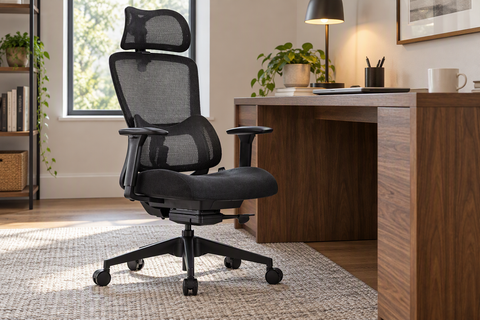
The Lira, Ergonomic Office Chair is a prime example of this logic. Its design focuses on smart adjustability, allowing the seat and backrest to move in a way that supports the user's dynamic shifts. This is particularly valuable for designers who alternate between typing, drawing, and reviewing work on secondary monitors.
The "Glass Box" Experiment: Quantifying the Workspace Deficit
To illustrate the importance of integrated ergonomics, we simulated the workstation requirements for a Tall Male Designer (190cm / 6'3"). Taller individuals often face a "mismatch" with standard furniture that exacerbates the need to hunch.
Table 1: Height Analysis for a 190cm Designer
| Metric | Calculated Ideal | Standard Fixed Furniture | Deficit/Mismatch |
|---|---|---|---|
| Seat Height | 50.0 cm | 45.0 cm | -5.0 cm |
| Seated Desk Height | 78.5 cm (30.9") | 73.7 cm (29.0") | -1.91 inches |
In this scenario, a standard 29-inch desk creates a nearly 2-inch height deficit. To compensate, the designer must either sit too low (straining the hip flexors) or hunch forward to reach the keyboard and tablet. This height mismatch is a primary driver of the very slouching that a forward-tilt chair aims to correct. Without a height-adjustable desk to complement the chair, the benefits of the forward-tilt mechanism are partially neutralized.
For a deeper look at how frame construction supports different body types, see our guide on Why Frame Construction Matters Most for Big & Tall.
Stability and Load: Why the Desk Matters for Creatives
A designer's workstation is rarely just a laptop. It often includes multiple ultrawide monitors, a PC tower, graphics tablets, and high-fidelity speakers. This creates a significant "static load" on the desk itself.
In our simulation, a professional setup (three 34" monitors, mid-tower PC, peripherals) totaled 54.5 kg. When combined with the weight of a heavy tabletop (20 kg), the system load reaches 74.5 kg.
Table 2: Desk Motor Capacity & Utilization
| Feature | Single-Motor Desk (80kg Limit) | Dual-Motor Desk (120kg Limit) |
|---|---|---|
| Load Utilization | 93.1% (High Risk) | 62.1% (Optimal) |
| Stability Impact | Possible motor strain / wobble | Smooth, stable transitions |
| Longevity | Reduced lifespan under max load | High durability for active users |
For a designer engaged in precise drawing, even a millimeter of "wobble" during a height transition or while leaning on the desk can disrupt the creative flow. A dual-motor system is recommended not just for the weight capacity, but for the stability required to maintain a precise ergonomic setup. This ensures that when you switch from sitting to standing—a practice recommended by the World Health Organization (WHO) to reduce sedentary time—the transition is seamless.
Integrating the Solution: The Forward-Tilt Ecosystem
A forward-tilt chair does not work in isolation. To achieve a truly Ergonomic Workstation Blueprint, you must align the chair, the desk, and the monitors.
1. The Role of the Chair
The Exis,Ergonomic Office Chair features 4-level adjustable lumbar support and a 3D armrest system. When using the forward-tilt function, the adjustable lumbar support becomes critical; it must be positioned to fill the gap created as your torso moves forward.

2. The Necessity of Monitor Arms
When you tilt the seat forward, your head naturally moves closer to the screen. If your monitors are fixed in place, you may find yourself tilting your head upward to see the top of the display, causing neck strain. Pairing the chair with a Single Monitor Arm allows you to lower and pull the screen toward you, maintaining a neutral neck position. According to OSHA eTools for Monitors, the top line of text should be at or slightly below eye level to minimize visual and cervical fatigue.

3. The Starter Option
For those just beginning to optimize their creative space, the Onyx, Ergonomic Office Chair offers essential lumbar support and breathable mesh. While it may lack the complex forward-tilt mechanisms of high-end models, it provides the foundational "neutral position" support required for general office tasks.
Practical Recommendations for Designers
Adopting a forward-tilt chair requires a change in habits. It is not a "set and forget" feature.
- The 5-10 Degree Rule: Use the forward tilt at a modest angle. Tilting too steeply can cause you to slide forward, putting unnecessary pressure on your knees and shins.
- Intermittent Use: Forward tilt is most effective when used for 20-30 minute bursts of "detail work." You should alternate this with an upright, neutral posture to prevent static muscle fatigue.
- The 20-8-2 Rhythm: Follow the Cornell University Ergonomics recommendation: 20 minutes of sitting, 8 minutes of standing, and 2 minutes of moving/stretching.
- Armrest Alignment: When leaning forward, adjust your armrests inward and upward. This supports the weight of your arms while you use a tablet or keyboard, reducing the load on your trapezius muscles.
Addressing the Friction Points
While forward-tilt chairs offer significant benefits, there are "gotchas" that users should be aware of. Integrating robust tilt mechanisms increases engineering complexity by 30-50%. This often translates to a heavier chair and more maintenance points. Furthermore, users with specific conditions like hip impingement or limited hip mobility should use forward tilt with caution, as the enforced lean can cause discomfort in the hip joint.
As noted in the HSE guide on working with display screen equipment, a workstation is only as good as its setup. Even the most expensive chair cannot fix a monitor that is too high or a desk that is too low.
Sustaining Creativity Through Science
For the professional designer, ergonomics is a tool for longevity. By understanding the physiological principles of the "neutral position" and the benefits of forward-tilt mechanisms, you can create a workspace that supports your creativity rather than hinders it.
Investing in a chair like the Lira, Ergonomic Office Chair or the Exis,Ergonomic Office Chair is a commitment to your musculoskeletal health. When paired with a stable, dual-motor desk and adjustable monitor arms, these tools allow you to focus on what matters most: the work on the screen.
YMYL Disclaimer: This article is for informational purposes only and does not constitute professional medical advice. If you have pre-existing musculoskeletal conditions, chronic back pain, or hip issues, please consult a qualified physiotherapist or ergonomic specialist before making significant changes to your workstation setup.
References
- BIFMA G1-2013 Ergonomics Guideline for Furniture
- CCOHS: Office Ergonomics - Sit/Stand Desk
- ISO 11226:2000 Evaluation of static working postures
- OSHA eTools: Computer Workstations - Neutral Working Postures
- Cornell University Ergonomics Web — Workstation Guides
- WHO 2020 Guidelines on Physical Activity & Sedentary Behaviour




Leave a comment