

Professional video editing is a discipline of high-stakes precision and extreme sedentary duration. Unlike general office work, the act of scrubbing through a timeline, color grading, and managing complex motion graphics requires a level of visual focus that often dictates physical posture. For many editors, the workday ends not with a sense of creative accomplishment, but with a dull, persistent ache in the lower back. This phenomenon is frequently dismissed as an inevitable byproduct of the job, yet it is often the result of a fundamental mismatch between human biomechanics and workstation configuration.
The misconception that a high-priced "ergonomic" chair is a universal cure-all often leads to frustration. In reality, the efficacy of lumbar support is not merely a feature of the furniture; it is a function of how that furniture interacts with the specific, often non-standard, postures of a video editor. Understanding the physiological principles behind spinal health is the first step toward building a sustainable editing environment.
The Biomechanics of the "Timeline Lean"
The human spine is naturally curved in an "S" shape. The inward curve of the lower back, known as lumbar lordosis, is essential for distributing the weight of the upper body and absorbing mechanical stress. When an editor sits, the pelvis tends to tilt backward, which flattens this natural curve. This transition from a lordotic (curved) to a kyphotic (flattened or rounded) posture increases intervertebral disc pressure significantly.
Research indicates that static sitting can increase pressure on the lumbar discs by up to 40% compared to standing. For video editors, this issue is exacerbated by the "forward lean." During precise timeline work or detailed masking, editors instinctively move closer to the screen. This shift renders most static lumbar supports—such as fixed cushions or rigid chair backs—completely ineffective, as the lower back loses contact with the support mechanism.
According to the Occupational Safety and Health Administration (OSHA) eTools on Computer Workstations, maintaining a "neutral posture" is critical. This involves keeping the joints naturally aligned to reduce stress on muscles, tendons, and the skeletal system. When an editor leans forward, they break this neutrality, placing a "static load" on the muscles of the lower back and neck. Over time, this leads to Work-related Musculoskeletal Disorders (WMSDs), characterized by chronic pain and reduced mobility.
The Tall Editor’s Dilemma: A Case Study in Ergonomic Deficit
To understand the limitations of standard equipment, consider the ergonomic requirements of a professional editor in the 95th percentile of height (approximately 190cm or 6'3"). Most mass-market furniture is designed for the 5th to 95th percentile range, but the extreme ends of this spectrum often face significant "ergonomic deficits."
In a theoretical analysis of a tall editor using a standard 38-inch ultrawide monitor and a typical 29-inch high desk, several critical failures emerge.
Table 1: Ergonomic Gap Analysis for a 190cm (6'3") Video Editor
| Metric | Ideal Requirement | Standard Desk (29") | Deficit / Impact |
|---|---|---|---|
| Desk Height (Seated) | 78.5 cm (30.9") | 73.7 cm (29") | -4.8 cm: Forces hunching or lowering the chair, which compresses the lumbar curve. |
| Viewing Distance | 165.6 cm (65.2") | 61.0 cm (24") | -104.6 cm: Forces a massive forward lean to see details, breaking lumbar contact. |
| Seat Height | 50.0 cm (19.7") | Variable | If raised to meet the desk, feet may dangle, cutting off circulation (ischemia). |
| Lumbar Position | L3 - L5 Vertebrae | Fixed / Low | Often hits the sacrum instead of the lumbar curve on taller frames. |
Note: Values are estimated based on standard industry ergonomic calculators and anthropometric data for the 95th percentile male.
This data demonstrates that for a tall professional, a standard desk height is a primary source of lumbar strain. The height deficit forces the user into a "C-shaped" spine, increasing disc pressure. Furthermore, the viewing distance crisis—caused by shallow desk depths—forces a forward head posture that cascades down the kinetic chain, ultimately flattening the lumbar curve.
Engineering the Solution: Beyond the Standard Chair
Addressing these issues requires a multi-faceted approach that combines high-performance hardware with behavioral interventions. The goal is to facilitate "dynamic sitting"—a state where the equipment supports the body through various ranges of motion rather than forcing it into a single, static position.
1. Dynamic Lumbar Mechanisms
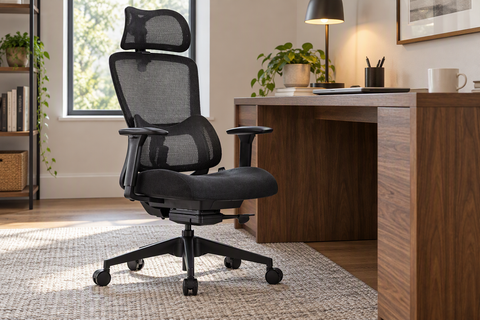
For editors who shift between reclining for playback and leaning forward for editing, a chair with an independent, auto-following lumbar mechanism is essential. Unlike a simple pillow, these mechanisms adjust their depth and angle in real-time. This ensures that even during a slight forward lean, the support maintains contact with the L3-L5 vertebrae, preserving the inward curve of the spine.
2. The Role of the Height-Adjustable Desk
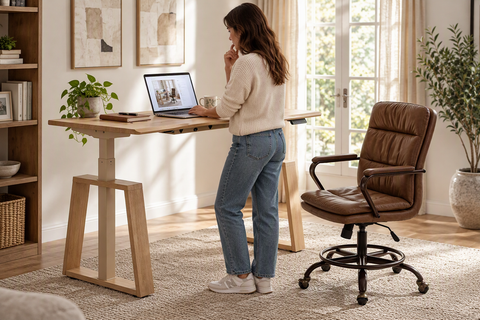
A height-adjustable desk is not just a tool for standing; it is a tool for precision seated ergonomics. As shown in the gap analysis, even a two-inch difference in desk height can be the difference between a neutral spine and a chronic ache. By fine-tuning the desk height to match the editor's specific torso length, the need to hunch is eliminated.
According to a systematic review by Cochrane: Workplace interventions for reducing sitting at work, sit-stand desks can significantly reduce sitting time by 84 to 116 minutes per day. While standing is not a substitute for exercise, it serves as a "reset" for the lumbar discs, allowing them to rehydrate and reducing the static load on the lower back.
3. Optimizing Peripheral Placement
The position of the keyboard and mouse directly influences the position of the shoulders and, by extension, the lower back. If the keyboard is too high, the editor must shrug their shoulders, which creates tension in the trapezius and upper back. This tension often causes the editor to shift their pelvis to compensate, ruining their lumbar alignment.
Using a Pull-out Keyboard Tray allows for the keyboard to be positioned at an "elbow-neutral" height, even if the desk surface is higher to accommodate large monitors. This helps keep the editor's back firmly against the chair's lumbar support.

The "90-90-90" Rule vs. The Reality of Editing
The traditional "90-90-90" rule suggests that the ankles, knees, and hips should all be at 90-degree angles. While this is a useful baseline, it does not account for the micro-movements required during a 10-hour edit.
Professional ergonomists suggest the "Dynamic Fit" test:
- Adjust Lumbar Depth: While in your typical "editing lean," adjust the lumbar support until you feel gentle, even pressure. It should not feel like a hard lump, but rather a firm cradle.
- The Thoracic Check: Ensure the support is not hitting your shoulder blades (thoracic spine). It should target the natural "small" of your back.
- Leg Positioning: Use an Adjustable Ergonomic Footrest to alternate leg positions. Elevating the feet slightly can tilt the pelvis into a more favorable position for lumbar support.
For those who require even more mobility, a Footstool with Wheels can be integrated into the setup. This allows the editor to frequently change the angle of their hips, which prevents the hip flexors from becoming tight—a common cause of lower back pain known as "Lower Crossed Syndrome."

Practical Recommendations for the Edit Suite
To build a high-performance environment that adheres to the principles outlined in The 2026 Workstation White Paper: Converging Ergonomic Science and Sustainable Engineering, editors should follow a structured setup protocol.
Establish the Correct Monitor Height
The Canadian Centre for Occupational Health and Safety (CCOHS) recommends that the top line of text on a monitor should be at or slightly below eye level. For editors using large ultrawide screens, this is vital. If the monitor is too low, the editor will drop their head, leading to "text neck" and a collapsed lumbar curve. Using Convertible Desktop Shelves can help raise secondary monitors to the correct height without cluttering the primary workspace.

The Cornell 20-8-2 Rhythm
Cornell University’s Ergonomics Web suggests a specific sit-stand-move rhythm:
- 20 Minutes Sitting: In a neutral, supported posture.
- 8 Minutes Standing: To encourage blood circulation and disc decompression.
- 2 Minutes Moving: Stretching or walking to engage different muscle groups.
This rhythm is particularly effective for editors because it aligns with the natural "breaks" in creative focus—such as waiting for a render or reviewing a short clip.
Checklist for Lumbar Health
- Chair Standard: Ensure the chair meets ANSI/BIFMA X5.1 standards for safety and durability.
- Lumbar Placement: The support should be located at the level of the belt line, supporting the five lumbar vertebrae.
- Armrest Flexibility: 4D armrests should support the forearms without pushing the shoulders up, allowing the editor to sit close to the desk without losing lumbar contact.
- Seat Depth: There should be a 2-3 inch gap between the edge of the seat and the back of the knees to prevent circulatory restriction.
The Impact of Improved Ergonomics
Investing in professional-grade ergonomic equipment is not merely a matter of comfort; it is a strategic decision for career longevity. Chronic back pain is a leading cause of early retirement and reduced productivity in the creative industries. By implementing engineering controls—such as height-adjustable desks and dynamic lumbar chairs—editors can reduce the risk of debilitating MSDs.
While the initial setup requires a meticulous approach to measurements and standards, the long-term ROI is found in sustained focus and the absence of chronic pain. As the industry moves toward higher-resolution timelines and longer production cycles, the workstation must evolve from a simple desk into a sophisticated support system for the human frame.
YMYL Disclaimer: This article is for informational purposes only and does not constitute professional medical advice, diagnosis, or treatment. Always seek the advice of a physician or other qualified health provider with any questions you may have regarding a medical condition or musculoskeletal pain. The ergonomic recommendations provided are based on general industry standards and may not be suitable for individuals with pre-existing spinal conditions.
References
- BIFMA G1-2013 Ergonomics Guideline for Furniture
- CCOHS: Office Ergonomics - Sit/Stand Desk
- Cochrane: Workplace interventions for reducing sitting at work (2018)
- Cornell University Ergonomics Web — Workstation Guides
- ISO 9241-5:2024 Workstation layout & postural requirements
- OSHA eTools: Computer Workstations - Neutral Working Postures
- ANSI/BIFMA X5.1 General-Purpose Office Chairs




Leave a comment