

The Unseen Factor: Why Desk Depth is Crucial for Your Well-being
When setting up a workstation, most people focus on the most obvious elements: the chair's lumbar support, the height of the desk, and the mechanical keyboard. However, one of the most critical yet frequently overlooked ergonomic factors is desk depth. Far more than just a surface for holding your equipment, desk depth directly dictates your monitor viewing distance—a key variable for eye health and spinal posture.
An incorrect viewing distance forces your body to constantly compensate. If your monitor is too close, you risk digital eye strain and persistent headaches. If it is too far, you will naturally lean forward, craning your neck into an awkward position that ergonomists call forward head posture. This subtle habit places massive strain on the cervical spine and upper back, accelerating the risk of Musculoskeletal Disorders (MSDs).
This guide breaks down the science behind monitor viewing distance and provides a clear, practical framework for selecting a desk depth that safeguards your health and sharpens your daily focus.
The Science of Sight: Why Viewing Distance Matters
Ergonomics centers on designing workspaces to fit the human body—not forcing the body to adapt to improper setups. A foundational rule of workstation design is maintaining a neutral posture, where your joints remain naturally aligned and your muscles avoid static load. The physical distance between your eyes and your screen serves as the anchor for this alignment.
The Ergonomic Foundation of Viewing Distance
According to the U.S. Occupational Safety and Health Administration (OSHA), a monitor should be placed at a distance that allows you to read text clearly without leaning forward or tilting your head back. While straightforward in theory, achieving a truly "comfortable distance" relies on specific biomechanical ranges. The ideal setup lets your eye muscles relax while keeping your head balanced directly over your spine.
When a monitor sits too far away, the instinct is to jut the chin forward to bring small text into focus. This disrupts the natural S-curve of your spine, forcing the trapezius and neck muscles to carry extra upper-body weight. Over time, this leads to chronic tension, stiffness, and postural imbalances. Conversely, positioning a display too close overworks your eyes' ciliary muscles, triggering rapid eye fatigue, dryness, and severe focus strain.
The Link to Musculoskeletal Health
Work-related Musculoskeletal Disorders (MSDs) involve severe stress on muscles, nerves, tendons, and spinal discs. As reported by the U.S. National Institute for Occupational Safety and Health (NIOSH), MSDs are frequently caused or aggravated by static load and sustained awkward postures. Suboptimal monitor viewing distance is a leading culprit behind chronic neck, shoulder, and upper back discomfort in desk-bound workers.
Choosing a desk with appropriate depth establishes a default layout where healthy viewing distance happens automatically. Rather than constantly reminding yourself to sit back, your workspace design naturally preserves your physical well-being.

How to Determine Your Ideal Desk Depth
Selecting the right desk depth isn't about buying the largest desk your room can fit; it's about matching the surface area to your specific monitors, accessories, and workflow. The objective is to leave enough depth to position your screens correctly while keeping your keyboard and mouse comfortably within arm's reach.
The "Arm's Length" Rule: A Practical Starting Point
A classic rule of thumb in office ergonomics is the arm's length test. Sit upright in your natural working position and extend one arm straight out in front of you. The tip of your middle finger should just graze the screen of your monitor. For most adults, this places the monitor roughly 20 to 40 inches (50 to 100 cm) away. Because arm length corresponds with height, this simple test automatically scales to your body proportions.
However, display size and resolution also dictate optimal placement. Larger, high-resolution screens can (and should) sit further away without compromising text legibility. A refined ergonomic formula recommends a viewing distance of 1.0 to 1.5 times the screen's diagonal measurement. For instance, a 27-inch display is best positioned approximately 27 to 40 inches away from your eyes.
Matching Desk Depth to Your Workstation
To guarantee ideal viewing conditions, choose a desk depth tailored to your display hardware:
| Use Case | Monitor Setup | Recommended Desk Depth |
|---|---|---|
| Compact Workspace | Single monitor (up to 24 inches) or laptop | 24 inches (approx. 60 cm) |
| Standard Professional | Single monitor (27–32 inches) or dual monitors (up to 24 inches) | 30 inches (approx. 75 cm) |
| Power User / Creator | Multi-monitor arrays, ultrawide displays, or drawing tablets | 36+ inches (approx. 90 cm) |
A 24-inch desk depth functions adequately for laptops or small screens, but easily becomes cramped with modern 27-inch+ displays. A 30-inch depth serves as the ideal, versatile standard for modern setups, giving you room for large displays without forcing poor posture. For creative professionals using graphic tablets or massive multi-monitor arms, a 36-inch surface provides the required clearance.
Common Misconceptions and Pitfalls
Even with a generously sized desk, improper layout choices can negate your ergonomic setup. Avoiding these common mistakes will help you maximize your workspace potential.
Myth Debunked: Deeper Desks Are Always Better
A common misconception is that a deeper desk automatically solves viewing distance issues. However, extra desk space can introduce new ergonomic errors. Users with 30-inch or 36-inch deep desks frequently push their monitors all the way against the back wall or edge. This places the display beyond the user's focal range, forcing them to hunch forward to read screen content—completely defeating the purpose of a deep surface.
The Fix: Pull the monitor forward to match your personal arm's length range. Utilize the empty space behind the display for cable management boxes, ambient lighting, or monitor arm clamps.
Common Mistake: Ignoring Sit-Stand Dynamics
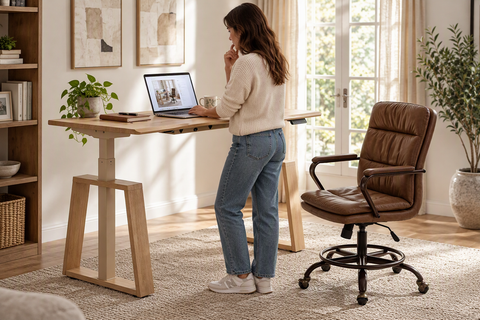
Another frequent oversight occurs when transitioning between sitting and standing modes on height-adjustable desks. Body position, foot stance, and eye angles shift when standing, often causing users to stand slightly further back from the desk edge than when seated.
It is vital to check and re-adjust viewing distance in both standing and sitting configurations. Taking time to fine-tune your monitor position ensures seamless posture alignment—a core theme covered in our guide on setting up your standing desk for peak productivity.

Advanced Setups and Solutions
Specialized workflows often demand refined monitor control that goes beyond standard desk surfaces alone.
The Power of Monitor Arms
An adjustable monitor arm is one of the single most impactful ergonomic investments you can make. By decoupling the display from its stock factory stand, a monitor arm gives you independent control over height, depth, and tilt. On a 36-inch deep desk, a monitor arm allows you to effortlessly pull the screen forward to an exact 28-inch viewing distance for typing, then push it clear to the back when reviewing paper blueprints or sketching.
Scenario-Based Recommendations
- For Gamers: Competitive gamers often prefer a closer viewing distance (0.8 to 1.0 times screen diagonal) for maximum peripheral immersion. While fine for short play sessions, consider extending the screen back during long gaming marathons to relieve visual fatigue.
- For Content Creators: Illustrators and video editors using external control surfaces, audio interfaces, or pen displays need extra surface depth. A 36-inch deep desk ensures accessories fit in front of monitors without crowding forearms.
- For Modern Home Offices: Most remote professionals require a balanced footprint. A desk featuring a 27-to-30-inch depth—such as the Ark Executive Standing Desk (63"x29")—delivers ample room for dual-monitor arms while remaining proportional within residential spaces.
Your Quick Adjustment Checklist
Follow this quick step-by-step audit to optimize your screen distance and body alignment today:
- Establish Body Posture First: Adjust your chair height until your feet rest flat on the floor with knees bent at a 90-degree angle. If standing, keep your feet shoulder-width apart and knees un-locked.
- Set Desk & Keyboard Height: Adjust desk height until your forearms rest parallel to the floor with your elbows bent at roughly 90 degrees while typing.
- Position Monitor at Arm's Length: Extend your arm straight ahead. Shift the screen forward or backward until your fingertips lightly touch the glass.
- Calibrate Eye Level: Ensure the top edge of the monitor screen sits at or slightly below eye level. As emphasized by Cornell University's Ergonomics Web, this promotes a comfortable downward viewing angle of 10 to 20 degrees, reducing eyelid exposure and neck extension.
- Verify Sit-Stand Presets: Test the placement while seated and standing. Save your preferred heights into your desk's memory controller for consistency.
Key Takeaways
Selecting the right desk depth is far more than a spatial decision—it is a core health choice that affects your posture, vision, and daily fatigue levels. Designing your desk surface to support natural viewing distance keeps productive posture effortless.
Summary Guidelines:
- Prioritize Viewing Distance: Proper placement shields your eyes from digital strain and prevents forward head posture.
- Start with Arm's Length: Position your screen approximately an arm's length away, scaling outward for larger displays.
- Match Desk Depth to Gear: Choose 24 inches for compact setups, 30 inches for standard multi-monitors, and 36+ inches for heavy creation setups.
- Avoid Pushing Displays Too Far: Don't shove monitors against the back edge of deep desks; keep screens within your natural focal range.
Taking a deliberate approach to desk depth ensures your workstation actively supports your health, focus, and long-term productivity.
Frequently Asked Questions (FAQ)
Is a 24-inch deep desk enough for a home office?
A 24-inch (60 cm) desk works in compact spaces or for simple laptop setups. However, if you use a 27-inch monitor or larger, a 24-inch surface will feel crowded and may force the screen too close to your eyes. A 27-to-30-inch desk depth is recommended for full-sized desktop setups.
How do I know if my monitor is too close or too far?
If your monitor is too close, you may suffer from eye fatigue, dry eyes, blurred vision, or headaches. If it is too far, you will find yourself leaning forward, squinting, or craning your neck, leading to upper back and shoulder soreness.
Do I really need a monitor arm?
While not mandatory, a monitor arm offers unmatched ergonomic control. It frees up valuable desktop real estate, prevents monitor stand clutter, and allows you to micro-adjust screen depth and height in seconds—making it ideal for sit-stand desks and deep surfaces.
Disclaimer: This article is for informational purposes only and does not constitute professional medical advice. If you suffer from pre-existing musculoskeletal conditions or chronic eye strain, please consult a qualified healthcare professional or certified ergonomist.




Leave a comment