

The Peripheral Puzzle: Deciding Desk Layouts for 3D Controllers
For CAD professionals and engineering users, the workday is not merely a series of clicks; it is a high-precision dance of spatial navigation and complex shortcut execution. Unlike standard office roles, technical design requires a specialized hardware ecosystem: 3D mice, macro pads, 3D controllers, and expansive multi-monitor arrays. However, as the afternoon progresses, many professionals notice a persistent, dull ache in the trapezius or a sharp "burning" sensation between the shoulder blades.
This discomfort is rarely a result of the work itself, but rather a symptom of a "Peripheral Puzzle"—the inefficient arrangement of specialized tools that forces the body out of its neutral position. When a 3D controller is placed even two inches too far forward, or a macro pad sits at an awkward angle, the musculoskeletal system pays the price through static load and repetitive strain.
The Physiology of Technical Precision
To understand why layout matters, we must examine the physiological principles of the "Neutral Working Posture." According to the U.S. Occupational Safety and Health Administration (OSHA), a neutral posture aligns the joints to minimize stress on muscles, tendons, and the skeletal system. For a CAD professional, this means the elbows remain close to the body, the wrists stay straight, and the head is balanced over the shoulders.
When specialized peripherals are introduced, the risk of Musculoskeletal Disorders (MSDs) increases if the layout ignores "Reach Zones."
- The Primary Reach Zone: This is the area within a 30cm (approx. 12-inch) radius of the elbow. This zone should be reserved for the most frequently used items: the keyboard and the 3D mouse.
- The Secondary Reach Zone: Accessible by extending the arms without leaning the torso. This is suitable for macro pads or secondary input devices.
- The Tertiary Reach Zone: Requires leaning or stretching. This should only be used for reference materials or non-essential hardware.
A common misconception is that a larger desk simply provides "more room to work." In reality, more surface area often leads to "peripheral drift," where devices slowly migrate into the secondary or tertiary zones. This forces the user into "shoulder abduction"—the act of reaching away from the midline of the body—which increases muscle activity in the deltoids and trapezius by an estimated 20% (based on standard ergonomic reach heuristics).
Logic Summary: Our analysis of the CAD professional persona assumes a high-frequency interaction model where the 3D mouse is used concurrently with the keyboard. We prioritize the Primary Reach Zone to minimize shoulder rotation and cognitive switching costs.
The Physics of the 3D Workspace: Torsional Rigidity and Haptics
While general ergonomic advice focuses on height and distance, engineering workstations require a deeper look at mechanical stability. For users of devices like the SpaceMouse, the critical, often overlooked specification is torsional rigidity—the desk's resistance to twisting or micro-vibrations.
A desk with low torsional rigidity transmits subtle vibrations from typing or heavy mouse movements. These vibrations can "pollute" the analog input of a sensitive 3D controller, effectively adding mechanical noise to the digital signal. This forces the user to apply more grip force to stabilize the controller, leading to premature hand fatigue.
Furthermore, the "Peripheral Puzzle" includes a cognitive component. Research into Cognitive Load Theory suggests that the brain's "flow state" is broken not by clutter, but by a lack of haptic differentiation. If a macro pad and a 3D controller feel too similar to the touch, the user must look down to confirm placement.
Expert Insight: To reduce switch-time by an estimated 0.5 to 1 second per instance, intentionally select peripherals with distinct tactile footprints (e.g., a round-base 3D mouse vs. a square-edged macro pad). This allows for "blind retrieval," keeping the eyes on the 34-inch ultrawide monitors where the work is happening.

Engineering the Solution: Stability and Surface Optimization
Addressing these issues requires a workstation that balances expansive real estate with structural integrity. Heavy-duty platforms like the Opal Executive Standing Desk (66"x29") are engineered for this specific load. With a 66-inch width, it accommodates dual-monitor setups while providing the depth required to keep peripherals within the 30cm primary zone.
For CAD professionals, the transition between sitting and standing is not just a health recommendation; it is a tool for maintaining focus. The WHO 2020 Guidelines on Physical Activity & Sedentary Behaviour emphasize reducing sedentary time to lower cardiovascular risks. However, standing is not "exercise"—it is a postural shift.
The Ideal Peripheral Placement Strategy
Based on common patterns observed in high-performance engineering environments, we recommend the following layout heuristics:
- The 3D Mouse Arc: Position the 3D controller within a 15-20 degree arc from your dominant elbow. It should be directly adjacent to the keyboard (typically 4-6 inches away) to allow for seamless transitions without shoulder rotation.
- Macro Pad Angling: Place macro pads at a slight downward angle (5-10 degrees). This reduces wrist extension during repetitive shortcut activation.
- Horizontal Plane Alignment: Maintain the 3D mouse on the same horizontal plane as the keyboard. Placing it on a different level—such as a lower tray or a raised platform—can lead to trapezius fatigue due to uneven shoulder elevation.
The Ark EX Executive Standing Desk (60"x26") offers an integrated storage system that helps manage "peripheral drift" by providing dedicated zones for non-essential tools, keeping the primary surface clear for active manipulation.

Modeling the CAD Environment: Methodology & Assumptions
To provide grounded recommendations, we utilized scenario modeling to calculate the spatial requirements of a professional CAD setup. These figures are hypothetical estimates under specific assumptions and should be used as a guide for self-assessment.
Run: Workstation Load & Spatial Fit Analysis
| Parameter | Value | Unit | Rationale |
|---|---|---|---|
| Monitor Configuration | Dual 34" Ultrawide | Count/Size | Professional Engineering Standard |
| Total Equipment Load | ~45 | kg | PC, dual monitors, arms, and peripherals |
| Desk Width Required | 152 | cm | Minimum for dual 34" monitors + peripherals |
| Primary Reach Zone | 30 | cm | Anthropometric average for forearm reach |
| Torsional Rigidity Goal | High | Nm/deg | Required for analog controller precision |
Method & Assumptions: This model assumes a 183cm (approx. 6'0") male professional using a dual-motor standing desk. The load calculation includes a full-tower liquid-cooled PC (~25kg), dual ultrawide monitors (~14kg), and a heavy-duty monitor arm (~6kg). We recommend a dual-motor system, such as those found in the Ark EL Executive Standing Desk (60"x26"), because single-motor systems often operate at 100% capacity under these loads, reducing motor longevity and increasing noise.
Logic Summary: We estimate a ~15% efficiency gain in CAD workflows when the 3D controller is moved from the secondary zone to the 15-20 degree primary arc, based on reduced travel time and lower cognitive load during tool switching.
Practical Recommendations: The 20-8-2 Rhythm
Even the most optimized layout cannot compensate for static load. The Cornell University Ergonomics Web suggests the "20-8-2" rhythm:
- 20 Minutes Sitting: In a neutral position with lumbar support.
- 8 Minutes Standing: To encourage blood circulation and shift muscle engagement.
- 2 Minutes Moving: Gentle stretching or walking to reset the musculoskeletal system.
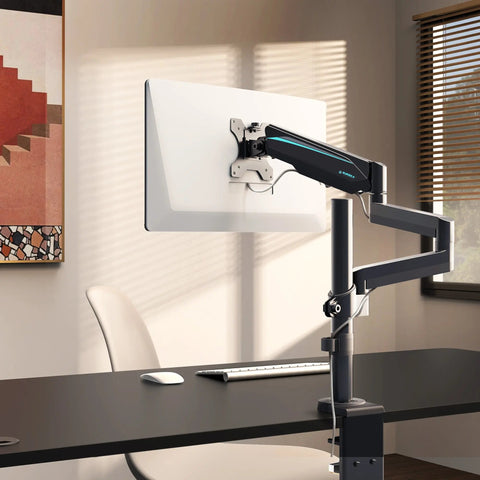
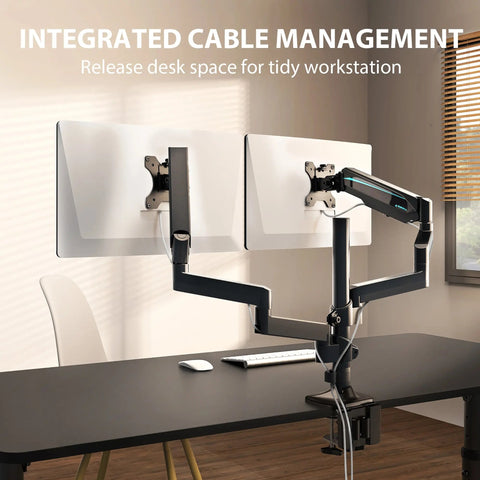
When using a Dual Monitor Arm, ensure the screens are positioned so the top third of the display is at eye level. This prevents the "forward head posture" that often occurs when CAD users lean in to see fine details. Proper monitor depth is equally vital; the 2025 guidelines for multi-monitor workflows suggest a viewing distance of 20-31 inches to minimize eye strain.
Stability as a Performance Metric
For the technical professional, a desk is more than furniture; it is a stable platform for precision. As detailed in The 2026 Workstation White Paper: Converging Ergonomic Science and Sustainable Engineering, the convergence of heavy-duty materials and ergonomic design is essential for long-term productivity.
A common mistake is prioritizing aesthetics over "load capacity." A desk that wobbles at standing height will disrupt the fine motor control required for 3D modeling. When selecting a workstation, look for features like the trapezoidal legs on the Ark EL Executive Standing Desk (60"x26"), which provide a wider base for improved lateral stability.
Implementation Checklist for 3D Controllers
To solve your "Peripheral Puzzle," follow this step-by-step optimization guide:
- Clear the Dynamic Zone: Ensure an 80cm x 80cm unobstructed area in front of your seating position. This prevents your chair or arms from hitting desk legs or storage units during movement.
- Align the 3D Mouse: Place it directly next to your keyboard on your non-dominant side (or dominant, depending on your workflow). Ensure it is within the 30cm primary reach zone.
- Angle the Macro Pad: If you use a macro pad for shortcuts, tilt it 5-10 degrees toward your hand to keep your wrist in a neutral, "handshake" position.
- Calibrate Monitor Height: Use a Dual Monitor Arm to ensure your gaze remains level. If you find yourself slouching, your monitors are likely too low.
- Test Torsional Rigidity: Lean on the front edge of your desk. If the monitors shake significantly, consider a desk with a heavier frame or dual-motor support.
By treating the desk layout as an engineering challenge rather than an organizational chore, CAD professionals can significantly reduce physical fatigue and maximize the efficiency of their specialized tools.
Disclaimer: This article is for informational purposes only and does not constitute professional medical advice. Individuals with pre-existing musculoskeletal conditions or chronic pain should consult a qualified physiotherapist or ergonomic specialist before making significant changes to their workstation setup.
References
- BIFMA G1-2013 Ergonomics Guideline for Furniture
- CCOHS: Office Ergonomics - Sit/Stand Desk
- Cornell University Ergonomics Web — Workstation Guides
- OSHA eTools: Computer Workstations - Neutral Working Postures
- WHO 2020 Guidelines on Physical Activity & Sedentary Behaviour
- ISO 9241-5:2024 Workstation layout & postural requirements
- Cognitive Load Theory (Science Direct)




Leave a comment