

The Science of Space: Why Desk Dimensions Dictate Professional Longevity
Many professionals find that by 3:00 PM, a dull ache begins to radiate from the base of the neck, or a persistent tightness develops in the lower back. While these symptoms are often dismissed as "part of the job," they are frequently the physiological manifestations of a workstation that fails to accommodate the user's physical dimensions. The common misconception is that a desk is merely a flat surface for hardware; in reality, it is a critical ergonomic interface that must support neutral posture and healthy circulation.
When a desk is too small, the user is forced into a "static load" scenario—a state where muscles remain contracted to maintain a cramped position. Over time, this contributes to Musculoskeletal Disorders (MSDs). According to the U.S. Occupational Safety and Health Administration (OSHA), poor posture and repetitive tasks are core risk factors for workplace injuries. Selecting the correct desk size is not a matter of aesthetic preference; it is a foundational requirement for maintaining musculoskeletal health and cognitive productivity.
Physiological Principles of Desk Ergonomics
To understand why specific dimensions matter, one must first understand the "Neutral Working Posture." As defined by OSHA eTools, a neutral posture keeps the joints aligned, reducing stress on muscles, tendons, and the skeletal system.
The Reach Envelope and Static Load
Ergonomists categorize the desk surface into "reach zones." The primary zone (the area reachable with elbows at the sides) should house the keyboard and mouse. The secondary zone (reachable by extending the arms) is for items used frequently but not constantly. When a desk is too narrow or shallow, these zones overlap incorrectly, forcing the user to overextend or "hunch" to reach essential tools. This leads to prolonged static sitting, which the EU-OSHA OSHwiki identifies as a primary contributor to lower back pain and reduced blood circulation.
The 2026 Perspective on Integration
Modern workstation design has shifted from "fitting the person to the desk" to "fitting the desk to the person." This evolution is detailed in the industry white paper, The 2026 Workstation White Paper: Converging Ergonomic Science and Sustainable Engineering, which emphasizes that adjustability and surface area must work in tandem to support the dynamic movements of the modern professional.
Logic Summary: The Anthropometric Fit Model Our analysis of desk sizing assumes a "fit range" rather than a single ideal. This model is based on:
- User Percentile: Accommodating the 5th to 95th percentile of the population as recommended by BIFMA G1-2013.
- Task Geometry: The spatial requirements for focal depth, elbow clearance, and legroom.
- Equipment Footprint: The physical dimensions of modern hardware (monitors, peripherals).
Depth: The Most Frequent Oversight in Workstation Planning
In our observation of common home office setups, the most prevalent mistake is underestimating the required desk depth. Users often prioritize width to accommodate multiple monitors, but they overlook the fact that a shallow desk forces the screens too close to the eyes.
The Viewing Distance Rule
According to OSHA eTools: Monitors, the monitor should typically be at a distance of 20 to 40 inches (50 to 100 cm) from the eyes. If a desk is only 24 inches deep, and a monitor stand takes up 6 inches, the screen is effectively 18 inches away. This leads to "Tech Neck"—a condition where the user tilts their head forward to compensate for the proximity, increasing the effective weight of the head on the cervical spine.
Recommendation for Depth
- Standard Setup: A minimum depth of 30 inches (76 cm) is recommended for most users. This provides sufficient room for a keyboard, a wrist rest, and a monitor at a healthy viewing distance.
- Monitor Arm Users: If you utilize a monitor arm that clamps to the back of the desk and pulls the screen forward, you might manage with a depth of 24–27 inches, but this requires careful planning to ensure the "elbow-to-keyboard" relationship remains ergonomic.
- The "Forward Lean" Trap: We often see users with shallow desks leaning forward to see small text, which collapses the lumbar curve. A deeper desk allows for a slightly reclined, supported posture while maintaining visual clarity. For more on this, see our guide on Solving 'Tech Neck'.
Width: Accommodating the Multi-Monitor Workflow
While depth protects your neck and eyes, width dictates your "workflow capacity." The ideal width depends heavily on your hardware configuration and the nature of your tasks.
Multi-Monitor Battlestations
For a dual 27-inch monitor setup, a desk width of at least 55 to 60 inches is necessary. This prevents the monitors from overhanging the edges and provides space for peripheral equipment like speakers or a desktop PC.
| Setup Type | Recommended Width | Rationale |
|---|---|---|
| Laptop Only | 43–47 inches | Compact; fits the laptop and a mouse with minimal surplus. |
| Single Monitor + Laptop | 55 inches | Allows the laptop to serve as a secondary screen without crowding. |
| Dual 27" Monitors | 60+ inches | Ensures screens remain within the optimal viewing arc without overlap. |
| Triple Monitor / Heavy Gear | 70+ inches | Accommodates the wide horizontal field of view and heavy equipment loads. |
The Stability Variable
As width increases, stability becomes a critical engineering concern, especially for standing desks. Wide desks are more prone to "oscillatory wobble" when used at standing height. According to UL 962 standards, which cover the safety of height-adjustable desks, mechanical stability is vital for preventing tip-overs and ensuring smooth operation under load.

Shape and Layout: Straight vs. L-Shaped Desks
The choice between a straight desk and an L-shaped desk often depends on space segmentation. However, the ergonomic implications are distinct.
The L-Shaped Corner Trap
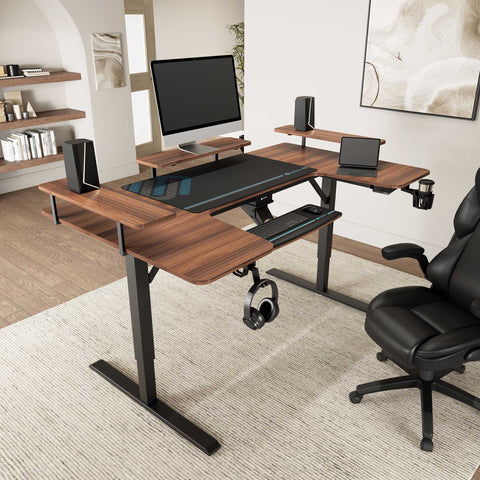
A common error with L-shaped desks is placing the primary monitor in the corner "crotch" of the L. This often forces the user into a twisted posture, as the keyboard and chair cannot align perfectly with the corner angle.
- Expert Insight: Always place your primary monitor directly in front of you on the main wing of the desk. Use the return wing for secondary tasks, such as reference documents or a second laptop.
- Productivity Benefits: L-shaped desks are excellent for "task switching." You can have a "digital zone" on one side and a "clutter-free zone" for analog work on the other. For creative professionals, this segmentation is a key factor in L-Shaped Desk Layouts for Content Creators.

Straight Desks and Space Efficiency
For smaller rooms, a straight desk is often more efficient. When selecting a straight desk, ensure there is at least 30–36 inches of clearance behind the desk for the chair. This allows for easy ingress and egress and supports the "20-8-2" rhythm—20 minutes of sitting, 8 minutes of standing, and 2 minutes of moving—recommended by Cornell University Ergonomics Web.
Technical Specifications: Motors, Frames, and Stability
For those transitioning to a sit-stand lifestyle, the internal mechanics of the desk are just as important as the surface dimensions.
Dual-Motor vs. Single-Motor Systems
While single-motor desks are common in the entry-level market, dual-motor systems are generally superior for professional use.
- Load Capacity: Dual motors distribute the lifting force, allowing for heavier setups (PC towers, multiple monitors).
- Smoothness: They provide a more synchronized lift, reducing the risk of monitors shaking or coffee spilling during height transitions.
- Longevity: Because each motor works less intensely, the system's lifespan is typically extended.
C-Frame vs. T-Frame Design
The design of the desk legs significantly impacts front-to-back stability.
- T-Frame: The leg is centered under the desk. This is common but can lead to more "fore-and-aft" wobble when typing at high elevations.
- C-Frame: The leg is offset toward the back. This provides more legroom and generally offers better stability because the center of gravity is more effectively managed. This is particularly crucial for users who have heavy monitor arms mounted to the rear edge.
Modeling Note: Stability and Vibration Analysis Our assessment of desk stability is based on a scenario model with the following parameters:
Parameter Value/Range Unit Rationale Setup Weight 45–75 lbs Average weight of 2 monitors + PC + Arm Max Height 48 inches 95th percentile male standing height Input Force 2.5 Newtons Typical typing force on mechanical keyboard Frame Material Cold-rolled steel N/A Industry standard for professional desks Floor Surface Low-pile carpet N/A Most common home office environment Boundary Condition: Stability decreases significantly if the desk is placed on uneven flooring or if the weight is distributed entirely on the front edge.

Room Planning: Measuring Beyond the Desktop
A desk that fits your monitors but blocks your door is a failure in planning. When measuring your space, consider the "Full Footprint."
- Leg Spread: The footprint of the desk legs is often wider or deeper than the desktop itself to ensure stability. Always check the base dimensions.
- Cable Management: Account for an extra 1–2 inches of "gap" between the desk and the wall to allow for monitor arms and cable routing.
- The Chair Arc: As noted by Safe Work Australia, you need space to move. Ensure you have a 36-inch clear zone behind the desk to allow the chair to roll back and swivel without hitting walls or furniture.
Summary of Ergonomic Recommendations
Selecting a desk is an investment in your physical well-being. By prioritizing depth for visual health, width for workflow, and stability for standing transitions, you create an environment that supports long-term productivity.
- Prioritize Depth: Aim for 30 inches to protect your eyes and neck.
- Match Width to Hardware: Don't crowd your monitors; give them room to breathe.
- Invest in Stability: Look for dual motors and C-frame designs if you plan to stand frequently.
- Audit Your Posture: Use tools like the HSE Workstation Checklist to ensure your new desk is set up correctly once it arrives.
For more detailed setup advice, explore our comprehensive guide on Setting Up Your Standing Desk for Peak Productivity.
Disclaimer: This article is for informational purposes only and does not constitute professional medical advice. If you have pre-existing musculoskeletal conditions or chronic pain, please consult a qualified healthcare professional or an occupational therapist before making significant changes to your workstation or work habits.
References
- BIFMA G1-2013 Ergonomics Guideline for Furniture
- ISO 9241-5:2024 Workstation layout & postural requirements
- OSHA eTools: Computer Workstations
- WHO 2020 Guidelines on Physical Activity & Sedentary Behaviour
- Cornell University Ergonomics Web — Workstation Guides
- The 2026 Workstation White Paper: Converging Ergonomic Science and Sustainable Engineering





Leave a comment