

Why Your Desk Size and Height Are Foundational to Your Well-being
Finding the right standing desk is about more than just aesthetics or fitting it into a room. The dimensions of your desk—its height range, width, and depth—are the foundation of an ergonomic workspace. An improperly sized desk forces your body into unnatural positions, which can contribute to musculoskeletal issues over time. According to the U.S. Occupational Safety and Health Administration (OSHA), poor posture is a significant risk factor for developing musculoskeletal disorders (MSDs).
When your desk isn't aligned with your body, you compensate. A desk that's too high forces you to shrug your shoulders, leading to neck and shoulder strain. A desk that's too low causes you to hunch forward, straining your back and compressing your spine. The goal is to achieve a "neutral posture," where your joints are naturally aligned, and your muscles are relaxed. This is the position where your body functions most efficiently, minimizing stress on your musculoskeletal system. This guide will provide a systematic approach to selecting a standing desk size that is perfectly matched to your height and workflow.
The Core Measurements: Calculating Your Ideal Desk Height
The most critical factor in choosing a standing desk is ensuring its height adjustment range accommodates both your ideal seated and standing postures. The reference point for this measurement is your elbow height.
How to Measure Your Seated Elbow Height
Your seated desk height should allow your keyboard and mouse to be positioned just at or slightly below your resting elbow height. This prevents you from raising your shoulders or bending your wrists unnaturally.
- Sit Correctly: Sit in your chair with your feet flat on the floor (or on a footrest if needed). Your back should be straight and supported, and your thighs should be roughly parallel to the floor.
- Position Your Arms: Let your upper arms hang relaxed at your sides. Bend your elbows to a 90-degree angle, as if you were about to type.
- Take the Measurement: Have someone measure the distance from the floor to the bottom of your elbow. This measurement is your ideal seated keyboard surface height. For better wrist posture, many ergonomic experts recommend setting the keyboard tray or desk surface about 2-3 cm below this point to achieve a slight negative tilt.
How to Measure Your Standing Elbow Height
The process for finding your standing height is similar, ensuring your posture remains neutral and supported.
- Stand Straight: Stand with your feet shoulder-width apart. It's important to wear the shoes you typically use at your desk, as this affects your total height.
- Position Your Arms: Just as with sitting, let your upper arms relax at your sides and bend your elbows to a 90-degree angle.
- Take the Measurement: Measure the distance from the floor to the bottom of your elbow. This is your target height for a standing desk.
Standing Desk Height Recommendation Chart
To simplify the process, we've created a reference chart based on ergonomic principles that cover a wide range of users, aligning with standards like BIFMA G1-2013. Find your height to determine your recommended starting desk height range. Remember that these are starting points; you should always fine-tune the height to your personal comfort.
| User Height (cm / ft-in) | Recommended Seated Desk Height (cm) | Recommended Standing Desk Height (cm) |
|---|---|---|
| 152 cm / 5'0" | 58 - 63 cm | 91 - 97 cm |
| 157 cm / 5'2" | 60 - 65 cm | 94 - 100 cm |
| 163 cm / 5'4" | 62 - 67 cm | 98 - 104 cm |
| 168 cm / 5'6" | 64 - 69 cm | 101 - 107 cm |
| 173 cm / 5'8" | 66 - 71 cm | 104 - 110 cm |
| 178 cm / 5'10" | 68 - 73 cm | 107 - 114 cm |
| 183 cm / 6'0" | 70 - 75 cm | 110 - 117 cm |
| 188 cm / 6'2" | 72 - 77 cm | 113 - 120 cm |
| 193 cm / 6'4" | 74 - 79 cm | 116 - 124 cm |
For users on the shorter or taller ends of the spectrum, it is crucial to select a desk with an extended height range. Desks with 3-stage columns generally offer a greater adjustment range, accommodating a wider variety of user heights.

Beyond Height: Choosing the Right Desktop Dimensions
While height is crucial, the surface area of your desk—its width and depth—is equally important for productivity and ergonomic health.
Determining Your Ideal Desk Width
The width of your desk should be dictated by your workflow. A minimalist setup with just a laptop may only require a 120 cm (48-inch) desk. However, for remote workers and gamers using multiple monitors, a wider desk is essential.
- Single Monitor Setup: A width of 120 cm to 140 cm (48-55 inches) is generally sufficient.
- Dual Monitor Setup: A width of at least 150 cm (60 inches) is recommended to provide ample space for two monitors and prevent them from feeling cramped.
- Multi-Monitor/Gaming Setup: For extensive setups involving three monitors, speakers, and other peripherals, a desk width of 180 cm (72 inches) or more, or an L-shaped configuration, is a better choice.
The Overlooked Dimension: Why Desk Depth is Critical
A common mistake I often see is people choosing desk depth based only on the size of their room, neglecting its ergonomic impact. Desk depth is vital for achieving the correct viewing distance for your monitor. According to the Canadian Centre for Occupational Health and Safety (CCOHS), your screen should be about an arm's length away to minimize eye strain.
A shallow desk, especially one under 60 cm (24 inches), forces you either to sit too close to your monitor or to place it so far back that there's no room for a keyboard and wrist rest. This problem is magnified when using a monitor arm, which often requires a few inches of clearance behind it.
- General Use & Single Monitors: A depth of 60-70 cm (24-28 inches) is a good minimum.
- Large Monitors (32"+) or Multi-Monitor Arms: Aim for a depth of 75 cm (30 inches) or more. This provides the flexibility to position your screens for optimal viewing angles and distance without sacrificing your keyboard and mouse area.
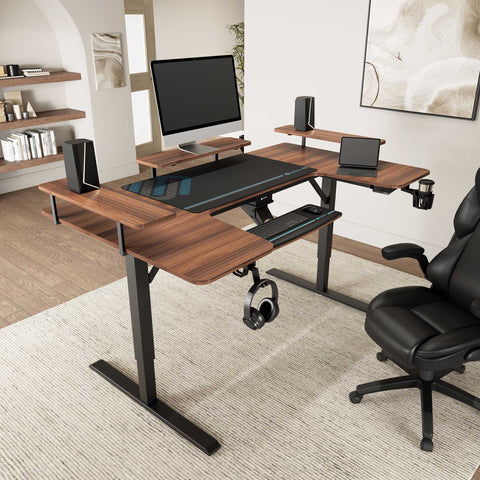
For those with complex workflows, an L-shaped desk can offer the best of both worlds, providing a primary surface with adequate depth and a secondary surface for documents or other equipment. A model like the L-Shaped Standing Desk with Accessories Set (60"x23") creates distinct zones, helping to keep your main workspace organized and focused.
Fine-Tuning Your Ergonomic Workstation
Once you've selected a desk with the right dimensions, the final step is to integrate it into a complete ergonomic system.
Adopting a Healthy Sit-Stand Rhythm
A standing desk is a tool to combat a sedentary lifestyle, not a replacement for movement. Standing all day can cause fatigue and strain, just as sitting all day does. The key is to alternate between sitting and standing. A great starting point is the "20-8-2" rule recommended by researchers at Cornell University: for every 30 minutes, sit for 20 minutes, stand for 8 minutes, and move around for 2 minutes.
When you first get your standing desk, ease into it. Start with 15-30 minutes of standing per hour for the first week. As your body adapts, you can gradually increase the duration. It typically takes 2-4 weeks to get fully comfortable with a new sit-stand routine.
Essential Accessories for a Complete Setup
To maximize the benefits of your standing desk, a few key accessories can make a significant difference.
- Monitor Arm: This is one of the most impactful accessories. It allows you to position your monitor at the perfect height (top third of the screen at or slightly below eye level) and distance, independent of your desk surface.
- Anti-Fatigue Mat: Standing on a hard floor can lead to leg and back fatigue. A quality anti-fatigue mat provides cushioning and encourages subtle movements, improving blood circulation.
- Adjustable Footrest: For shorter users, a footrest can provide support when seated, ensuring your feet aren't dangling.
- Cable Management: A motorized desk has moving parts. Use cable trays and ties to secure all wires, ensuring there's enough slack so they don't get pulled or tangled as the desk moves up and down.
- Monitor Stand: If a full monitor arm isn't an option, a simple riser like the Carbon Fiber Dual Monitor Stand can help elevate your screens to a more comfortable viewing height while also providing extra organizational space.

Key Takeaways
Choosing the right standing desk size is a crucial investment in your health and productivity. It's a process that goes beyond simple measurements and requires a thoughtful assessment of your body, your work, and your space.
To ensure you make the right choice, follow these core principles:
- Measure Yourself First: Use your seated and standing elbow height as the primary guide for determining the required height adjustment range of your desk.
- Design for Your Workflow: Select a desktop width and depth that comfortably accommodates all your equipment and allows for an optimal monitor viewing distance of at least an arm's length.
- Think as a System: Your desk is the centerpiece of your workstation, but its effectiveness is enhanced by key accessories like a monitor arm and an anti-fatigue mat.
- Adapt Gradually: Introduce standing into your workday slowly. Listen to your body and find a sit-stand rhythm that feels comfortable and sustainable.
By following these guidelines, you can create a workspace that not only fits your room but, more importantly, fits you.
Disclaimer: This article is for informational purposes only and does not constitute professional medical advice. The information provided is intended to support, not replace, the relationship that exists between a patient/site visitor and his/her existing physician. Always seek the advice of a qualified health provider with any questions you may have regarding a medical condition.




Leave a comment