

Quick Decision Checklist: Small Office L-Shaped Desks
If you are looking for immediate dimensions to plan your layout, use this quick reference based on common home office constraints.
- Minimum Corner Space Required: 48" x 40" (for a compact setup).
- Recommended Desktop Depth: 24" to 30" (to maintain healthy focal distance).
- Minimum Chair "Sweep Zone": 24" of unobstructed floor space behind the desk.
- Best for Dual Monitors: A Standard L-Desk (approx. 55" x 50").
- Measurement Tip: Always measure the distance from the corner to the nearest door frame or window to ensure the desk won't obstruct pathways.
Disclosure: This guide includes illustrative examples of our own products (Eureka Ergonomic) alongside industry-standard ergonomic principles to help you design an effective workspace.
Why Shape Matters: The L-Shaped Advantage
When working with a limited floor plan, conventional wisdom might suggest a small, straight desk. However, based on our observations of hundreds of home office setups, a straight desk often becomes a bottleneck for productivity. Once you add a second monitor, a laptop, and a notebook, the surface area vanishes, leading to a cluttered environment that can fragment your focus.
The L-shaped desk offers a unique spatial solution by utilizing the often-neglected corners of a room. This geometry provides two distinct zones: a primary "execution" zone for computer work and a secondary "thinking" zone for analog tasks, such as sketching, reading, or managing documents.
The Multi-Monitor Workflow
For those who rely on multi-monitor setups, the L-shape is highly effective. It allows you to position screens at a consistent focal distance, which is a key factor in reducing eye strain. According to the ISO 9241-5:2024 Workstation layout & postural requirements, maintaining a neutral head position and a comfortable viewing angle is fundamental to long-term musculoskeletal health. An L-shaped desk facilitates this by allowing you to pivot your chair rather than twisting your neck to see peripheral screens.
Heuristic Note: Our spatial analysis suggests that L-shaped desks can provide approximately 30% more usable surface area than rectangular desks within the same footprint length. This is achieved by reclaiming the "dead space" in the corner. (See the Method & Assumptions section for the calculation model).
Finding Your Perfect Fit: A Size Guide for Small Spaces
Choosing the right size is a balance between your functional needs and the physical limits of your room. In our experience supporting remote workers, a frequent oversight is the "sweep zone"—the area required for your chair to move back and rotate.
The "Sweep Zone" Rule of Thumb
Before selecting a desk, measure your room and subtract at least 24 inches from the available depth to account for chair push-back and leg space. For example, if your corner is 60 inches deep, a desk with a 30-inch depth leaves you with 30 inches of sweep zone—a functional margin for most ergonomic chairs.
| Desk Category | Typical Dimensions (Long Side x Short Side) | Ideal For | Estimated Space Requirement |
|---|---|---|---|
| Compact L-Desk | 48" x 40" | Laptop + Single Monitor | ~25-30 sq ft |
| Standard L-Desk | 55" x 50" | Dual Monitors + Laptop | ~35-40 sq ft |
| Executive L-Desk | 60" + | Triple Monitors + Printer | ~50+ sq ft |
Note: Dimensions are practical ranges based on common home office furniture standards.
Small Space Solutions
If you are working in a truly tight room, consider a compact L-desk with corner legs rather than central supports. This design choice can gain you crucial inches of legroom. Additionally, we recommend placing the shorter leg of the L along the longer wall; this often makes the room feel more open and less "closed in" by furniture.

The Geometry of Comfort: Ergonomic Standards
A well-sized desk is only effective if it supports your body's natural alignment. Ergonomics is the practice of fitting the environment to the user. To create a supportive workspace, we look to established guidelines like the BIFMA G1-2013 Ergonomics Guideline for Furniture.
Achieving a Neutral Posture
The goal is to achieve a "neutral" posture, where joints are naturally aligned to help minimize muscle strain.
- Desk Height: Ideally, your elbows should be at a 90-degree angle, with your wrists flat on the surface. If your desk is too high, you may find yourself shrugging, which can lead to tension in the trapezius muscles.
- Monitor Placement: The top of your screen should generally be at or slightly below eye level. According to OSHA eTools: Computer Workstations - Monitors, this helps minimize neck rotation and eye fatigue.
- The 20-8-2 Rhythm: We suggest following the Cornell University "20-8-2" rule: sit for 20 minutes, stand for 8 minutes, and move/stretch for 2 minutes. This movement helps prevent the static muscle fatigue associated with prolonged sitting.
The Role of Adjustability
While a fixed-height L-desk can work, a height-adjustable model offers the flexibility to shift between "thinking" and "execution" modes. Standing for short periods can provide a mental reset. However, as noted by the Canadian Centre for Occupational Health and Safety (CCOHS), it is important to set up your standing height with the same precision as your sitting height to avoid new strains.
Transforming Your Space: A Step-by-Step Guide
Once you have selected your desk, use these steps to move from a cluttered room to an organized workspace.
Step 1: Declutter and Visualize
Clear the area completely. Visual clutter competes for your brain’s attention, which can make it harder to maintain focus during deep work.
Step 2: Strategic Assembly and Placement
When assembling an L-shaped desk in a small room, plan your cable management before the desk is pushed against the wall. We recommend routing cables along the inner corner of the L using adhesive-backed clips. Accessing these areas is significantly more difficult once the desk is in its final position.
Step 3: Vertical Expansion
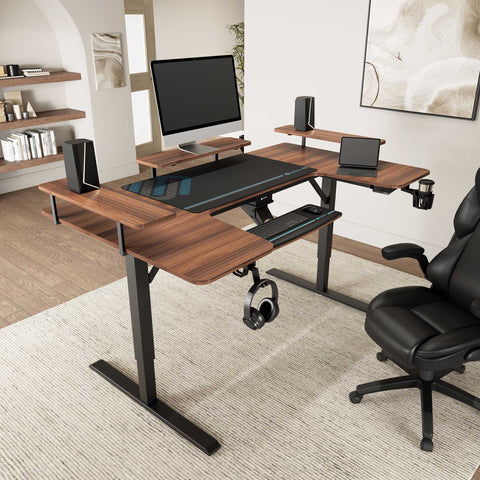
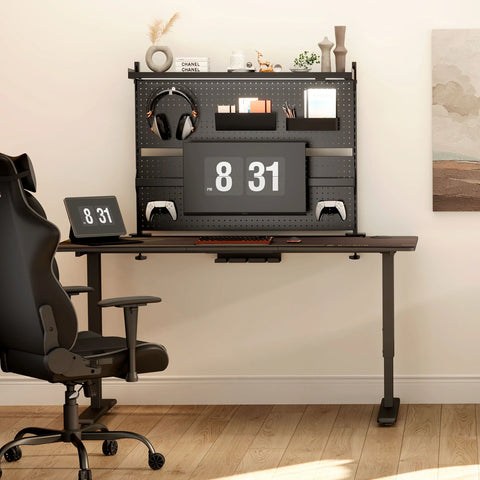
In small offices, when you can't expand horizontally, go vertical. Adding items like the Convertible Desktop Shelves (Our Product) allows you to lift monitors or equipment off the main surface. This clears the "primary work zone" for your keyboard and mouse.

Refining the Setup: Accessories and Organization
The right accessories can help reduce friction in your daily workflow and maximize the utility of a small footprint.
Monitor Management
Using a Single Monitor Arm (Our Product) is one of the most effective ways to reclaim desk real estate. By lifting the monitor stand, you open up space underneath for a notebook or docking station. Tip: Ensure your desk edge can handle the clamp pressure. For thinner desktops, we suggest using a reinforcing plate to distribute the weight.

Ergonomic Support
Even a high-quality desk setup can be improved with proper support for your lower limbs. A Footstool with Wheels (Our Product) can help you maintain a healthy posture by ensuring your feet are supported and your thighs are parallel to the floor. This is particularly helpful if your chair must be set higher to match a fixed desk height.

The Aesthetic Touch
Aesthetics can influence how you feel in your space.
- Lighting: Use a combination of natural light and warm task lighting to help reduce eye strain.
- Materials: A Carbon Fiber Dual Monitor Stand (Our Product) provides a durable, scratch-resistant surface for heavy tech setups while adding a modern texture to the room.
Sustaining Your Flow: Behavioral Interventions
Investing in quality furniture is a significant first step, but long-term comfort depends on how you use it. According to the World Health Organization (WHO) 2020 Guidelines on Physical Activity & Sedentary Behaviour, it is crucial to interrupt long periods of sitting. Use the "thinking" leg of your L-desk to stand up and take notes, or use your footstool to shift your weight throughout the day.
Method & Assumptions
To provide these recommendations, we utilized a combination of industry standards and spatial modeling.
Modeling Note & Calculation Example: Our "30% more usable surface" claim is a heuristic based on comparing a standard 60" L-shaped desk (with a 24" depth) to a 60" straight desk of the same depth.
- Straight Desk Area: 60" x 24" = 1,440 sq in.
- L-Shaped Desk Area (60"x48"x24"): (60" x 24") + (24" x 24" extension) = 2,016 sq in.
- Result: In this model, the L-shape provides roughly 40% more area. We use "approx. 30%" as a conservative estimate to account for the corner overlap and "reachability" constraints.
Parameter Value or Range Unit Rationale / Source Category Chair Sweep Zone 24 - 30 Inches Standard chair base radius + movement Primary Work Zone 15 - 20 Inches Depth for keyboard and neutral reach Monitor Viewing Dist. 20 - 30 Inches OSHA / Ergonomic best practice Desk Height (Seated) 28 - 30 Inches BIFMA / ISO 5th-95th percentile Corner Leg Gain 2 - 4 Inches Estimated clearance vs. T-leg designs
Disclaimer: This article is for informational purposes only and does not constitute professional medical, legal, or financial advice. The ergonomic recommendations provided are based on general industry standards and may not be suitable for individuals with pre-existing musculoskeletal conditions. Always consult with a qualified healthcare professional or a certified ergonomist before making significant changes to your workstation setup, especially if you experience chronic pain or discomfort.
References
- The 2026 Workstation White Paper: Converging Ergonomic Science and Sustainable Engineering
- BIFMA G1-2013 Ergonomics Guideline for Furniture
- ISO 9241-5:2024 Workstation layout & postural requirements
- OSHA eTools: Computer Workstations - Monitors
- Canadian Centre for Occupational Health and Safety (CCOHS): Office Ergonomics - Sit/Stand Desk
- WHO 2020 Guidelines on Physical Activity & Sedentary Behaviour




Leave a comment