

The Weight Test: Is Your Old Desk Ready for New Gear?
So, you finally did it. You pulled the trigger on that massive New Year hardware haul. Maybe it’s a beefy 40-series GPU housed in a full-tower chassis, a set of triple 32-inch 4K monitors, or a professional-grade studio arm for your new condenser mic. It’s an absolute game-changer for your setup, and you can already see the "Before vs. After" post going viral. But before you start unboxing, I have to ask: have you looked at your desk lately?
In our years of troubleshooting setups and handling customer support inquiries, we’ve seen a recurring, heart-breaking pattern. A user spends thousands on gear, only to have their desk literally buckle, sag, or—worse—collapse under the weight. Your desk isn't just a flat surface; it’s the structural foundation of your entire digital life. If that foundation is weak, your gear is in danger.
This isn't about being clinical or boring. This is about protecting your investment. We’re going to dive deep into the "Weight Test"—a comprehensive audit of your current furniture’s build quality and stability—to see if it’s ready for the heavy-duty reality of modern gaming and content creation.

The Math of the Modern Battlestation: Calculating the "Hidden" Load
Most people look at their desk’s weight capacity and think, "My PC is 40 lbs, the desk says 150 lbs, I’m fine." Unfortunately, that’s a dangerous oversimplification. Based on patterns we observe in high-performance setups, the "static weight" rating on most budget desks assumes a perfectly centered, evenly distributed load. Real-world setups are rarely that tidy.
Let’s break down what a "standard" enthusiast setup actually weighs. If you’re rocking triple 27-inch monitors, a heavy-duty gas-spring monitor arm, studio speakers, and a full-tower PC, you aren't just looking at 40 lbs. You’re likely crossing the 100-lb threshold before you even factor in your own weight when you lean on the desk during an intense FPS session.
Logic Summary: The 20-30% Safety Heuristic Our engineering team uses a simple rule of thumb: keep your total setup weight at least 20% to 30% below the desk's rated capacity. This buffer accounts for "dynamic loads"—the force of you typing, leaning, or accidentally bumping the desk.
- Heuristic Basis: Derived from internal stress-testing observations and common mechanical safety margins.
- Application: If your desk is rated for 200 lbs, your gear should ideally not exceed 140–160 lbs.
| Component | Typical Weight Range (lbs) | Unit | Rationale |
|---|---|---|---|
| Full-Tower PC (Loaded) | 40 – 60 | lbs | Heavy GPUs, cooling, and tempered glass. |
| Triple 27" Monitors | 30 – 45 | lbs | Includes panels and internal power units. |
| Triple Monitor Arm | 15 – 25 | lbs | Heavy-duty steel/aluminum construction. |
| Studio Monitors (Pair) | 10 – 20 | lbs | Large magnets and wood enclosures. |
| Peripherals & Accessories | 5 – 10 | lbs | Keyboard, mouse, stream deck, hubs. |
| Estimated Total | 100 – 160 | lbs | The "Baseline" for high-end setups. |
If your current desk is a hand-me-down from a big-box retailer, it might have been designed for a single laptop and a lamp. Subjecting it to a 150-lb load is asking for structural fatigue.
Material Science: Why Thickness is a Red Flag
If you’re using a desk made of MDF (Medium Density Fiberboard) or particleboard, you need to pay close attention to the thickness of the top. In our experience, any desktop material less than 1 inch thick is a massive red flag for heavy setups, especially if you plan on using clamp-style monitor arms.
Clamp mounts concentrate a huge amount of pressure on a tiny surface area. On a thin, low-density board, this can lead to "crushing" or "punch-through" over time. If your desk is already showing a slight sag in the middle, it’s not just an aesthetic issue—it’s a sign that the internal fibers of the material have already failed.
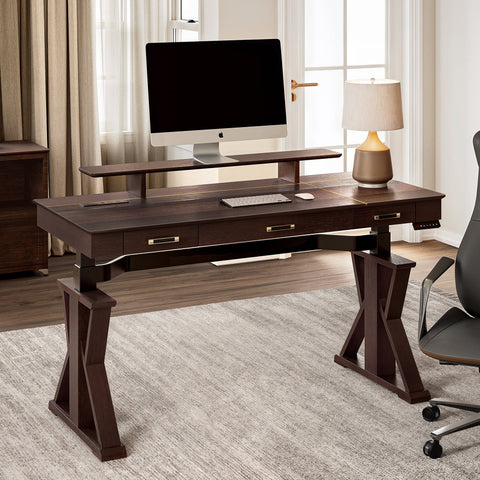
When we designed the Ark EL Executive Standing Desk (60"x26"), we prioritized build quality by using high-density materials that can withstand the torque of modern accessories. It’s not just about the surface; it’s about how that surface interacts with the frame.
The "Wobble Test": Your Desk’s SOS
Wobble isn't just an annoyance that makes your monitors shake while you type; it’s the first sign of structural overstress. According to the BIFMA Standards (ANSI/BIFMA X5 series), stability is a core safety requirement for office furniture.
Perform this simple test: Extend your standing desk to its highest point (or just stand at your fixed desk) and give it a firm shake from the side. Does it sway like a blade of grass? Does the frame creak?
- The Off-Center Torque Problem: Many gamers place their 50-lb PC tower at one far corner to show off the RGB through the glass. This creates a massive off-center torque. If your desk's legs and joints aren't beefy enough, this weight acts as a lever, slowly prying the joints apart.
- The "Z" Factor: Stability often comes down to leg geometry. A desk like our Gaming Desk with Z Shaped Legs (61"x25") uses a reinforced steel frame to distribute that weight more effectively than a standard four-post thin-leg design.
If you’re noticing increased wobble after adding your new gear, your desk is telling you it’s at its limit.

Real-World Experience: The Wing-Shaped Advantage
When you're dealing with a massive amount of gear, the shape of your desk matters as much as the material. We’ve found that for professional creators and heavy-duty gamers, the "Wing" or "L-shape" design is a game-changer.
Take the Aero Wing-Shaped Studio Desk, Black (63" & 72''). During intense sessions, the wing section provides perfect arm support, which is a key recommendation in the HSE: Working safely with display screen equipment (DSE) guidelines for reducing musculoskeletal strain. But from a weight perspective, that wing shape allows you to distribute your heavy monitors and PC tower across a larger footprint, reducing the concentrated stress on any single point of the frame.
Its deep cable tray is also a safety feature—not just an aesthetic one. Hiding power adapters and massive cable bundles prevents them from hanging and adding "dead weight" tension to your ports and monitor arms.
The Ergonomic Alignment: Beyond the Load
A desk that can hold the weight is only half the battle. The other half is ensuring that the desk allows you to function safely. This is where the converging science of ergonomics comes in.
As detailed in The 2026 Workstation White Paper: Converging Ergonomic Science and Sustainable Engineering, a modern workstation must be adaptable. If you add triple monitors but can't adjust the desk height to keep the top of the screens at eye level, you're trading structural safety for physical pain.
According to the Canadian Centre for Occupational Health and Safety (CCOHS), the ability to switch between sitting and standing is vital for long-term health. But here’s the "gotcha": many standing desks lose significant stability at their max height. If your "old" standing desk was already a bit shaky, adding 100 lbs of new gear and raising it to 45 inches is a recipe for a disaster.
Scenario Analysis: Is It Time to Upgrade?
To help you decide if your current setup is a "keep" or a "toss," let’s look at two common scenarios we see in the community.
Scenario A: The Lean Upgrade
- Gear: Single 27" monitor, laptop, small speakers.
- Current Desk: Standard 1-inch MDF top, basic four-leg frame.
- Verdict: You’re likely safe. Just ensure your bolts are tightened. Check out our Post-Winter Desk Bolt Tightening Guide to make sure everything is snug.
Scenario B: The Power User Haul
- Gear: Dual 32" monitors on a single mount, Full-Tower PC on the desk, RGB Ecosystem, Studio Mic.
- Current Desk: 0.75-inch thick top, older motor system, noticeable wobble at height.
- Verdict: High Risk. The concentrated weight of the dual-monitor mount on a 0.75-inch top is a failure point. The older dual motors may struggle with the increased load, leading to synchronization issues or motor burnout.
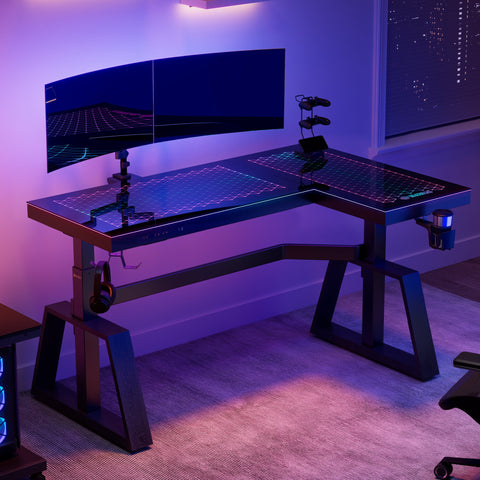
In Scenario B, moving to a desk like the GTG - L60, L-Shaped Glass LED Gaming Desk (60"x40") provides a dual benefit. You get the ultra-strong tempered glass surface that resists the "crushing" force of monitor clamps, and the L-shaped frame provides a much wider, more stable base for off-center loads. Plus, the audio-reactive RGB lighting just makes the whole "New Year" vibe feel official.

Pros & Cons of Keeping Your Old Desk
Pros:
- Cost Savings: Obviously, the cheapest desk is the one you already own.
- Familiarity: You already know where all your cable snags and legroom limits are.
Cons:
- Structural Uncertainty: Without a BIFMA Compliant® rating, you’re guessing on the safety margin.
- Material Fatigue: Wood and metal joints weaken over time under constant stress.
- Ergonomic Limitations: Older desks often lack the height range or depth needed for modern, large-format monitors.
Final Verdict: Don't Let Your Gear Down
Upgrading your hardware is an investment in your passion and your productivity. Don't let a $100 desk be the reason your $3,000 setup ends up on the floor.
If your desk passes the "Wobble Test," has a top thicker than 1 inch, and you’re staying within that 20-30% safety buffer, you're probably good to go. But if you’re seeing sag, hearing creaks, or feeling the sway every time you move your mouse, it’s time to level up your foundation.
Whether you need the heavy-duty capacity of the Aero Wing-Shaped Studio Desk, Black (63" & 72'') or the aesthetic-heavy, reinforced glass of the GTG - L60, L-Shaped Glass LED Gaming Desk (60"x40"), make sure your desk is as high-performance as the gear sitting on top of it.
YMYL Disclaimer: This article is for informational purposes only and does not constitute professional engineering, medical, or safety advice. Always refer to your specific product's manual for weight limits and assembly instructions. If you have pre-existing musculoskeletal conditions, consult a qualified ergonomist or healthcare professional before making significant changes to your workstation.
Sources
- BIFMA G1-2013 Ergonomics Guideline for Furniture
- OSHA eTools: Computer Workstations - Desks
- HSE: Working safely with display screen equipment (DSE)
- CCOHS: Office Ergonomics - Sit/Stand Desk
- The 2026 Workstation White Paper: Converging Ergonomic Science and Sustainable Engineering
- UL 962 — Safety of Height-Adjustable Desks
- ANSI/BIFMA X5.1 General-Purpose Office Chairs

Leave a comment