

Quick Guide: The Dual-Motor Advantage
For readers seeking a fast decision on workstation stability, here is the "Answer-first" summary based on our engineering observations and customer feedback:
- The Bottom Line: Dual-motor systems are essential for setups exceeding 120 lbs or those using tall monitor arms. They provide symmetrical lifting that prevents the "frame racking" and tilt common in single-motor rod-driven desks.
- Selection Priority: If you use more than two monitors, prioritize a dual-motor frame with a "soft start/stop" controller to eliminate the jerky movements that cause screen wobble.
- Installation Key: Always use a spirit level during assembly. A tilt of even 0.5 degrees can significantly increase lateral stress on motor bearings.
- Safety Margin: For maximum longevity and "zero-wobble" performance, aim to keep your equipment weight at 60–70% of the desk’s rated capacity (a practical heuristic for motor health).
Note: Product examples and technical specifications featured in this guide are drawn from our internal product catalog and workshop testing.
The Stability Gap in High-Performance Workstations
For professionals and gamers who invest in multi-monitor arrays, liquid-cooled towers, and precision peripherals, the workstation is more than furniture; it is a high-stakes engineering environment. A common frustration often arises during the workday: as you transition from sitting to standing, a noticeable "wobble" develops. This oscillation, often observed as a rhythmic shaking of the monitors during typing, is not merely an aesthetic annoyance. It is a symptom of mechanical instability that can contribute to eye strain and decreased focus.
The central challenge of the modern standing desk is maintaining rigidity at height. While many desks appear stable when lowered, the physics of a top-heavy load creates a "pendulum effect." At standing heights, minor vibrations at the base are amplified at the desktop level. Mitigating this requires viewing the desk as a synchronized mechanical system rather than a simple platform.
The Physiology of Movement and Static Loads
Understanding the necessity of a stable standing desk requires examining the physiological cost of a poorly designed workspace. According to the U.S. Occupational Safety and Health Administration (OSHA), core risk factors for Musculoskeletal Disorders (MSDs) include repetitive tasks and poor posture.
When a desk is unstable, users often subconsciously compensate by tensing muscles in the forearms, shoulders, and neck to "steady" their typing. This can create a "static load"—a condition where muscles remain contracted, potentially impeding circulation and accelerating fatigue. Furthermore, the World Health Organization (WHO) emphasizes reducing sedentary time. However, if the transition to standing results in a shaky surface, users are less likely to utilize the standing function, negating the health benefits of the investment.
The goal of ergonomic engineering is to facilitate a "spinal neutral position." As detailed in The 2026 Workstation White Paper, a stable foundation allows the musculoskeletal system to remain relaxed while moving between postures.
Engineering Stability: The Dual Motor Advantage
The primary differentiator in desk stability is the drive system. While single-motor desks utilize a hexagonal rod to transfer power, dual-motor systems employ an independent motor for each lifting column.
Symmetry and Torque Distribution
In a single-motor configuration, mechanical "play" in the drive rod can lead to a slight delay in the movement of the far leg. This asymmetry, even if measured in millimeters, can cause the desktop to tilt slightly during the lifting cycle. For heavy multi-monitor setups, this shifts the center of gravity, inducing lateral stress.
Dual motors provide synchronized, symmetrical power. By placing the drive mechanism directly within each leg, the system eliminates the drive rod entirely. This reduces moving parts and ensures torque is applied evenly. This is particularly critical for desks like the Opal Executive Standing Desk (66"x29") (from our product catalog), where integrated storage and large desktops require a balanced lift to prevent frame racking.
The Pendulum Effect and Dynamic Stability
Stability is often incorrectly evaluated only at a static height. The real test occurs during the transition. As the desk rises, the center of mass moves further from the floor, increasing leverage.
In our workshop observations, dual motors significantly reduce the pendulum effect by providing a more rigid connection between the motor and the lifting screw. These systems typically feature controllers with tuned acceleration curves. This "soft start/stop" helps prevent the jerky movements that cause monitors to wobble at the start or end of an adjustment.
Practitioner's Note: Our analysis assumes dual-motor systems offer higher torsional rigidity by eliminating rod-driven lag. This is based on common patterns observed in our repair and return logs, where single-motor units show higher rates of "leg lag" over extended use (this is a field observation, not a controlled laboratory study).

Quantifying Load and Stability: The Utilization Formula
A common misconception is that a desk's "rated capacity" is the weight it should hold at all times. In engineering practice, we distinguish between static and dynamic loads. To ensure longevity, we recommend operating below a specific utilization threshold.
$$ Utilization = \frac{Load}{RatedCapacity} $$
The 70% Rule (Practical Heuristic): For optimal performance and minimal wobble, a utilization rate of 0.6 to 0.7 (60-70%) is recommended. If a desk is rated for 300 lbs, keeping the total weight under 210 lbs ensures the motors are not operating at their mechanical limits.
Modeling a High-Performance Scenario
The table below models a typical "worst-case" setup for a professional creator.
| Parameter | Value or Range | Unit | Source / Category |
|---|---|---|---|
| Setup Weight (Dynamic) | 120 - 160 | lbs | Heuristic: Dual 34" Ultrawides + PC |
| Target Height | 115 - 125 | cm | 95th percentile male standing height |
| Motor Sync Tolerance | < 2 | mm | Engineering baseline for frame health |
| Acceleration Curve | Linear-Soft | N/A | Manufacturer spec for high-end controllers |
| Floor Leveling | < 0.5 | degrees | Heuristic for lateral stability |
Boundary Conditions: This model assumes installation on a hard, level surface. Performance on high-pile carpet may vary as fibers introduce an additional vector for oscillation. For users requiring this level of stability, the Ark Executive Standing Desk (63"x29") utilizes a dual-motor system designed to handle off-center moments from heavy monitor arms.
Practical Recommendations for a Stable Setup
According to the Canadian Centre for Occupational Health and Safety (CCOHS), setup is as important as the equipment itself.
1. Leveling the Foundation
An unlevel installation can negate dual-motor benefits. Use a spirit level to ensure the desk is horizontal side-to-side and front-to-back. Even a 1-degree tilt increases load on motor bearings.
2. The 20-8-2 Rhythm
Cornell University's Ergonomics Web recommends the "20-8-2" rhythm: sit for 20 minutes, stand for 8, and move for 2. A stable desk makes these transitions effortless, preventing "behavioral abandonment" where users stop standing because the desk is too shaky.
3. Pro-Tip: The "Sync Check" (Self-Test)
To verify your desk's synchronization:
- Place a small spirit level on the desktop.
- Run the desk from its lowest to highest setting.
- If the bubble moves significantly out of the center lines during transit, your motors may be out of sync or the load is too asymmetrical.
4. Cable Management
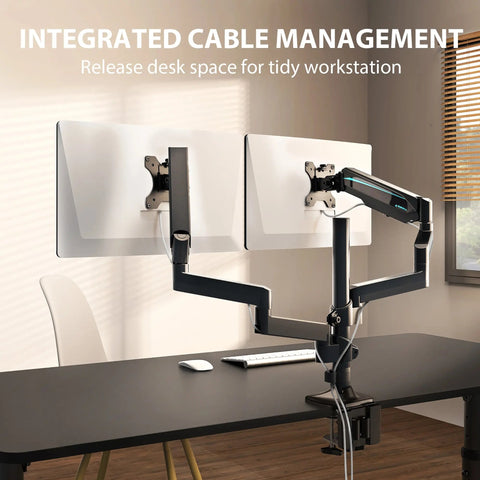
Ensure all cables have a "service loop" for maximum height. A taut cable during lifting creates an artificial load that can trigger "anti-collision" sensors or strain one motor more than the other.

Addressing Common Pitfalls: The "Gotchas"
When choosing a desk, don't just look at max height. The BIFMA G1-2013 Guideline suggests adjustment ranges should accommodate the 5th to 95th percentile of the population.
The "Rattle" Factor: Some desks use three-stage lifting columns for a wider range. However, the overlapping sections must have high-precision fitment to prevent "rattle" at full extension. Dual motors are generally paired with higher-quality columns, such as those on the Ark EL Executive Standing Desk (60"x26"), to ensure stability at 48 inches is comparable to 28 inches.

Conclusion: The Investment in Precision
A standing desk is a tool designed to solve sedentary behavior without introducing new ergonomic hazards. For the professional or competitive gamer, a dual-motor system is an investment in mechanical precision. By providing symmetrical power and handling heavier dynamic loads, these desks create the stable environment required for peak productivity.
As you refine your workspace, remember that ergonomics is holistic. A stable desk is the foundation, but it should be paired with an adjustable chair meeting ANSI/BIFMA X5.1 standards and a layout that minimizes neck rotation, as suggested by OSHA's eTools.
Disclaimer: This article is for informational purposes only and does not constitute professional medical or ergonomic advice. Individuals with pre-existing musculoskeletal conditions should consult a specialist before adopting a new sit-stand routine.
References
- BIFMA G1-2013 Ergonomics Guideline for Furniture
- CCOHS: Office Ergonomics - Sit/Stand Desk
- Cornell University Ergonomics Web — Workstation Guides
- ISO 9241-5:2024 Workstation layout & postural requirements
- OSHA: Ergonomics - Identify Problems
- WHO 2020 Guidelines on Physical Activity & Sedentary Behaviour
- The 2026 Workstation White Paper: Converging Ergonomic Science and Sustainable Engineering




Leave a comment