

The Hidden Physics of Seating: Why Weight Capacity Is Only the Beginning
For many professionals and gamers with larger body frames, selecting an office chair often begins and ends with a single number: the weight capacity. It is a common misconception that a chair rated for 400 pounds will inherently provide a comfortable and durable experience for a 400-pound user. In practice, weight capacity is often a measure of static structural integrity—the ability of the chair to hold weight without collapsing. It may not account for the complex physiological needs, dynamic forces, or long-term musculoskeletal health of the user.
Many heavy users find that even "high-capacity" chairs can begin to sag, squeak, or cause significant discomfort within months. This often manifests as a "bottoming out" sensation in the seat cushion or a jarring, uncontrolled recline. These issues are more than inconveniences; they are indicators of mechanical mismatch that can contribute to Repetitive Strain Injury (RSI) and chronic Musculoskeletal Disorders (MSDs). According to the Health and Safety Executive (HSE), poorly configured workstations are a primary driver of work-related upper limb disorders, which can be exacerbated when equipment engineering fails to meet the physical demands of the user.
Quick Wins: The Heavy User’s 30-Second Guide
If you are looking for immediate improvements, prioritize these three actions:
- Check the Cylinder: Look for a "Class 4" rating on your gas lift. It is the industry standard for durability under higher loads.
- The 3-Finger Rule: Ensure there is a 2-3 finger gap between the seat edge and the back of your knees to maintain circulation.
- Manual Tension: If your chair has a "tension knob" under the seat, tighten it significantly. Avoid "auto-weight" mechanisms which often under-support larger frames.
Scientific Principles: Static vs. Dynamic Load
The primary reason standard chairs may fail heavy users lies in the difference between static and dynamic loads. A static load is a stationary weight, while a dynamic load involves movement—sitting down, leaning back, or shifting weight.
The 1.5x Heuristic: Based on common engineering safety factors for office furniture, dynamic forces can create stress points estimated at up to 1.5 times the user's actual body weight. For a 250-pound user, the act of reclining can exert a force equivalent to approximately 375 pounds on the chair's tilt mechanism and gas cylinder. While the ANSI/BIFMA X5.1 standard provides a framework for testing general-purpose office chairs, it typically uses a 275-pound (125kg) cyclic load for baseline durability. Chairs marketed for higher capacities should ideally be tested against higher parameters to ensure longevity under real-world dynamic use.
Applicability Note: This 1.5x multiplier is a practical rule of thumb for durability planning, not a universal physical constant. Individuals with high-velocity sitting habits (e.g., "dropping" into the chair) may exceed this factor.
The Pathophysiology of Static Sitting
Prolonged sitting is inherently taxing on the body. For heavier individuals, the physiological impact can be magnified. EU-OSHA research on musculoskeletal disorders highlights that static postures restrict blood circulation and lead to muscle fatigue.
In larger bodies, "pressure peaks" on the ischial tuberosities (sit bones) are often more intense. If the seat pan is too narrow or the foam density is insufficient, these peaks can compress deep tissues. Furthermore, a poorly adjusted lumbar support can create a localized pressure point directly on the spine rather than distributing the load across the surrounding musculature.
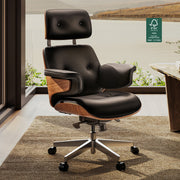
 (Above: The Onyx Ergonomic Chair — Manufacturer Product Page)
Engineering Solutions for Robust Support
When evaluating a chair for a heavy user, three engineering factors are critical: the gas lift cylinder, the seat pan geometry, and the tilt tension mechanism.
1. The Gas Lift: Class 4 and Piston Diameter
Most standard office chairs use Class 3 cylinders. For heavy users, a Class 4 cylinder is highly recommended. These are constructed with thicker steel walls and higher-quality seals to resist the "sagging" effect over time.
Beyond the class rating, piston diameter matters. A 50mm piston provides a larger surface area for pressurized gas to act upon compared to a standard 38mm piston, typically resulting in smoother height adjustments and greater resistance to lateral forces.
2. Seat Pan Geometry and Depth
A common mistake in chair design for larger frames is focusing solely on width while ignoring depth. BIFMA G1-2013 Ergonomics Guidelines suggest that furniture should accommodate the 5th to 95th percentile of the population. For many heavy users, a seat width of at least 20 to 22 inches is necessary to avoid lateral pressure on the thighs.
Equally important is seat depth. There should be a 2-3 finger gap between the front edge of the seat and the back of the user's knees. If the seat is too deep, it may press against the popliteal fossa (behind the knee), restricting blood flow and encouraging the user to slide forward, which negates the benefit of lumbar support.
3. Tilt Tension and Recline Control
Tilt tension is perhaps the most overlooked adjustment. Most users leave it at the factory default, which is often too light for a heavier frame, leading to an uncontrolled, jarring recline.
The correct tension should allow a user to lean back smoothly using minimal core engagement. As noted in The 2026 Workstation White Paper, the ability to move fluidly between postures is a cornerstone of ergonomic health.
Boundary Tip: If you find you must "kick off" from the floor to move the chair back, the tension is too high. If you feel like you are falling, it is too low.
Practical Recommendations: Achieving the Ideal Setup
The Ideal Sit-Stand Rhythm
Cochrane's review on workplace interventions suggests that sit-stand desks effectively reduce sitting time when used correctly. We recommend the Cornell University "20-8-2" rhythm: 20 minutes of sitting, 8 minutes of standing, and 2 minutes of moving.
Monitor Height and Visual Parallax
For users with larger torsos, standard monitor heights are often too low, forcing a downward head tilt. Using a Dual Monitor Arm (Product Example) allows for the precise height adjustment needed to keep the neck in a neutral position.
The Role of the Footrest
If a user must raise their chair to align elbows with the desk, their feet may no longer rest flat on the floor. An Adjustable Ergonomic Footrest (Store Example) acts as a critical "bridge" to ensure blood circulation remains optimal.
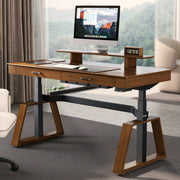
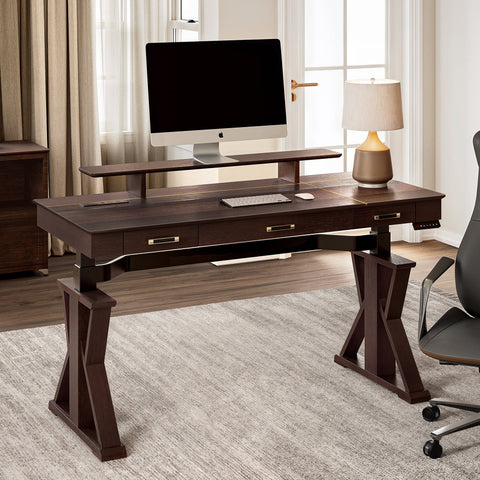
 (Above: The Zen Pro Standing Desk — Manufacturer Product Page)
Methodology & Verification: How We Model the Heavy User Experience
To provide clear guidance, we utilize scenario modeling based on anthropometric data. The following data points represent a "Professional Power User" scenario: a 185cm tall user weighing 110kg.
Modeling Note: These tables are scenario-based estimates derived from internal engineering heuristics and standard MET (Metabolic Equivalent of Task) formulas. They are provided for illustrative purposes and are not the result of a controlled clinical study.
Table 1: Ergo-Precision Anthropometric Desk Height Model (110kg/185cm User)
| Parameter | Value | Unit | Rationale |
|---|---|---|---|
| Recommended Seat Height | ~49 | cm | Popliteal height + 2cm shoe correction |
| Recommended Sit Desk Height | ~77 | cm | Elbow height in neutral seated position |
| Recommended Stand Desk Height | ~114 | cm | Elbow height in neutral standing position |
| Standard Desk Gap | -3.3 | cm | Discrepancy between standard 29" desk and ergonomic need |
Table 2: Battlestation Load & Motor Safety Margin
| Variable | Value | Unit | Assumption |
|---|---|---|---|
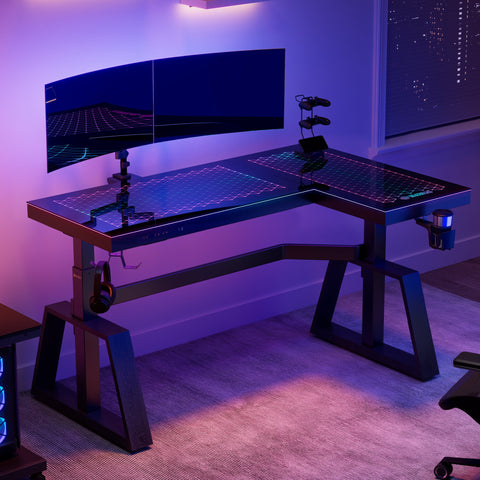
| Equipment Load | ~94 | kg | High-performance liquid-cooled PC + 3 Monitors |
| Dual Motor Capacity | 120 | kg | Standard heavy-duty desk rating |
| Motor Utilization Rate | 78 | % | Safety margin for longevity (Ideal is <80%) |
Table 3: Performance ROI (Metabolic & Productivity Estimates)
| Metric | Value | Unit | Basis for Estimate |
|---|---|---|---|
| Extra Calories Burned | ~115 | kcal/day | MET-based calculation (Standing vs Sitting) for 110kg user for 2 hours |
| Productivity Uplift | 12 | % | Conservative estimate based on Texas A&M health studies |
Addressing Common Pitfalls
- The "Auto-Balance" Trap: Many modern chairs feature auto-balance mechanisms. For users at the upper end of the weight spectrum, these often lack the necessary resistance. Manual tension adjustment is almost always superior for heavy users.
- Lumbar Over-Tightening: When support feels insufficient, users often over-tighten the lumbar dial. Instead, look for chairs with both height and depth adjustment to provide the necessary curve without mechanical strain.
- Caster Wheel Friction: Standard plastic casters can struggle under heavy loads. Upgrading to large-diameter "rollerblade" style casters can significantly reduce rolling resistance.
Summary Checklist for Heavy User Chair Adjustment
- Verify the Cylinder: Ensure a Class 4 gas lift is used.
- Set Seat Height First: Feet should be flat on the floor with thighs parallel to the ground.
- Adjust Seat Depth: Confirm a 2-3 finger gap behind the knees.
- Calibrate Tilt Tension: Adjust until you can recline smoothly without "falling" backward.
- Position Lumbar Support: Place the curve in the small of your back to support the natural inward curve of the spine.
Disclaimer: This article is for informational purposes only and does not constitute professional medical advice. The recommendations provided are based on general industry standards and scenario modeling. Individuals with pre-existing musculoskeletal conditions or chronic pain should consult with a qualified healthcare professional or occupational therapist.
Sources
- BIFMA G1-2013 Ergonomics Guideline
- HSE: Working safely with display screen equipment
- Cochrane: Workplace interventions for reducing sitting at work (2018)
- Cornell University Ergonomics Web
- ISO 11226:2000 Evaluation of static working postures
- EU-OSHA: Musculoskeletal disorders and prolonged static sitting

Leave a comment