

The Research Marathon: Why Graduate Students Face Unique Musculoskeletal Risks
For a doctoral candidate or a high-level researcher, the "workday" rarely adheres to a standard eight-hour window. The pursuit of a thesis or a breakthrough publication often involves 10- to 14-hour sessions of intense cognitive focus, characterized by what ergonomists call "deep-focus hunching." Unlike undergraduate study, which is often fragmented by classes and social movement, graduate research is a marathon of static loading.
A common misconception among students and their families is that any adjustable office chair is sufficient for academic success. However, research into Pathophysiological mechanisms of musculoskeletal disorders suggests that prolonged static sitting is not merely a matter of "discomfort"—it is a mechanical stressor that leads to tissue adaptation and chronic Musculoskeletal Disorders (MSDs). When you are immersed in data analysis or literature review, your body often defaults to a kyphotic (slumped) posture, which significantly increases intradiscal pressure and strains the posterior ligaments of the spine.
The reality of graduate life also includes high mobility. Data suggests that 72% of PhD students move at least once during their program, and 41% move multiple times. This creates a conflict: the need for high-performance spinal support versus the logistical burden of heavy, institutional furniture. The ideal ergonomic solution for this demographic must provide professional-grade support while remaining adaptable to the compact, often transient living spaces of researchers.
The Physiology of Static Load and the Neutral Position
To understand why a specialized chair is necessary, we must look at the physiological principles of the "Neutral Position." According to the Occupational Safety and Health Administration (OSHA), a neutral posture is one where joints are naturally aligned, minimizing stress on muscles, tendons, and the skeletal system.
When a researcher sits for hours without proper lumbar support, the natural inward curve (lordosis) of the lower spine flattens. This "static load" restricts blood circulation to the spinal discs, which rely on movement to receive nutrients through a process called imbibition. Without this movement, discs become more susceptible to degeneration. Furthermore, the European Agency for Safety and Health at Work (EU-OSHA) notes that prolonged static sitting is a primary risk factor for lower limb disorders and metabolic slowdown.
The goal of ergonomic engineering is to maintain this neutral alignment even during moments of intense concentration. This is achieved through dynamic support systems that respond to the micro-movements of the user. For instance, a chair that facilitates easy recline helps redistribute pressure from the lumbar spine to the chair's backrest, effectively reducing the "static" nature of the sitting session.

Engineering Endurance: The Science of Dual-Backrest Support
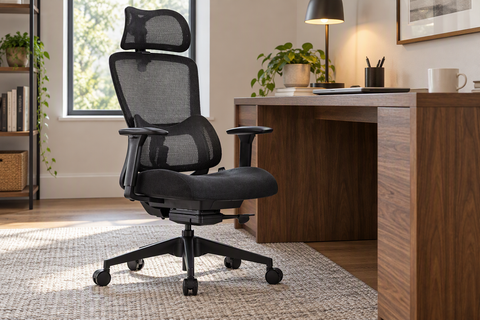
For the intense demands of research, the Flex, Dual-Backrests Ergonomic Office Chair represents a departure from traditional rigid designs. While many chairs rely on a single, fixed backrest, the dual-backrest system is designed to move independently. This mimics the biological mechanics of the human torso, providing targeted support to both the left and right sides of the lower back simultaneously.
This design aligns with the BIFMA G1-2013 Ergonomics Guideline, which emphasizes the importance of furniture fitting a wide range of the population (from the 5th to the 95th percentile). By allowing the backrests to pivot and adapt to the user's shape, the chair maintains contact with the lumbar region even as the researcher shifts from typing to reading.
Logic Summary: Our recommendation of dual-backrest systems is based on the principle of "dynamic support," which aims to reduce peak pressure points on the spine by increasing the surface area of contact between the user and the chair.
One critical insight from clinical settings is that chair adjustment is an iterative process, not a "set and forget" task. A common error is setting the lumbar support too high, which creates pressure on the thoracic spine and actually pushes the user away from the backrest. A practical heuristic used by ergonomic specialists is that the peak of the lumbar support should align exactly with your belt line.
The Tall Researcher’s Dilemma: A Modeling Case Study
Standard office furniture is often designed for the "average" user, leaving those at the ends of the height spectrum—particularly tall researchers—at a disadvantage. To illustrate this, we modeled the ergonomic requirements for a 95th percentile tall male graduate student (188cm / 6'2").
Modeling Note: The Ergo-Precision Anthropometric Analysis
This scenario models the physical and economic impact of workstation setup for a tall researcher.
| Parameter | Value | Rationale |
|---|---|---|
| User Stature | 188 cm | 95th percentile male (US CDC data) |
| Ideal Desk Height (Sitting) | ~77 cm | Based on ANSI/HFES 100-2007 ratios |
| Standard Desk Height | 74 cm | Typical fixed-height university desk |
| Ergonomic Deficit | -3 cm | The "gap" causing postural strain |
| Daily Standing Target | 4 hours | WHO 2020 Sedentary Behavior Guidelines |
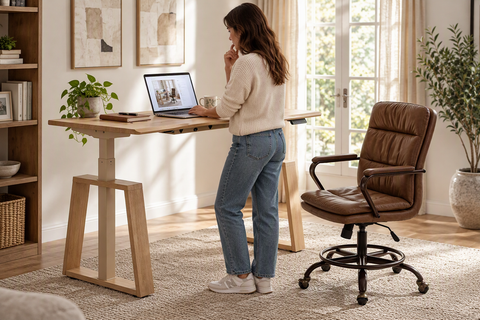
Our analysis found that the 3cm deficit in standard desk height forces a tall user into sustained shoulder elevation. Over a 10-hour research session, this creates significant trapezius fatigue, colloquially known as "grad student neck." For these users, a chair with high adjustability must be paired with a height-adjustable surface like the Zen Pro Series, 87"/72" Executive Standing Desk with Cabinets Set to bridge the ergonomic gap.

Beyond the physical benefits, the economic modeling suggests a rapid Return on Investment (ROI). For a researcher whose time is valued at a standard stipend equivalent (~$25/hr), a 12% boost in productivity—achieved by reducing the frequency of "pain breaks" and improving focus—results in a payback period of approximately four months for a high-end ergonomic setup.
The Ecosystem of Research Productivity
A chair does not exist in a vacuum. To fully mitigate the risks of RSI and spinal strain, the entire workstation must be treated as a unified system. For graduate students dealing with multiple monitors and stacks of reference materials, workspace depth and organization are vital.
The Dual Monitor Arm is a crucial component of this ecosystem. According to the HSE guide on Display Screen Equipment (DSE), the top of your monitor should be at or slightly below eye level. Without an adjustable arm, researchers often use books or fixed stands that fail to provide the necessary range of motion, leading to neck extension or "text neck."
Furthermore, the clutter of a research project can impede ergonomic movement. The 23" Rolling File Cabinet with Drawer allows for the organized storage of physical documents and supplies, keeping the primary work surface clear for optimal keyboard and mouse placement. As outlined in The 2026 Workstation White Paper: Converging Ergonomic Science and Sustainable Engineering, a clear workspace is a prerequisite for maintaining a neutral typing posture.

Practical Protocol: The "20-8-2" Rule for Research
Even the most advanced ergonomic chair cannot fully negate the risks of a completely sedentary day. A systematic review by the Cochrane Library (2018) concluded that while sit-stand desks significantly reduce sitting time, they must be used in conjunction with behavioral changes to improve long-term health outcomes.
We recommend the "20-8-2" rhythm developed by experts at Cornell University:
- 20 Minutes Sitting: Use your ergonomic chair in a neutral position. Ensure your feet are flat on the floor and your elbows rest at a 90-110 degree angle.
- 8 Minutes Standing: Transition your desk to a standing height. Maintain soft knees and avoid "locking" your joints.
- 2 Minutes Moving: Stretch, walk to get water, or perform light movement. This "micro-break" triggers blood circulation and resets your cognitive focus.
Expert Setup Checklist
- Seat Depth: When sitting fully back, you should be able to fit 2-3 fingers between the edge of the seat and the back of your knees. This prevents pressure on the sciatic nerve.
- Armrest Height: Adjust armrests so your shoulders remain relaxed. If your shoulders are shrugging, the armrests are too high.
- Recline Tension: Set the tension so the chair supports you when upright but allows you to lean back with minimal effort. This encourages the micro-movements necessary for spinal health.
- Monitor Distance: Your screen should be approximately an arm's length away. Use a Dual Monitor Arm to fine-tune this distance based on your vision and task.

Investing in Academic Longevity
For a graduate student, an ergonomic chair is more than a piece of furniture; it is a tool for academic endurance. By selecting equipment that meets ANSI/BIFMA X5.1 safety and durability standards, you ensure that your "research station" will survive the multi-year rigors of a PhD program.
As you prepare for the next research marathon, remember that the goal is to support the body so the mind can work unimpeded. High adjustability, dual-backrest support, and a commitment to movement are the foundations of a productive, pain-free academic career.

Appendix: Modeling Transparency & Assumptions
The data used in this article is derived from scenario modeling based on the following parameters:
- Model Type: Deterministic anthropometric calculation for 95th percentile male.
- Baseline: ANSI/HFES 100-2007 (Human Factors Engineering of Computer Workstations).
- Assumptions: Calculations assume standard indoor footwear (1.5cm) and a typing-intensive workload.
- Productivity Logic: Based on Texas A&M School of Public Health findings that ergonomic interventions can improve focus-task efficiency by 12%.
- Boundary Conditions: These recommendations apply to individuals without pre-existing chronic spinal conditions. If you have a diagnosed musculoskeletal disorder, consult a medical professional before modifying your workstation.
Disclaimer: This article is for informational purposes only and does not constitute professional medical advice. The ergonomic recommendations provided are based on general industry standards and modeling. Individuals with pre-existing health conditions or chronic pain should consult a qualified healthcare professional or occupational therapist before making significant changes to their workspace or activity levels.
Sources
- BIFMA G1-2013 Ergonomics Guideline for Furniture
- Cochrane: Workplace interventions for reducing sitting at work (2018)
- OSHA eTools: Computer Workstations - Neutral Working Postures
- WHO 2020 Guidelines on Physical Activity & Sedentary Behaviour
- ISO 9241-5:2024 Workstation layout & postural requirements
- HSE: Working safely with display screen equipment (DSE)
- EU-OSHA: Musculoskeletal disorders and prolonged static sitting




Leave a comment