

Imagine walking into your living room at 8 a.m. Sunlight hits the wall, and instead of a bulky desk crowding the floor, you see a clean line of wood floating along the wall. Your laptop, monitor, and notebook seem to hover in place. When the workday ends, you slide your chair away and your “office” visually disappears, leaving the room calm again.
That is the power of a well‑designed floating desk built from wall shelves.
In this guide, I’ll walk you through how to turn wall shelving into a safe, ergonomic, minimalist office—especially in small apartments and shared family spaces. You’ll learn how to choose materials, mount them safely, hit key ergonomic dimensions, and keep the whole setup visually quiet.
1. Is a Floating Desk Right for Your Space?
Before you buy hardware or drill into walls, step back and design the experience you want.
Define your “minimalist office” vision
For most small‑space remote workers, the ideal floating desk setup has:
- Zero or minimal legs so you keep open floor and visual lightness.
- A clean, cable‑managed surface that doesn’t scream “office” in your living room.
- Enough depth and load capacity to work safely with a laptop, monitor, and accessories.
- Ergonomic dimensions that respect your body, not just the wall.
A common misconception is that “any shelf wide enough for a laptop can be a desk.” In reality, ergonomic data and installer experience both say the opposite.
According to workstation guidance summarized by Cornell University’s Ergonomics Web, comfortable screen viewing for computer work targets a viewing distance of roughly 20–28 inches (50–70 cm) and a keyboard position that keeps elbows around 90° with relaxed shoulders. Our own analysis and field setups show that to achieve this with a monitor on a stand and keyboard in front, you typically need at least 22–24 inches (56–61 cm) of surface depth. Anything shallower pushes the screen too close or your wrists to the edge.
This is why the classic deep “desk” dimension (around 24–30 inches) exists. Treat that as your starting target.
When a floating desk shines
A floating‑shelf desk tends to work very well when:
- Your room is under 150–200 sq ft (14–18 m²) and every square foot of floor matters.
- You want an office that visually blends with residential furniture, not corporate steel frames.
- You need to tuck the workstation into a niche, under a window, or between built‑ins.
- You share space with a partner or family and want work clutter to disappear after hours.
It is less appropriate if:
- You frequently load the “desk” like a workshop bench.
- You need wide multi‑monitor arrays and heavy equipment.
- Your walls are in poor condition or you cannot anchor into studs or solid masonry.
2. Engineering a Safe Floating Desk (Shelf, Wall, and Load)
A floating desk is more than a pretty shelf. It is a small structural project that has to handle dynamic loads: typing, leaning, kids grabbing the edge, sometimes someone briefly sitting on it.
Understand real‑world load capacity
Conventional wisdom says that if a shelf is “rated for 50 lb,” you’re safe as long as you stay under 50 lb. Installer experience and engineering data show that this is often too optimistic.
Practical guides to drywall anchors (for example, the engineering overview at engineerfix.com) indicate that:
- Plastic drywall anchors are usually good for about 15–25 lb (7–11 kg) each in 1/2" drywall.
- Heavy‑duty toggle bolts can handle roughly 50–100 lb (23–45 kg) each.
- Lag screws into studs are often in the 50–75 lb (23–34 kg) range per fastener.
Those figures assume short lever arms and static loads. A desk‑depth shelf (16–24") with someone leaning on the far edge multiplies those forces. Based on both these data and in‑field experience, a good rule is to derate any advertised “capacity” by at least 50% for a desk‑depth surface and:
- Insist on two or more studs or structural anchors.
- Use a continuous cleat or steel bracket rather than tiny point brackets.
From installer practice, a typical laptop + monitor + accessories cluster weighs 30–50 lb (14–23 kg). Applying a 2.5× safety factor, you plan for at least 80–120 lb (36–54 kg) of structural capacity for the desk alone, then test it.
Pro Tip: Don’t trust the box rating
A common myth is that “a 50 lb floating shelf can be used as a desk if you just don’t sit on it.” In practice, a 40–48" floating desk used for daily work should be built and anchored as if it needs 120 lb of safe capacity, not 50 lb. That includes proper fasteners, spanning at least two studs, and minimizing the lever arm between the wall and where you’re leaning.
Choose the right shelf material and span
Not all boards behave the same.
Real‑world engineering guidance shows:
- 3/4" MDF shelves often start to show visible sag at typical book‑shelf loads when the span exceeds around 28" (71 cm).
- The same thickness in solid pine or hardwood can often span 30–36" (76–91 cm) with less deflection.
- MDF tends to have higher creep—it slowly sags over time under constant load.
For a 40–48"‑wide floating desk, MDF either needs steel reinforcement (such as an under‑mounted angle frame) or very conservative loading. In small home offices, this is one reason many installers favor:
- Solid wood or high‑quality plywood for the desktop.
- A separate structural system (cleats or brackets) to carry the load.
When you’re pairing a floating desk with a nearby storage piece, a tall unit like the Ark EL, 71'' Display Bookshelf with Storage Cabinet, Oak can handle vertical loads and hidden storage, while the wall‑mounted surface focuses on providing a comfortable workspace.
Expert Warning: Hidden brackets aren’t automatically safer
It is tempting to choose concealed rod‑style floating shelf brackets because they look so clean. Professional analyses of these systems, however, note that they concentrate stress in a small area of drywall or stud and are very sensitive to drilling accuracy.
Architectural reviews of floating shelf systems explain that these rod‑in‑tube designs are usually appropriate for 8–12"‑deep shelving. Once you go past 12–14" depth, and especially when you load the front edge as you do when typing, the bending moment at the bracket skyrockets and can lead to gradual wall damage even if the shelf looks fine for months.
For desk‑depth applications (16–24"), experienced installers strongly prefer:
- Full‑length steel or aluminum cleats screwed into multiple studs, or
- Robust angle brackets that visibly transfer load directly to the wall.
You sacrifice a little visual purity but gain stability and safety.
Mounting strategy: support the whole span
From years of small‑space installations, three rules emerge:
- Hit at least two studs (wood framing) or use appropriate masonry anchors in concrete/brick.
- Prefer continuous support under the whole desk:
- Steel or timber cleat screwed across multiple studs.
- Panel‑style support frame that is itself anchored.
- Consider dynamic loads:
- People lean, push off, and occasionally perch on the desk edge.
- Kids may treat the front edge like a grab bar.
A practical test after install is to load the desk to 150% of your expected working load (for example, 75 lb for a 50 lb setup) and gently lean on the front edge. If the wall moves, fasteners creak, or you see any gap opening, stop and reinforce before daily use.
3. Ergonomics: Making a Floating Desk Comfortable for Real Work
A minimalist wall desk still has to support healthy posture. This is where formal ergonomics standards meet practical home installation.
Key postural targets (sitting and standing)
The U.S. Occupational Safety and Health Administration’s Computer Workstations – Neutral Working Postures guidance recommends:
- Elbows at about 90–100°, close to the body.
- Wrists straight, not bent up or down.
- Hips and knees at roughly 90–110° angles when seated.
- Head and neck balanced, with minimal forward reach and tilt.
The Canadian Centre for Occupational Health and Safety’s guide to sit–stand setups adds that the monitor should be positioned so the top line of text is at or slightly below eye level and at arm’s length to reduce neck and eye strain, as explained in their sit/stand desk resource.
Putting those together, a floating desk should respect these dimensions:
- Desk (keyboard) height while seated: usually 26–29" (66–74 cm) from the floor for most adults, depending on chair height and body size.
- Monitor center height: roughly 4–8" (10–20 cm) below eye level.
- Monitor distance: about 20–28" (50–70 cm) away.
Depth and layout: why 24" matters
Ergonomic workstation standards, including ISO 9241‑5 and BIFMA G1 guidance, use population data (5th to 95th percentile adults) to define workable dimensions. Combined with practical experience, they point to a simple rule:
- For most adults, a desk depth of at least 22–24" (56–61 cm) is required for a neutral seated posture with a monitor on a stand.
Our field setups consistently show that:
- At 18–20" depth, people either push the monitor too close (leading to eye strain) or float their keyboard at the edge (causing wrist extension and shoulder tension).
- At 24–30" depth, it becomes much easier to keep elbows at the correct angle and maintain a natural gaze.
If wall constraints force you to accept a shallower surface, you can recover some ergonomics by:
- Adding an adjustable keyboard tray so the primary typing plane sits just below elbow height while the laptop or monitor sits a bit farther back.
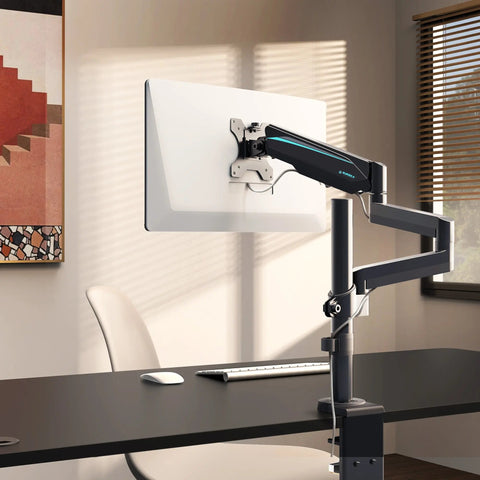
- Using a dual monitor stand to raise and push screens slightly rearward while keeping them stable.
For example, an Adjustable Keyboard Tray can mount under your floating surface so you keep the desktop visually thin but still give your forearms a proper, neutral position.
Sample ergonomic dimensions for a wall desk
Use these as starting points, then fine‑tune for your body:
| User Height (approx.) | Suggested Desk Height (seated) | Monitor Center Below Eye | Notes |
|---|---|---|---|
| 5'2"–5'5" (157–165 cm) | 26–27" (66–69 cm) | 4–6" (10–15 cm) | Likely need foot support if chair is high. |
| 5'6"–5'9" (167–175 cm) | 27–28" (69–71 cm) | 4–8" (10–20 cm) | Common range for many adults. |
| 5'10"–6'1" (178–185 cm) | 28–29" (71–74 cm) | 4–8" (10–20 cm) | Taller users may raise chair and add footrest. |
These are guidelines, not rigid rules. According to the UK Health and Safety Executive’s DSE guidance, workstations must be adjustable to fit the user and should be fine‑tuned to comfort, particularly for users with musculoskeletal issues.
Don’t forget standing and movement
Many people are tempted to mount a floating desk high and call it a standing desk. Ergonomic research suggests more nuance.
Cornell University’s Ergonomics Web advocates a “20‑8‑2” pattern: in any 30 minutes of computer work, aim for about 20 minutes sitting, 8 minutes standing, 2 minutes moving. This is a rhythm guideline, not a law, but it reinforces two truths:
- Standing is not exercise (as the WHO physical activity guidelines point out—true health benefits come from moderate‑to‑vigorous activity over the week).
- Both prolonged sitting and prolonged standing can contribute to discomfort and musculoskeletal strain.
Expert practice with wall desks is to:
- Optimize your floating desk for a comfortable seated posture.
- Add a sit–stand converter or separate standing surface if you want frequent standing.
- Use micro‑breaks, short walks, and stretching to reduce static loading.
4. Step‑by‑Step: Building Your Floating Desk in a Small Living Space
Here is a clear, practical workflow you can follow.
Step 1: Map the wall and define zones
- Choose the wall that best keeps your workflow out of main traffic paths.
- Use painter’s tape to mark:
- Desk top height (e.g., 28").
- Desk depth (e.g., 24").
- Any adjacent furniture, such as a tall bookshelf or cabinet.
- Sit on your intended chair in place and mimic typing to check arm angles.
If you plan to pair your desk with a vertical storage piece, you can align it with a display bookshelf such as the Ark EL, 71'' Display Bookshelf with Storage Cabinet, Oak to create a cohesive “work wall” that still feels like living‑room furniture.
Step 2: Find structure (studs or masonry)
- Use a reliable stud finder or test holes to locate studs.
- Mark at least two studs within your planned desk span.
- If you only have drywall, plan for heavy‑duty toggles rated well above your expected load, and reduce the span or total load.
Avoid relying on small plastic anchors alone for a desk‑depth surface.
Step 3: Choose your support system
Pick one of these common approaches:
- Continuous wood or steel cleat screwed across 2–3 studs.
- Wall‑mounted frame or bracket system supporting both back and sides.
For most home offices, a cleat + desktop approach gives you a minimalist look with serious strength.
Step 4: Size and prepare the desktop
Aim for:
- Depth: 22–24" in most cases.
- Width: 36–60" depending on room and stud spacing.
- Thickness: 1–1.5" for a solid, refined profile.
Lightly round or bevel the front edge to reduce wrist pressure—this small detail matters for long typing sessions.
Seal or finish any cut edges, especially if you use composite materials, to reduce emissions and moisture ingress.
Step 5: Install and load‑test safely
- Secure the cleat or brackets into studs or masonry with appropriate fasteners.
- Attach the desktop firmly, ensuring no play at the back edge.
- Pre‑load the desk with 1.5× your expected working load for at least an hour (for example, stack books, weights, or boxes).
- Observe:
- Any visible sagging across the span.
- Gaps opening between the desk and wall.
- Noises like cracking, popping, or fasteners shifting.
If everything stays quiet and stable, you’re ready to move on to ergonomics and ambiance.
5. Turning a Wall Shelf into a Workspace Sanctuary
Once the structure is safe, the magic comes from how you layout and soften the space so it feels like part of your home, not a temporary office dumped in the living room.
Layout: where laptop, monitor, and accessories live
Use this simple placement template:
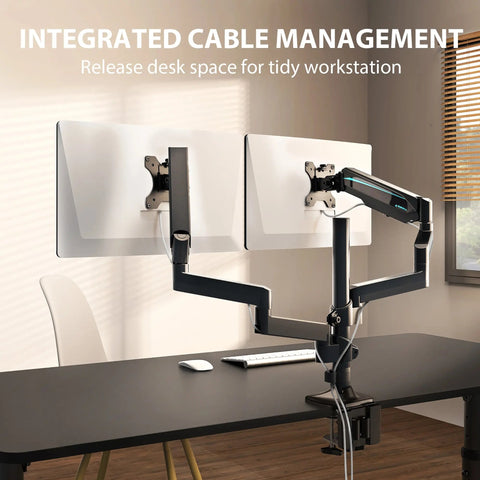
- Monitor(s): Centered on the desk, with the screen top at or slightly below eye level. A riser like a Carbon Fiber Dual Monitor Stand can lift one or two screens while freeing space underneath for keyboard storage.
- Keyboard & mouse: Directly in front of your torso, wrists straight. If your desk surface is set slightly high for aesthetics, use an Adjustable Keyboard Tray to bring your hands back into a neutral zone without changing the wall mount.
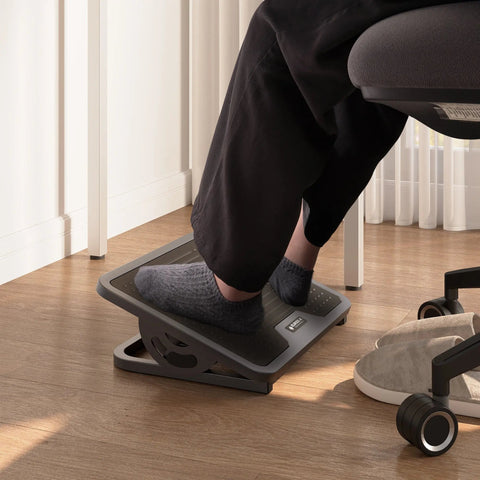
- Foot support: If your feet don’t rest flat when your elbows are at the right angle, add an Adjustable Ergonomic Footrest so knees stay around 90–100° and circulation is supported.
The U.S. OSHA Computer Workstations – Desks guidance emphasizes the importance of sufficient legroom and appropriate work surface height; footrests are explicitly recommended when users’ feet cannot rest flat after adjusting chair height.
Cable management: invisible tech, visible calm
For a minimalist office in a shared space, exposed cables ruin the effect and add actual ergonomic risk if they snag.
Installer‑tested rules that work well:
- Route cables into a discrete raceway or channel along the wall behind the shelf.
- Leave a 20–30 cm service loop in each cable so you can slide the laptop or monitor without strain.
- Use a single “umbilical” drop to the power strip and keep the strip off the floor if possible.
This keeps your floating desk looking almost wireless, even for dual‑monitor setups.
Storage: keep work clutter out of sight
In mixed‑use living rooms, privacy matters as much as aesthetics. You probably don’t want documents, notebooks, or work gear on display when friends visit.
Two strategies work particularly well:
-
Vertical closed storage next to the desk.
- A tall cabinet‑style bookshelf like the Ark EL, 71'' Display Bookshelf with Storage Cabinet, Oak provides both open shelves for decor and a door‑closed cabinet for work items.
- You can align the cabinet’s top with your floating desk to feel like a single built‑in composition.
-
Slim, concealed under‑desk storage.
- Shallow drawers or wall‑mounted boxes for notebooks, chargers, and stationery.
- Wall pockets or file holders on the return wall to keep papers vertical and out of sight.
The goal is that after work, you sweep everything into hidden storage, push in your chair, and the wall reads as a curated nook, not an active workstation.
Ambiance: light, color, and sound
A minimalist workspace sanctuary uses a few well‑chosen elements:
- Lighting: Combine a soft ambient source (ceiling or floor lamp) with a focused desk light that doesn’t create screen glare. The OSHA Workstation Environment guidance stresses controlling glare and reflections for comfort.
- Color palette: Keep the floating desk and adjacent storage in one or two wood tones or muted colors to avoid visual noise.
- Greenery and texture: A small plant, a framed print, or a textured ceramic piece on a floating section of the wall adds warmth without clutter.
6. Quick Configuration Templates for Different Apartments
To make this immediately usable, here are three scenario‑based setups.
A. Studio apartment “disappearing office”
- Wall: Short wall beside the sofa.
- Desk: 40"W × 24"D floating shelf, rounded front edge, mounted at 27".
- Storage: One tall oak bookshelf with lower cabinet directly adjacent.
- Accessories: Dual monitor stand to keep screens central; footrest to correct leg angle.
- Ambiance: Warm wall sconce above the desk, a single framed print, one plant.
When you close the laptop and tuck the keyboard under the stand, the wall reads as a reading nook.
B. Family living room shared by two adults
- Wall: Long wall opposite TV.
- Desk: 60"W × 24"D floating desktop, supported by a full‑length cleat.
- Zones: Left side for one person’s laptop, right side for another’s monitor.
- Storage: Closed cabinet for shared office supplies and personal items.
- Accessories: Two adjustable keyboard trays for individualized heights.
This setup respects different body sizes while maintaining a unified, uncluttered look.
C. Bedroom corner deep‑work pod
- Wall: Corner near the window.
- Desk: 48"W × 22"D floating shelf tying into both walls.
- Storage: One narrow cabinet plus a few floating display shelves above eye level.
- Accessories: Monitor stand to raise the screen; footrest; subtle LED strip under the shelf for evening focus.
With the chair angled slightly toward the window, you create a small sanctuary that feels separate from the bed.
7. Myth‑busting and Expert Tips for Long‑Term Comfort
Myth: “Standing all day at a wall desk is healthier than sitting correctly.”
Research compiled by the World Health Organization’s 2020 Guidelines on Physical Activity and Sedentary Behaviour emphasizes that health benefits come from 150–300 minutes of moderate‑intensity activity per week and reducing overall sedentary time, not just swapping sitting for static standing.
Evidence summaries on musculoskeletal disorders in office work also show that prolonged static standing can strain the lower limbs and back, much like prolonged sitting. A balanced routine of posture changes and short movement breaks is far more effective.
Pro Tip: Build movement into your minimalist setup
Use your elegant floating desk as a cue for healthy rhythm rather than a static pedestal:
- Set a timer or software reminder for 20–30 minute intervals.
- Alternate between typing, standing, and brief walks.
- Use the edge of the desk for gentle stretches, but do not put your full body weight on it.
According to EU‑OSHA’s feature on prolonged static sitting at work, interrupting long periods of sitting with small movement bouts significantly reduces discomfort and long‑term risk. Meta‑analyses such as Santos et al. 2025 on ergonomic interventions confirm that well‑designed adjustments and posture changes measurably reduce musculoskeletal pain in working populations.
Wrapping Up: Key Takeaways for Your Floating Desk Office
A wall‑mounted floating desk can completely transform a small living room or bedroom into a calm, high‑functioning workspace sanctuary—if you treat it like both furniture and light engineering.
Remember these core principles:
- Depth and ergonomics matter. Target 22–24" depth and set the work surface at your elbow height when seated; adjust monitor height and distance to keep your gaze slightly downward.
- Overbuild for safety. Plan for 2.5× your expected load, hit at least two studs, and use continuous cleats or robust brackets; test with 150% load before daily use.
- Protect your posture. Use tools like an adjustable keyboard tray, monitor stand, and footrest to fine‑tune your neutral posture, and follow movement rhythms like 20‑8‑2 rather than standing all day.
- Blend form with function. Pair the desk with closed storage, thoughtful lighting, and disciplined cable management so your workspace disappears visually after hours.
With a bit of planning and respect for both physics and ergonomics, your floating desk can become the most inspiring, efficient square meter in your home.
Disclaimer: This article is for informational purposes only and does not constitute professional engineering, construction, or medical advice. Wall conditions, building standards, and individual health needs vary widely. Before modifying structural elements or if you have existing musculoskeletal or other health conditions, consult a qualified contractor, structural professional, or healthcare provider.
Sources
- OSHA – eTools: Computer Workstations
- CCOHS – Office Ergonomics: Sit/Stand Desk
- Cornell University Ergonomics Web – Guides
- WHO – 2020 Guidelines on Physical Activity and Sedentary Behaviour
- HSE – Working Safely with Display Screen Equipment
- OSHA – Workstation Environment
- Prolonged Static Sitting at Work – Health Effects and Good Practice Advice (EU‑OSHA)




Leave a comment