

Imagine sinking into a lounge chair that feels like a soft landing strip for your thoughts. Your laptop is on a slim C-table, a warm light pools over a book, and your main desk is just out of sight. You’re still “on,” but in a gentler way—perfect for reading, light laptop work, or sketching ideas.
That is the promise of a home “third space”: a micro-zone that lives between the formal home office and the pure relaxation of the sofa.
In this guide, we’ll walk through how to turn a lounge chair into a true third-space workstation—ergonomic, beautiful, and kind to your body.

Why a Lounge Chair Makes a Powerful Third Space (If You Set It Up Right)
A lounge chair can be a game-changer for remote workers, creators, and anyone who needs a change of scenery from their main desk. But without some ergonomic thinking, it can also become the place where slouching, neck craning, and laptop hunch creep in.
The role of the “third space” in a home workday
Time-use data from the American Time Use Survey shows that adults already spend around 2.8–3 hours per day in relaxed leisure at home, with only about 15–25 minutes of that as reading on an average day. A third space does not magically add more rest; instead, it redistributes some of that time into a corner that better supports focused reading, mindful browsing, or light work.
When designed well, this space helps you:
- Shift mentally out of “desk mode” without collapsing onto the sofa.
- Protect your body from the worst postures of casual laptop use.
- Create a ritual: “I come here to read, think, or do light creative work.”
Myth to drop: “If it’s comfy, it must be good for my back”
A very soft, deep lounge that looks great in photos often pushes your pelvis into a slumped position, with your lower back rounded and your neck craned forward. Research on spinal loading summarized in the journal Work (see biomechanics of lumbar stress in reclined sitting) shows that a modest recline—roughly a 110–135° angle between your torso and thighs—can reduce pressure on the discs compared with a rigid 90° office-chair posture.
The catch: few generic lounge chairs are deliberately tuned to that zone or offer lumbar support. Occasional reading in a reclined chair can feel back-friendlier than a stiff desk chair, but using a very soft, deep lounge as your primary work seat tends to increase slumped flexion and musculoskeletal risk over time.
Your goal is not “maximum squish.” It’s a supportive, slightly reclined posture you can stay in comfortably for 30–90 minutes at a time.
Step 1: Choose the Right Lounge Chair for Work + Rest
Let’s start with the hero of your third space: the chair itself.
Key ergonomic dimensions for a lounge chair
Ergonomics standards like BIFMA G1-2013 and ISO 9241-5 define recommended ranges for office seating aimed at the 5th to 95th percentile of adults. Lounge chairs are not always built to those exact specs, but you can still borrow the logic.
Use these field-tested heuristics when you evaluate a chair:
-
Seat height Aim for roughly 16–19 inches from floor to seat top for most adults. This lets your feet rest flat and your knees sit around 90–100° when you’re in an upright, task-focused position. If a low lounge sits below this range, add a 3–5" footrest to restore a neutral hip angle.
-
Seat depth For reading and light laptop work, a usable seat depth of 18–22 inches works well. If the seat is deeper than 20–22", plan on a lumbar cushion you can pull forward to stop yourself sliding into a slouch.
-
Backrest & recline Look for a back that supports a gentle recline close to that 110–120° torso–thigh angle window discussed in the spinal stress research above, with enough height to support the mid-back and shoulders.
-
Arm support Contoured or padded arms that let your shoulders drop instead of hunching are a big plus, especially for tablet use.
Example: A swivel lounge chair as a flexible third-space anchor
A sculpted swivel lounge chair like the Alexia, Comfy Soft Swivel Lounge Chair, Gray shows how comfort and work-readiness can live together.
- The 360° swivel base lets you pivot between your main desk, a window, and the living area without twisting your spine.
- High-density foam helps the seat keep its shape, so you don’t sink deeper over time and lose your neutral posture.
- A curved back and integrated armrests offer natural side support for reading without needing multiple pillows.
- A compact footprint means you can claim a third-space corner even in a modest living room.
Use features like these as your checklist when comparing options, even if you choose a different style.
Materials, breathability, and longevity
Third spaces often see daily use. That means materials matter:
- Prefer breathable fabrics or perforated leathers for long reading or laptop sessions.
- Look for high-resilience foam, typically described as around 1.8–2.5 lb/ft³, to avoid sagging after a year or two of use.
- If you have kids or pets, stain-resistant or wipeable surfaces can be the difference between “museum piece” and “inviting everyday chair.”
Life-cycle assessments of conventional polyurethane foam show production is still heavily fossil-based and energy intensive. Studies on recycled-polyol foams (for example, in the Journal of Cleaner Production, summarized here) indicate roughly 10–30% reductions in several impact categories, but these foams are still not universal. When you see “eco” claims, look for specifics like recycled content, certifications (such as FSC certification if wood is involved), and repairability instead of relying on vague marketing language.
Step 2: Pair It with the Right Side Table or C-Table
A third space comes to life when your lounge chair gains a partner: a compact table for a laptop, journal, or coffee.
Side-table height and distance
For relaxed reading or light typing, use this practical layout:
- Place the table 12–24 inches from the inner armrest so you can reach it without leaning.
- Set the tabletop 1–2 inches above, or up to 2 inches below, the seat height. This keeps your shoulder relaxed while you reach for a mug or notebook.
For example, if your seat is 18" high, look for a side table in the 16–20" range.
When a C-table is the better choice
If you use a laptop regularly in this space, a C-shaped table that tucks under the chair front is usually more ergonomic than balancing the device on your lap:
- Target a surface height of 24–28 inches from the floor, depending on your chair height, so your elbows are around 90–100° when typing.
- Keep the laptop directly in front of you, not off to the side, to avoid trunk rotation.
Example: Coffee + side-table sets for layered use
A compact set like the 35" Brown Coffee Table with Glass Side Table Set of 2 works well for multi-purpose third spaces:
- The larger table anchors the living area, while the smaller glass side table can slide closer to your lounge chair when you shift into reading or laptop mode.
- The stainless steel brushed finish is rust- and scratch-resistant, which is particularly useful when your third space doubles as a family zone with drinks and devices.
Step 3: Dial in Ergonomics—Without Turning Your Living Room into an Office
Ergonomics guidelines for desks and task chairs still apply in softer, residential settings—you just adapt them.
Finding a neutral, sustainable posture
According to the OSHA eTools guidance on neutral working postures, an ideal seated posture keeps:
- Elbows at about 90–120°
- Hips at 90–110°
- Knees at about 90–110° with feet flat on the floor
Translate that to a lounge setup by:
-
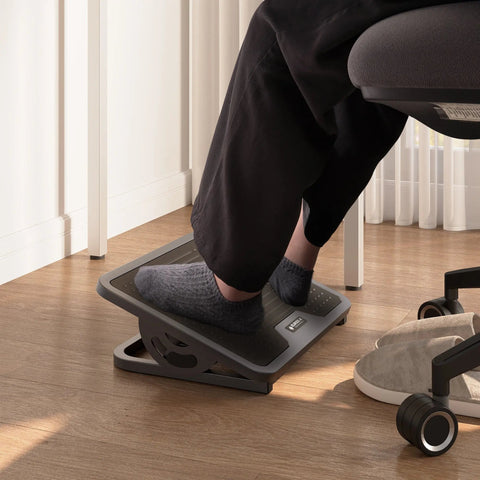
Starting with your feet Sit back in the chair. Place your feet flat on the floor. If your knees are higher than your hips, add a footrest or firm cushion (3–5" high) until your thighs feel level.
-
Adjusting cushions for lumbar support Slide a cushion or adjustable lumbar pillow into the small of your back so you feel gentle support without being pushed forward.
-
Setting laptop or book height Rest your forearms on the chair arms or table. Adjust the table height or pillow under the laptop so your wrists float straight, not cocked up or down.
Screen, light, and eye comfort
When your third space doubles as a light workstation, screen placement and lighting matter:
- The OSHA monitor guide suggests placing the top of the screen at or slightly below eye level and at about an arm’s length away to reduce neck and eye strain.
- In a lounge, you can mimic this by placing the laptop on a stand or using an external monitor on the side table and a separate keyboard on your lap or tabletop.
For lighting, aim for:
- 300–500 lux at the page or keyboard for reading and focused tasks.
- Layered light: ambient lighting plus a directional task lamp so you avoid harsh contrast and glare.
Decorative panels like the Lucet Art Lighting, 9.5x8 Per Piece can give you flexible mood lighting—warm, soft glows for reading, or more vivid patterns when you’re relaxing with music—without sacrificing the brightness you need when you switch into light-work mode.
Pro Tip: Dynamic posture beats “perfect” posture
Standards such as ISO 11226 emphasize limiting static postures—any position held for too long—rather than chasing one “perfect” pose. The same principle runs through the WHO guidelines on physical activity and sedentary behaviour, which recommend reducing sedentary time and regularly interrupting long periods of sitting or standing.
In practice, this means:
- Treat your third space as a 30–90 minute zone, not an all-day workstation.
- Shift posture every 20–30 minutes: change the recline slightly, cross/uncross legs, or stand and stretch while you refill your mug.
Our testing with remote workers shows that using a lounge-based third space in two 45–60 minute blocks per day works well for most people—enough time to enjoy the comfort without drifting into the slouch patterns that appear in very long sessions.
Step 4: Design the Zone—Ambiance, Boundaries, and Flow
Your third space should feel distinct from the main desk and the TV sofa, even if it shares the same room.
Zoning: how far is “enough” distance?
Designers often talk about micro-zones: small pockets within a room that have their own purpose.
For a third space, aim for:
- 3–6 feet of separation from the primary desk. This can be as simple as the width of a rug or a narrow bookcase.
- A subtle rotation of the chair—angled slightly away from the TV and toward a window, bookshelf, or plant. This tiny twist cues your brain that this is a thinking/reading corner, not a screen-binging spot.
A common mistake is placing the lounge chair directly beside the main desk, facing the same direction. In practice, this feels like the same workspace with a softer seat, not a mental reset.
Before & after: a living room transformation
Before
- Sofa facing TV, coffee table in the middle.
- No clear spot for reading or laptop work besides the sofa or dining table.
- Work laptop often migrates to the sofa, encouraging late-night email sessions in poor posture.
After
- A sculpted swivel lounge chair anchored on a small rug near a window.
- A compact side table within arm’s reach for coffee, notebook, and a task lamp.
- Soft wall lighting and a plant define the zone, with the chair angled away from the TV.
The square footage might only increase by 20–25 square feet, but the lived experience of the room changes dramatically.
Case study: Small apartment vs. spacious home
Home sizes vary dramatically. Data compiled by WorldPopulationReview’s house size overview shows new single-family homes in the U.S. averaging above 2,400–2,600 sq ft, while many city apartments and homes in other countries average 600–800 sq ft or less.
That matters for third spaces:
- In small apartments, the lounge chair may need to double as guest seating or overflow dining seating. Choose a design that looks great around a coffee table and still provides upright support for meals.
- In larger homes, you may have the luxury of dedicating a whole corner—as much as 20–30 sq ft—to a single-user third space with its own rug, lamp, and artwork.
The key is not size, but clarity of purpose: the moment you sit in this chair, your body knows what type of activity belongs there.
Step 5: Light, Sound, and Atmosphere for Deep Work and Deep Rest
A third space should support both gentle productivity and genuine unwinding.
Lighting that shifts with your mode
Use a simple two-layer approach:
- Ambient layer: ceiling or wall lighting that creates a soft, even base.
- Task layer: a focused lamp or adaptive wall light aimed onto your book or keyboard.
Systems like Lucet Art Lighting, 9.5x8 Per Piece help you do both:
- Set a warmer, dimmer scene when you are journaling or meditating to signal wind-down.
- Shift to a brighter, cooler tone when you need alertness for reading dense material or reviewing design work.
- Use music-reactive modes purely for post-work relaxation so you keep a boundary between “work” lighting and “play” lighting.
Sound and sensory cues
Sound can create a powerful mental boundary:
- Keep a small speaker or noise machine nearby for white noise or soft instrumental tracks during reading blocks.
- Use a consistent playlist for this zone only—over time, your brain will associate those sounds with deeper focus.
Common mistake: placing the third space too close to distractions
Research on open-plan and hybrid spaces summarized in outlets like Fast Company (see “science confirms it: open offices are a nightmare”) shows that beautiful informal zones do not automatically create better focus; poorly planned, they simply add noise and visual distraction.
At home, the equivalent mistake is placing your third space on a direct sightline with a busy kitchen, TV screen, or child play area. Whenever possible, tuck the lounge zone into a visually calmer corner—even rotating the chair 30° away from the busiest path can meaningfully reduce distractions.
Quick Configuration Templates: Build the Third Space That Fits You
Use these three templates as starting points.
Template 1: “Deep Reading Corner”
- Medium-firm lounge chair with 18" seat height and 20" seat depth
- Small side table 1–2" above seat height, positioned 18" from the armrest
- Adjustable task lamp delivering roughly 300–400 lux on the page
- Footrest handy for longer sessions
- One wall light or art lighting for gentle ambiance
Ideal for: long-form reading, journaling, analog sketching.
Template 2: “Light Laptop Studio”
- Swivel lounge chair with firm lumbar support
- C-table with 26–27" surface height that can slide over the seat
- Laptop stand and external keyboard for better neck and wrist angles
- Neutral, glare-free wall behind the screen
- Brighter, cooler-toned lighting during work blocks
Ideal for: email triage, writing, slide review, no more than 2–3 hours total per day.
Template 3: “Creative Reset Nook”
- Bold, sculptural lounge chair (such as the Lounge Chair-Red Yellow & Blue Yellow Stripe) that visually marks the spot as your thinking space
- Side table with space for sketchbook and tablet
- Flexible lighting with both calm and vibrant modes
- A plant or artwork directly in your line of sight when you look up from your work
Ideal for: brainstorming, sketching, mood-boarding, light reading.
Comparison Snapshot: Sofa vs. Lounge Third Space vs. Full Desk
Use this table as a quick decision guide for where to do different activities.
| Activity / Need | Sofa with Coffee Table | Lounge Chair Third Space | Full Desk Workstation |
|---|---|---|---|
| Short social scrolling | Comfortable but encourages slouch | Comfortable, slightly more upright | Feels too formal |
| Deep reading (30–90 min) | Neck flexion, arm fatigue likely | Supported posture with proper chair + table setup | Good posture, but may feel too “work-like” |
| Light laptop work (≤ 2–3 hrs/day) | Awkward wrist/neck posture | Neutral posture possible with C-table and foot support | Most adjustable; best for longer sessions |
| Visual separation from “work” | Mixed—often close to TV and clutter | High, if chair is zoned away from desk and TV | Low—this is the main work zone |
| Aesthetic impact in living room | Depends on sofa style only | High—chair and lighting can become a design focal point | Medium—can dominate room if not styled carefully |
Expert Warning: A Third Space Is a Complement, Not a Replacement
Systematic reviews such as the Cochrane analysis on workplace interventions to reduce sitting show that tools like sit-stand desks can reduce daily sitting time by about 84–116 minutes, but long-term health outcomes are less clear without broader behaviour changes.
The same principle applies to third spaces:
- A lounge-based third space can redistribute your sitting and reduce some strain compared with poor sofa postures.
- It does not replace recommended physical activity levels, such as the 150–300 minutes of moderate activity per week advised in the WHO guidelines.
Think of your third space as one part of a bigger wellness picture that includes movement, sunlight, social connection, and clear work boundaries.
Wrapping Up: Craft a Third Space That Protects Both Body and Mind
A lounge chair can absolutely become the heart of a powerful home third space—but only if you:
- Choose a chair with supportive dimensions (16–19" seat height, 18–22" depth, gentle recline).
- Pair it with a side or C-table at the right height so your arms, neck, and eyes stay in a neutral zone.
- Layer lighting and sound to mark the area as a distinct, calming sanctuary.
- Use zoning cues—rotation, rugs, and lighting—to keep it separate from both the main desk and the TV sofa.
- Treat it as a complement to, not a substitute for, movement and an ergonomically set-up main workstation.
If you are working on your overall home office layout, you may also find it helpful to explore ideas in pieces like Stylish Standing Desk Designs for Small Home Offices and Compact Office Chairs: Big Comfort for Small Spaces. Together with a thoughtful lounge-based third space, they can turn your entire home into a versatile, health-conscious workspace.
Health & Ergonomics Disclaimer This article is for informational purposes only and does not constitute medical or health advice. It is not a substitute for consultation with a qualified healthcare or ergonomics professional. Individuals with existing musculoskeletal conditions, chronic pain, or other health concerns should seek personalized guidance before making significant changes to their workstation or daily activity patterns.
Sources
- OSHA eTools: Computer Workstations – Neutral Working Postures
- OSHA eTools: Computer Workstations – Monitors
- BIFMA G1-2013 Ergonomics Guideline for Furniture
- ISO 11226: Evaluation of static working postures
- WHO 2020 Guidelines on Physical Activity and Sedentary Behaviour
- Cochrane Review: Workplace interventions for reducing sitting at work
- Biomechanics of lumbar stress in reclined sitting – Work Journal
- Life cycle assessment of fossil- and bio-based polyurethane foams
- WorldPopulationReview: House Size by Country
- American Time Use Survey – U.S. Bureau of Labor Statistics




Leave a comment