

The Ergonomic Mismatch: Why Standard Workstations Fail Petite Users
For individuals standing 5'4" or shorter, the modern home office often feels like a space designed for someone else. This is not a mere feeling; it is a documented anthropometric reality. Most mass-market office furniture is engineered to accommodate the 50th to 95th percentile of the population, often leaving the 5th percentile—the petite user—struggling with desks that are too high and chairs that are too deep.
Quick Start: The 3-Step Petite Setup If you are under 5'4", your path to comfort begins with these three "Answer First" metrics:
- Target Desk Height: Aim for 24.5 to 25.5 inches (standard desks are usually 29").
- Seat Depth: Ensure your chair pan is 14 to 16 inches deep to prevent knee pressure.
- The "Elbow Rule": Your desk surface should meet your elbows at a 90-degree angle while your shoulders are relaxed and feet are flat.
The consequences of this "ergonomic mismatch" typically manifest in the late afternoon. It begins as a dull ache between the shoulder blades, progresses to a tingling sensation in the wrists, and often ends with lower back stiffness. Many users attribute this fatigue to the nature of hard work, yet the root cause is frequently a violation of fundamental physiological principles. Understanding how to bridge this gap requires a specialized, data-driven approach to workspace design.
The Physiology of Static Load and Musculoskeletal Disorders (MSDs)
To understand why a desk that is just two inches too high can cause significant pain, one must look at the mechanics of the human musculoskeletal system. According to the U.S. Occupational Safety and Health Administration (OSHA), Musculoskeletal Disorders (MSDs) are often the result of three primary risk factors: excessive force, repetitive tasks, and awkward postures.
For the petite user, "awkward posture" is often a permanent state. When a desk is too high, the user must shrug their shoulders to reach the keyboard. This creates a "static load" on the trapezius muscles. Unlike dynamic movement, which promotes blood flow, static loading restricts circulation, leading to a buildup of metabolic waste products in the muscle tissue. Over time, this can lead to chronic conditions such as tension neck syndrome or rotator cuff tendonitis.
Furthermore, the ISO 11226:2000 standard on the evaluation of static working postures emphasizes that the duration and angle of a posture are critical. A petite user sitting in a standard chair often finds that the seat pan is too deep, causing the front edge to press against the back of the knees (the popliteal fold). To avoid this discomfort, the user typically slides forward, losing the support of the backrest. This "perch sitting" flattens the lumbar curve, placing immense pressure on the spinal discs.
Quantifying the "Petite Gap": A Technical Analysis
To move from theory to practice, we must examine the specific dimensions required for an ergonomic fit. The following data represents a simulated model for a 5'2" (157.5 cm) user.
| Metric | Standard Office Dimension | Ideal Petite Dimension (5'2" User) | The Ergonomic Gap |
|---|---|---|---|
| Desk Height (Seated) | 29 - 30 inches | 24.5 - 25.8 inches | ~3.2 - 5.5 inches |
| Seat Depth | 18 - 20 inches | 14 - 15.5 inches | ~4.0 inches |
| Monitor Height | Fixed Stand (High) | Eye-level or slightly below | Variable |
| Foot Placement | Flat on Floor | Requires Support | 2 - 4 inches |
Methodology Note: These "Ideal" values are derived from a geometric model using 5th percentile female anthropometric data (NHANES/CDC). The simulation assumes a neutral 90-degree elbow flexion, a 1-inch shoe sole thickness, and a compressed seat cushion height. This model serves as a baseline; individual limb-to-torso ratios may require +/- 1 inch of adjustment.
As noted in The 2026 Workstation White Paper: Converging Ergonomic Science and Sustainable Engineering, the "neutral position" is the gold standard for preventing injury. For a user under 5'2", achieving this requires a desk that can descend significantly lower than the industry standard.
Solving the Spatial Constraint: The Compact Standing Desk
In small apartments, a massive executive desk is rarely an option. A compact standing desk addresses both the body's needs and the room's constraints.
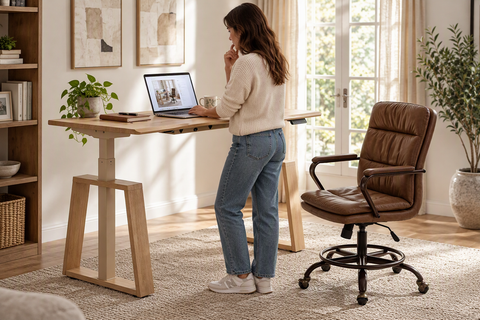
Featured Solution (Eureka Ergonomic): The Standing Desk with Drawers, Wood Finish (47'' /55'') allows for a minimum height that accommodates shorter statures while maintaining a small footprint. (Alternative: Users can also look for third-party "junior" desks or "keyboard tray" attachments that lower the input surface below the main desktop.)

When selecting a desk for a small space, the depth is critical. A 24-inch depth is often the "sweet spot." Our spatial analysis shows that in a 10-foot deep room, a 24-inch desk leaves a comfortable 26-inch surplus for secondary circulation. For high-traffic areas, the Faux Saddle Leather Adjustable Standing Desk (55"x23") [Brand Recommendation] offers a shallower 23-inch profile.
The Load Capacity Myth
One common misconception is that a single-motor compact desk is "weaker" than a dual-motor professional unit. However, a typical petite user's setup—a laptop, a 27-inch monitor, and peripherals—rarely exceeds 35 kg. Most modern single-motor desks are rated for 80 kg, meaning the setup operates at only 43.75% capacity, ensuring long-term motor reliability.
Essential Accessories for the Petite Workspace
1. The Role of the Footrest
The Adjustable Ergonomic Footrest [Brand Recommendation] is the single most important tool if your chair does not go low enough for your feet to reach the floor. When feet dangle, the weight of the legs pulls on the lower back. (Generic Alternative: A firm yoga block or a stack of sturdy books can serve as a temporary DIY footrest to stabilize the pelvis.)
2. Monitor Placement and Visual Parallax
According to the Canadian Centre for Occupational Health and Safety (CCOHS), the top line of text on the screen should be at or slightly below eye level. Using a desk with a built-in monitor riser or a flexible third-party monitor arm allows for this precise vertical adjustment, preventing "chin-up" posture.
3. Mobile Storage Solutions
In small spaces, verticality is key. A Mobile Height Adjustable CPU Cart [Brand Recommendation] moves the computer tower off the desk, freeing up valuable legroom—a critical factor for petite users who need to move their legs freely to maintain circulation.

The 20-8-2 Rhythm: A Behavioral Framework
Hardware is only half of the equation. The World Health Organization (WHO) 2020 Guidelines recommend interrupting long periods of static behavior. We recommend the "20-8-2" rule developed by researchers at Cornell University:
- 20 Minutes Sitting: Neutral posture, feet supported.
- 8 Minutes Standing: Change the load on the spine using a standing desk.
- 2 Minutes Moving: Stretching or walking to promote blood circulation.
Practical Setup Checklist (Interactive Guide)
To optimize your home office, use this step-by-step calibration:
- Measure Your Seated Elbow Height: Sit with shoulders relaxed. Measure from the floor to the underside of your elbows. This is your Target Desk Height.
- Verify Seat Depth: Sit back fully. Ensure a 2-to-3-finger gap between the seat edge and the back of your knees.
- The "Arm's Length" Test: Your monitor should be one arm's length away.
- Reach Zone Mapping: Keep your mouse and phone within a 10-inch radius of your neutral hand position.
- Stabilize the Base: If your knees are not at a 90-degree angle with feet flat, add a footrest immediately.
For more detailed guidance, refer to our guide on Setting Up Your Standing Desk for Peak Productivity.
YMYL Disclaimer: This article is for informational purposes only and does not constitute professional medical advice. Always seek the advice of your physician or a qualified physiotherapist regarding musculoskeletal pain or pre-existing conditions.




Leave a comment