

Why Your First Office Chair is a Health Investment, Not Just Furniture
Selecting your first ergonomic office chair can feel like a major decision, and it is. For many working from home, the dining chair or sofa quickly reveals its shortcomings through afternoon back pain, neck strain, and a general feeling of fatigue. This discomfort is more than just an annoyance; it's a warning sign. According to the U.S. Occupational Safety and Health Administration (OSHA), work-related musculoskeletal disorders (MSDs) are among the most frequently reported causes of lost or restricted work time. These injuries often result from the cumulative impact of poor posture and static positions.
When you sit for long hours in a chair not designed for computer work, you subject your body to static loading. Your muscles work continuously to hold your body in place, leading to fatigue. As EU-OSHA notes in its guidance on prolonged static sitting, this can reduce blood circulation and increase the load on your spinal discs. An ergonomic chair is not a luxury; it's a fundamental piece of equipment designed to mitigate these risks. It serves as a primary "engineering control," a solution that addresses the root cause of the hazard by providing proper support and encouraging healthy posture.
Decoding Ergonomic Features: What Really Matters?
Navigating the world of ergonomic chairs means encountering a lot of terminology. The key is to focus on adjustability. A chair is only ergonomic if it can be adjusted to fit your body. Industry guidelines like the BIFMA G1-2013 Ergonomics Guideline are developed to ensure furniture can accommodate a wide range of body types, typically from the 5th to the 95th percentile of the population. Here’s what to look for.
Foundational Adjustments: The Non-Negotiables
- Seat Height: This is the most basic adjustment. Your feet should rest flat on the floor (or on a footrest) with your knees bent at approximately a 90 to 100-degree angle. This position helps maintain a stable base and reduces pressure on your lower back.
- Seat Depth: Proper seat depth ensures your back is fully supported by the backrest while leaving a small gap—about two to three fingers' width—between the front edge of the seat and the back of your knees. This prevents the seat from cutting off circulation to your lower legs.
The Pillars of Support: Lumbar, Armrests, and Backrest
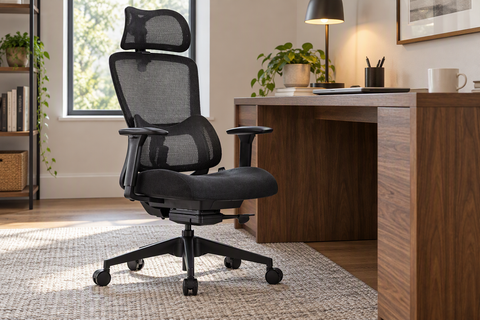
- Lumbar Support: This is arguably the most critical feature for preventing low back pain. The lumbar support should fit into the natural inward curve of your lower spine. A common mistake is adapting your posture to a fixed support; instead, the support should adapt to you. Advanced chairs often feature height-adjustable or even depth-adjustable lumbar systems. For example, the Exis,Ergonomic Office Chair includes a 4-level adjustable lumbar support, allowing you to position the support precisely where your spine needs it most.

-
Armrests: Adjustable armrests are essential for reducing strain in your shoulders and neck. I used to think they were optional until I realized my persistent shoulder tension came from my arms hovering over the desk all day. Your armrests should be set at a height where your elbows can rest at a 90-degree angle with your shoulders relaxed. Look for 3D or 4D armrests, which allow for adjustments in height, width, and pivot, providing support for various tasks like typing or reading.
-
Backrest Recline: A chair that encourages dynamic movement is superior to one that locks you into a single position. The ability to recline allows you to shift your weight, decompress your spine, and vary the load on your back muscles throughout the day. A recline range between 100-135 degrees is ideal for transitioning between focused work and more relaxed postures.
Material and Build Quality
A common misconception is that a softer, more "cushiony" seat is better. In reality, a medium-firm seat cushion made of high-density foam provides more consistent support and prevents "bottoming out," which can lead to posterior pelvic tilt and increased lumbar strain. For the backrest, breathable mesh is a popular choice as it promotes airflow, keeping you cool during long sessions. A chair like the Lira, Ergonomic Office Chair, with its modern mesh back, provides this benefit while maintaining a supportive structure.

The Shopping and Setup Process: A Practical Checklist
Finding the right chair is only half the battle; setting it up correctly is just as important. This process starts before you even buy.
Expert Warning: Debunking the 5-Minute Sit Test
A common myth is that you'll know the right chair the moment you sit in it. This is rarely true. A quick sit in a showroom doesn't reveal how your body will feel after two, four, or eight hours. Pressure points and support inadequacies often surface only after prolonged use. When testing a chair, try to simulate a real work session of at least 60 minutes. Type, read, and use the recline function to see how it supports you through different tasks.
Pre-Purchase Checklist
Use this table as a decision-making framework when comparing chairs. It focuses on the features that deliver the most significant ergonomic benefits.
| Feature | What to Look For | Why It Matters for Your First Chair |
|---|---|---|
| Seat Height Range | A range that allows your feet to be flat on the floor with knees at ~90-100°. | Establishes a stable, neutral foundation for your entire posture. |
| Seat Depth Adjustment | Sliding mechanism with at least 2 inches of travel. | Prevents pressure behind the knees and ensures your back can reach the backrest. |
| Lumbar Support | Height-adjustable; depth adjustment is a major plus. | Directly reduces strain on the lower back, a common site of office-related pain. |
| Armrest Adjustability | At least 2D (height, width); 3D/4D is better. | Relaxes shoulders and reduces tension that travels up to the neck and head. |
| Backrest Recline | A range of at least 100-130° with multiple locking positions or tension control. | Encourages dynamic movement, which is critical for spinal health and preventing stiffness. |
| Seat Cushion | Medium-firm, high-density foam (at least 2-4 cm thick). | Provides enduring support without causing the pelvic tilt that soft cushions can. |
The First Two Weeks: Fine-Tuning Your Fit
Don't expect immediate perfection. Ergonomists suggest a 5 to 10-day adaptation period for your body to adjust to a new, supportive posture. Start with a foundational setup and make small tweaks each day. For a detailed walkthrough, our guide on Setting Up Your Ergonomic Chair for Maximum Comfort provides a step-by-step process.
- Start with Your Feet: Adjust the chair height so your feet are flat on the floor.
- Set Your Depth: Slide the seat so you have that 2-3 finger gap behind your knees.
- Position Lumbar Support: Adjust the lumbar curve to fit snugly in your lower back.
- Adjust Armrests: Bring the armrests to a height where your elbows are at 90 degrees and shoulders are down.
- Check-in and Tweak: After a day or two, re-evaluate. Is there pressure anywhere? Are your shoulders creeping up? Make small adjustments and live with them for another day before changing again.
Beyond the Chair: Creating a Truly Ergonomic Ecosystem
Your ergonomic chair is the centerpiece of your workstation, but it works as part of a system. To get the full benefit, you must consider how it interacts with your other equipment.
-
Monitor Height: According to Cornell University's Ergonomics Web, your monitor should be positioned so the top of the screen is at or slightly below eye level. Looking down at a laptop or a low monitor is a primary cause of neck pain. A simple fix is a monitor stand, like the Carbon Fiber Dual Monitor Stand, which raises your screens to an ergonomic height while also providing organizational space.
-
Foot Position: If your feet don't comfortably reach the floor after adjusting your chair to the correct height relative to your desk, an Adjustable Ergonomic Footrest is a must. It provides a stable surface to prevent dangling feet, which can cause poor circulation and lower back strain.
-
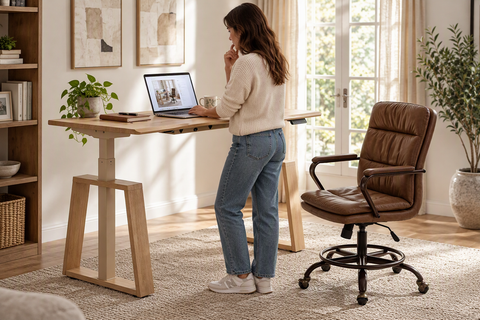
Introduce Movement: Standing is not a replacement for exercise, but alternating between sitting and standing is an effective way to combat a sedentary workday. A good starting rhythm to try is 30-50 minutes of sitting followed by 10-20 minutes of standing. This simple habit promotes blood circulation and reduces the static load on any single muscle group.
Key Takeaways
Choosing your first office chair is an investment in your long-term well-being and productivity. Instead of getting lost in marketing terms, focus on the fundamentals that deliver proven results.
- Prioritize Adjustability: A chair that can be tailored to your body is the only chair that will be truly ergonomic for you. Focus on seat height, seat depth, lumbar support, and armrests.
- Understand the Feel: A medium-firm cushion provides better long-term support than an overly soft one. Give your body at least a week to adapt to a new, more supportive chair.
- Think Systematically: Your chair is part of a larger ecosystem. Ensure your monitor is at eye level and your feet are properly supported to complete your ergonomic setup.
By following these principles, you can move beyond aesthetics and make an informed choice that will support your health for years to come.
Frequently Asked Questions (FAQ)
How much should I spend on my first ergonomic chair? While price doesn't always equal quality, a good entry-level ergonomic chair with essential adjustments (seat height/depth, adjustable lumbar, and 2D armrests) typically starts in the $300-$500 range. Consider it an investment in your health that pays off in comfort and productivity.
Is a mesh or foam chair better? This often comes down to personal preference. Mesh chairs offer superior breathability, which is great for warmer climates or people who tend to run hot. Fabric or foam chairs can provide a plusher feel, but it's crucial to ensure the foam is high-density to provide adequate support.
How do I know if the lumbar support is in the right place? The support should be positioned to fill the natural inward curve of your lower back, roughly at the same level as the top of your pelvis or belt line. You should feel a gentle, supportive pressure, not an aggressive push.
Do I need a headrest? A headrest is most beneficial for users who frequently recline to read or take breaks. For standard upright typing, it is less critical. However, if you suffer from neck pain, a properly adjusted headrest can provide significant relief by supporting the weight of your head.
Disclaimer: This article is for informational purposes only and does not constitute professional medical advice. You should consult a qualified professional, such as a physical therapist or an ergonomist, for advice tailored to your specific needs, especially if you have pre-existing health conditions.




Leave a comment