

The Ergonomic Foundation: More Than Just a Surface
Before considering monitors or peripherals, the desk and chair form the foundation of your well-being. A setup that fails to support a neutral posture can lead to musculoskeletal disorders (MSDs), a risk highlighted by occupational health authorities like the U.S. Occupational Safety and Health Administration (OSHA). The goal is to create an environment where your body can remain in a relaxed, neutral position for hours, whether you're in a tense firefight or meticulously editing a video timeline.
A common mistake is prioritizing aesthetics over adjustability. I've seen countless beautiful setups that cause visible discomfort because the desk or chair locks the user into a single, awkward posture. The fix is to start with ergonomics and build aesthetics around it. An adjustable-height standing desk is a powerful tool for both gamers and creators, as it allows you to change positions and reduce the health risks associated with static postures. Research, including a major 2018 review from Cochrane, has shown that sit-stand desks can significantly reduce sitting time.
For the Gamer: Stability and Space
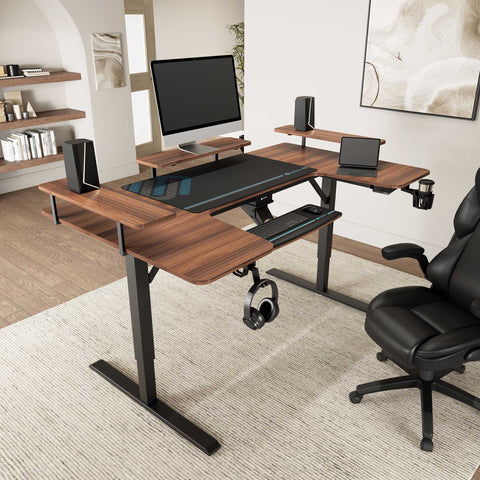
A gamer's desk must be a fortress. During high-stakes moments, the last thing you need is a wobbly surface. Look for desks with robust steel frames, cross-bracing, and a high weight capacity (>150 lbs), especially if you use multiple heavy monitors or a large PC case. The surface needs to be expansive enough to accommodate wide, sweeping mouse movements, which is critical for low-DPI aiming in FPS games.
For instance, a desk like the GTG-G55, Glass Desktop Gaming Standing Desk (55"x23") provides a wide, stable base combined with the benefits of height adjustability. This allows you to transition from sitting to standing, which can help manage energy levels and reduce fatigue during marathon gaming sessions. For more on this, exploring the differences between standing vs. fixed-height desks for gaming can provide deeper insights.
For the Creator: Uninterrupted Workflow and Adaptability
A creator's needs are different. Your desk is a canvas. You require a large, uncluttered surface to accommodate not just your keyboard and mouse, but also graphics tablets, control surfaces, notebooks, and reference materials. The ability to quickly change your posture is also key to productivity. I often found that switching to a standing position for 15-20 minutes helped me break through a creative block. This aligns with the advice from Cornell University experts to vary your posture, often suggesting a "20-8-2" rhythm (20 minutes sitting, 8 standing, 2 moving).
The desk must support a dynamic workflow. One moment you might be typing, requiring the desk at a standard seated height. The next, you could be sketching on a tablet, which is often more comfortable with the desk slightly lower to reduce shoulder strain. An adjustable-height desk isn't a luxury here; it's a core component for boosting a creator's productivity.
Desk Priorities: Gamer vs. Creator
| Feature | Gamer Priority | Creator Priority |
|---|---|---|
| Stability | Critical: Must eliminate wobble during intense gameplay. Look for dual motors and cross-bracing. | High: Needs to be stable for precise work, but less subject to sudden movements. |
| Surface Area | High: Needs depth for monitor distance and width for large mousepads. | Critical: Requires a large, uninterrupted surface for multiple devices and physical tools. |
| Height Adjustability | High: Excellent for alternating posture during long sessions and managing energy. | Critical: Essential for switching between tasks like typing, drawing, and editing. |
| Weight Capacity | High: Must support multiple monitors and heavy PC towers. Aim for 150-200 lbs+. | High: Must support multiple monitors, speakers, and potentially heavy reference materials. |
| Aesthetics | High: Often integrated into the overall "battlestation" look with RGB lighting. | Medium: Focuses on a clean, organized look that minimizes distractions. |
Perfecting Your View: Monitor Placement
Your monitor setup is a major factor in preventing neck and eye strain. According to the Canadian Centre for Occupational Health and Safety (CCOHS), your monitor should be placed directly in front of you, with the top of the screen at or slightly below eye level. The ideal viewing distance is about an arm's length away.

For the Gamer: Immersion and Refresh Rate
Gamers often prioritize immersion and reaction time. This can lead to a few common setups:
- Single Ultrawide Monitor: Excellent for peripheral vision in racing or simulation games. The curve helps keep the edges of the screen within your field of view.
- Dual Monitors: A primary monitor for gameplay and a secondary one (often mounted above or to the side) for Discord, stream chats, or guides.
Regardless of the setup, a high refresh rate (144Hz or higher) is a standard requirement for smooth visuals. The key is ensuring your primary game monitor is perfectly centered and at the correct height to avoid constant head turning.
For the Creator: Color Accuracy and Screen Real Estate
Creators live by screen real estate and color fidelity. Your work demands it.
- Multiple Monitors: A common setup involves two or three monitors. This allows you to have a video timeline on one screen, a preview on another, and your tools or bins on a third. IPS panels are highly preferred for their superior color accuracy.
- Vertical Monitor: For coders, writers, or streamers managing a live chat, a vertically oriented monitor is a game-changer. It displays more lines of code or text, reducing the need for constant scrolling.
- A Non-Obvious Tip: If you use a drawing tablet, try lowering your primary monitor by an inch or two. I discovered this helps reduce the angle of neck extension when your gaze shifts between the screen and the tablet, which made a huge difference in my end-of-day neck strain.
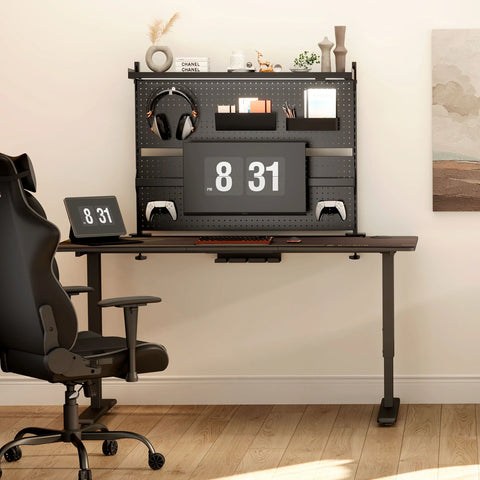
For both gamers and creators, a Carbon Fiber Dual Monitor Stand can be an invaluable tool. It elevates the screens to the correct ergonomic height while freeing up the desk surface underneath for speakers, a console, or other essential tools.
Command Center: Peripherals and Workflow
How you arrange your keyboard, mouse, and other tools directly impacts your risk of developing a Repetitive Strain Injury (RSI). The goal is to keep your wrists straight and your elbows at a roughly 90-degree angle.
Debunking a Common Myth
There's a persistent myth of the "messy genius"—that a cluttered desk is a sign of a creative mind. In reality, for digital-heavy work, a disorganized workspace creates physical and mental friction. Searching for a tool or contorting your arm around clutter introduces micro-stresses that add up. A well-zoned desk, where primary tools are within easy reach and secondary items are stored away, reduces cognitive load and minimizes harmful, repetitive movements.
Gamer Workflow: Speed and Precision
Gamers need their input devices arranged for speed. The keyboard is often angled to align with the natural position of the left hand on the WASD keys. A large mousepad provides unrestricted space for the mouse. The focus is on minimizing the travel time for your hands between different controls.
Creator Workflow: Zoning for Tasks
The most effective creators I know use "zoning." They divide their desk into logical areas:
- Primary Zone (Center): Keyboard and mouse for core tasks.
- Creative Zone (Left or Right): A graphics tablet or audio mixer, positioned for comfortable, long-duration use.
- Reference Zone (Secondary Area): Space for notebooks, a second laptop, or physical prototypes.
This approach ensures that you aren't constantly moving items around. Everything has a home, allowing you to transition between tasks seamlessly.
The Unseen Details: Cable Management and Environment
Clean cable management and a well-organized environment are not just about aesthetics; they are about safety, performance, and peace of mind.
For the Gamer: Airflow and Aesthetics
For a high-performance gaming PC, airflow is critical. Placing the PC tower on the floor is a common mistake that leads to dust accumulation and poor thermal performance. Aesthetically, gamers often want to showcase their build, and clean cable routing is part of that. Synchronized RGB lighting is popular, but a practical tip is to place ambient lighting behind your monitors to reduce glare, a technique known as bias lighting.
For the Creator: Safety and Reliability
For creators, reliability is everything. A cable snagged by a rising standing desk can bring your entire workday to a halt, or worse, damage expensive equipment. This is where off-floor solutions become critical.

A Knob-operated Adjustable CPU Holder is an elegant solution to this problem. By mounting the PC tower to the underside of the desk, it travels up and down with the surface, ensuring cables never get stretched or tangled. This also keeps the PC away from floor dust and makes cleaning the area much easier. Another critical safety tip: never place power strips inside closed drawers or cable trays without ventilation. I learned this the hard way when a client's setup was experiencing thermal shutdowns caused by an overheating power supply tucked into a sealed box.
Quick Setup Checklist
Once your desk is assembled, run through these quick checks:
- Wobble Test: With the desk at standing height, try to wobble it. A good frame will have minimal give.
- Motor Test: Place your equipment on the desk and test the height adjustment. The motors should sound smooth, not strained.
- Cable Slack Test: Raise the desk to its maximum height. Ensure there is a gentle "S" curve in your cables, with no tension.
- Ergonomic Check: Sit and stand at your station. Are your elbows at 90 degrees? Is your monitor at eye level? Adjust as needed following a comprehensive guide like the one for setting up your standing desk for peak productivity.
Key Takeaways
Ultimately, whether you're a gamer or a creator, the ideal desk setup is one that is consciously designed around your unique workflow and ergonomic health.
- Gamers should prioritize stability, a large surface for unrestricted movement, and an immersive monitor setup.
- Creators should focus on a large, versatile workspace that supports multiple devices and task-specific ergonomic adjustments.
For both, an adjustable-height desk is not a perk but a foundational tool for long-term health and performance. By starting with a solid, ergonomic base and thoughtfully integrating your monitors and peripherals, you create a space that doesn't just house your equipment—it actively fuels your passion.
Disclaimer: This article is for informational purposes only and does not constitute professional medical advice. If you have pre-existing health conditions, such as chronic back pain or a musculoskeletal disorder, please consult with a qualified physician or physical therapist before making significant changes to your workstation or daily routine.




Leave a comment