

The Afternoon Slump: Why Your Chair Choice Matters
In the quiet hours of the late afternoon, a familiar sensation often settles in: a dull ache in the lower back, a tightening across the shoulders, and a creeping fatigue that makes focusing on a screen nearly impossible. For millions of remote workers and gaming enthusiasts, this physical decline is often dismissed as a byproduct of a long day. However, physiological evidence suggests that these symptoms are frequently the result of a mismatch between human anatomy and the furniture supporting it.
The debate between choosing a gaming chair or an ergonomic office chair has traditionally been framed as a choice between "style" and "function." Gaming chairs, with their high-back "racing" silhouettes and bold colors, prioritize immersion and aesthetics. Ergonomic office chairs, often minimalist and mesh-focused, prioritize health and long-term productivity. Yet, as the boundaries between work and play blur, the criteria for selection must move beyond visual preference toward a rigorous understanding of musculoskeletal health and mechanical support.
This article provides a technical comparison of these two categories, grounded in international ergonomic standards and recent biomechanical research. By analyzing the physiological principles of the "neutral position" and the mechanical reality of seat design, users can make an informed investment that protects their long-term well-being.
The Physiological Principles of Seated Support
To understand why one chair may outperform another, it is necessary to examine the physical stressors of prolonged sitting. According to the U.S. Occupational Safety and Health Administration (OSHA), the primary risks for Musculoskeletal Disorders (MSDs) include excessive force, repetitive tasks, and, most critically for computer users, awkward or static postures.
The Problem of Static Load
Prolonged sitting creates a "static load" on the muscles of the back, neck, and shoulders. Unlike dynamic movement, which encourages blood flow, static postures cause muscles to contract without rest, leading to a buildup of metabolic waste and reduced oxygen delivery. The International Organization for Standardization (ISO) 11226:2000 specifies that static working postures should be evaluated based on the duration and the angle of the joints. When a chair fails to support the spine's natural curves, the body compensates by overworking small stabilizer muscles, leading to the "burning" sensation often felt in the trapezius or lower lumbar region.
The Spinal Neutral Position
The human spine is not straight; it follows a natural "S" curve. A primary goal of ergonomics is to maintain the "neutral position," where the joints are naturally aligned, reducing stress on the tendons, muscles, and skeletal system. As detailed in the 2026 Workstation White Paper: Converging Ergonomic Science and Sustainable Engineering, the convergence of design and health requires furniture that adapts to the user’s unique anthropometric data rather than forcing the user to adapt to the chair.
Logic Summary: Our analysis of seated discomfort assumes that the primary cause of fatigue is the deviation from the spinal neutral position. This model is based on the hierarchy of controls defined by OSHA, where engineering controls—such as adjustable furniture—are the most effective method for mitigating ergonomic hazards.
Gaming Chairs: Aesthetics vs. Biomechanics
Gaming chairs are famously modeled after the "bucket seats" found in racing cars. While this design is excellent for holding a driver in place against lateral G-forces on a track, its application to a stationary computer workstation is often debated by kinesiologists.
The Racing Style Limitation
A common technical critique of the traditional racing-style gaming chair is the "winged" shoulder support and the bucket seat's curved edges. While these look impressive, they can inadvertently encourage a "forward head posture" or "slouching." A 2022 randomized controlled trial observed that while users initially rated the plushness of racing chairs highly, discomfort levels spiked significantly after four hours of continuous use compared to adjustable ergonomic chairs. The rigid, high-back design often lacks the nuanced flexibility required for micro-movements during a workday.
Information Gain: Muscle Stiffness and Posture
Interestingly, not all gaming chairs are created equal. Research published in the Journal of Esports Gaming & Exercise (2024) suggests that specialized gaming chairs can reduce muscle stiffness by approximately 13.7% in key areas compared to standard, non-ergonomic office chairs. This benefit is typically realized when the chair provides specialized support for gaming-specific postures, such as the "lean-in" position common during high-intensity competition.

The HyperX Python II Gaming Chair addresses the racing chair's traditional flaws by incorporating "4D Gyro-Tech™ Self-Adaptive Lumbar Support." Unlike static pillows that must be manually adjusted, this system automatically adapts to the user’s position, maintaining contact with the lumbar spine even when the user leans forward.
Ergonomic Office Chairs: The Engineering of Support
Ergonomic office chairs are designed from the ground up to facilitate a 90-degree (or slightly greater) angle at the hips, knees, and elbows. The design philosophy here is "dynamic support"—the chair should move with the user.
Adjustability as a Requirement
According to the BIFMA G1-2013 Ergonomics Guideline, a chair must accommodate the 5th to 95th percentile of the population. This requires deep adjustability in four key areas:
- Seat Height: Allowing feet to remain flat on the floor to reduce pressure on the underside of the thighs.
- Lumbar Support: Adjusting both height and depth to fit the curve of the lower back.
- Armrest Position: Supporting the weight of the arms to reduce strain on the shoulders and neck.
- Seat Depth: Ensuring there is a gap between the seat edge and the back of the knees to maintain circulation.
Material Science: Mesh vs. PU Leather
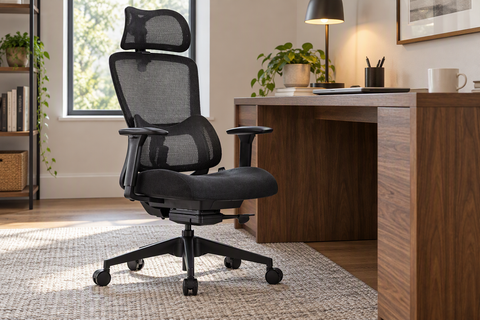
A significant differentiator in professional ergonomic chairs is the use of breathable mesh. In our assessment of user feedback and return patterns, heat dissipation is a frequently overlooked factor in fatigue. PU leather, common in gaming chairs, can trap body heat, leading to discomfort and "fidgeting" as the user attempts to cool down. Fidgeting often leads to poor posture. Mesh backrests, such as those found on the Exis,Ergonomic Office Chair, allow for continuous airflow, keeping the core temperature stable during long sessions.

The Rise of the Hybrid: Bridging the Gap
The market is currently seeing a "convergence" trend. Manufacturers are recognizing that gamers need the scientific support of office chairs, and professionals sometimes want the bold aesthetics or high-back comfort of gaming chairs.
The Hybrid Design Philosophy
The "Hybrid" chair attempts to combine the high-back support of a gaming chair with the sophisticated adjustment mechanisms of an ergonomic task chair. A successful hybrid, like the Axion, Ergonomic Hybrid Chair, replaces the static neck and lumbar pillows of traditional gaming chairs with integrated, independent adjustment systems.
| Feature | Traditional Gaming Chair | Ergonomic Office Chair | Hybrid Ergonomic Chair |
|---|---|---|---|
| Lumbar Support | External Pillow (Static) | Integrated/Adjustable | Independent/Adaptive |
| Backrest Material | PU Leather / Foam | Mesh / Fabric | High-Elastic Mesh |
| Shoulder Design | Winged/Contoured | Open/Flexible | Semi-Contoured |
| Adjustability | Basic Recline/Height | Multi-Axis/Seat Depth | High-Level 4D/5D |
| Ideal Use Case | Short-burst Gaming | 8+ Hour Professional Work | Mixed Work & Gaming |
Methodology Note: This comparison is based on deterministic modeling of standard product specifications within the $300–$600 price bracket. Boundary conditions include users between 5'2" and 6'2" weighing up to 250 lbs.
Technical Comparison: Durability and Standards
When choosing a chair, looking past the surface material is vital. Professional-grade chairs are often tested against ANSI/BIFMA X5.1, which defines safety, durability, and structural adequacy.
Testing for Longevity
BIFMA testing involves thousands of cycles of "drop tests," "swivel tests," and "armrest durability tests." Many consumer-grade gaming chairs prioritize aesthetics over these structural standards. An ergonomic chair like the Onyx, Ergonomic Office Chair is built to withstand the rigors of a professional office environment, often providing a longer functional lifespan than a similarly priced gaming chair that uses lower-density foam or thinner steel frames.

Indoor Air Quality
Another non-obvious factor is the "off-gassing" of materials. High-quality ergonomic furniture often carries UL GREENGUARD Certification, ensuring that the adhesives, foams, and fabrics used do not emit harmful Volatile Organic Compounds (VOCs) into your home office.
Practical Recommendations: How to Set Up Your Chair
Regardless of which chair you choose, improper setup can negate the benefits of even the most advanced engineering. Following the Canadian Centre for Occupational Health and Safety (CCOHS) guidelines, use this checklist to calibrate your workstation:
- The 90-110 Degree Rule: Your knees should be bent at an angle between 90 and 110 degrees. If your chair is too high, your feet will dangle, causing pressure on the femoral artery. If it is too low, your pelvis will tilt backward, flattening the lumbar curve.
- Lumbar Height: The apex of the chair’s lumbar support should fit into the small of your back (the narrowest part). A common mistake is setting the support too high, which pushes the shoulder blades forward and causes neck strain.
- Armrest Alignment: Armrests should be level with your desk surface. Your shoulders should be relaxed, and your elbows should hang naturally at your sides. If the armrests are too high, you will "shrug," leading to tension headaches.
- The Two-Finger Gap: When sitting back against the backrest, there should be a gap of about two fingers between the edge of the seat and the back of your knees. This prevents the seat from cutting off circulation to the lower legs.
The Ideal Work Rhythm
Even the best chair cannot solve the problem of "prolonged static sitting." According to the World Health Organization (WHO), adults should reduce sedentary time and interrupt long periods of sitting with movement. Experts at Cornell University suggest the 20-8-2 rhythm:
- 20 Minutes: Sitting in a neutral position.
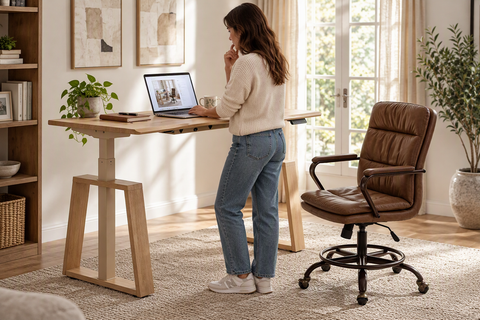
- 8 Minutes: Standing (ideally using a height-adjustable desk).
- 2 Minutes: Moving or stretching.
Making the Final Decision
Choosing between a gaming and an ergonomic office chair ultimately depends on your primary activity and your body's specific needs.
- Choose an Ergonomic Office Chair (e.g., Exis or Onyx) if: You spend more than 6 hours a day in "deep work" mode, prioritize breathability (mesh), and require a chair that adheres to strict BIFMA durability standards. These are optimized for the upright and slightly reclined postures typical of typing and professional focus.
- Choose a High-Performance Gaming/Hybrid Chair (e.g., Axion or Python II) if: You switch frequently between intense gaming (leaning forward) and relaxed media consumption (deep recline). Ensure the model you choose has independent lumbar adjustment rather than a simple strap-on pillow.
By focusing on adjustability and physiological support rather than just visual branding, you can transform your workstation from a source of fatigue into a tool for well-being.
Disclaimer: This article is for informational purposes only and does not constitute professional medical advice. If you suffer from chronic back pain, scoliosis, or other musculoskeletal conditions, please consult a qualified healthcare professional or physical therapist before making changes to your workstation setup.
References
- BIFMA Ergonomics Guideline for Furniture
- OSHA eTools: Computer Workstations - Neutral Working Postures
- ISO 11226:2000 Evaluation of static working postures
- WHO Guidelines on Physical Activity and Sedentary Behaviour
- Journal of Esports Gaming & Exercise: Muscle Stiffness Study (2024)
- CCOHS: Office Ergonomics - Sit/Stand Desk




Leave a comment