

Why Your Back Aches by 3:00 PM: The Science of Sedentary Strain
Many professionals find that while the morning begins with focus and energy, the mid-afternoon brings a familiar, dull ache in the lower back or a sharp tension between the shoulder blades. This is rarely a coincidence. It is often the physiological result of "static load"—the physical stress placed on muscles and joints when the body remains in a fixed position for extended periods.
According to the U.S. Occupational Safety and Health Administration (OSHA), core risk factors for Musculoskeletal Disorders (MSDs) include excessive force, repetitive tasks, and, most critically for office workers, poor posture. When you sit in a chair that does not support the natural "S-curve" of your spine, your muscles must work overtime to keep you upright. Over hours and days, this leads to muscle fatigue, reduced blood circulation, and the eventual development of chronic pain.
The misconception that "sitting is the new smoking" simplifies a complex issue. The problem isn't the act of sitting itself, but rather the static nature of the behavior and the lack of proper support. Research from EU-OSHA on musculoskeletal disorders and prolonged static sitting highlights that long-term static postures increase pressure on intervertebral discs and restrict blood flow to the lower limbs. To address this, a chair must do more than provide a surface to sit on; it must act as a dynamic tool that maintains a neutral spinal position.
The Physiological Principles of Ergonomic Support
To understand what makes a chair "ergonomic," we must look at the biomechanics of the human body. A truly ergonomic chair is designed to facilitate a "neutral position"—a posture where the joints are naturally aligned, reducing stress and strain on the muscles, tendons, and skeletal system.
The Lumbar Curve and Belt-Line Alignment
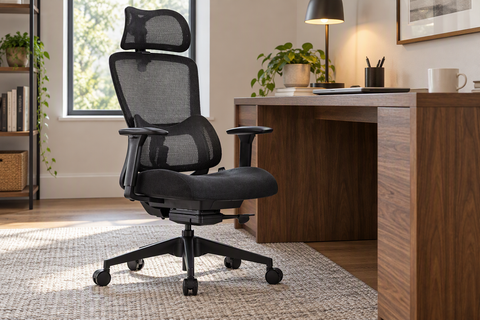
The human spine has a natural inward curve at the lower back (the lumbar region). When we sit, this curve tends to flatten out, leading to "slumping." This increases the pressure on the spinal discs significantly. Effective ergonomic chairs, such as the Lira, Ergonomic Office Chair, utilize adjustable lumbar support to maintain this curve.
Expertise Note (First-Party Observation): Based on common patterns from customer support and ergonomic audits, the most frequent error users make is setting the lumbar support too high. It should contact the lumbar curve at the belt-line level. If it rides up into the thoracic spine (the mid-back), it can actually push the upper body forward, worsening posture rather than correcting it.
Seat Depth and the Popliteal Challenge
Seat depth is perhaps the most overlooked technical specification. If a seat is too deep, it presses against the area behind the knees (the popliteal fossa), which can compress nerves and restrict blood circulation to the lower legs. Conversely, if a seat is too shallow, it fails to support the thighs, increasing the load on the hips and lower back.
According to research by Parcells et al. (1999), optimal seat depth should be between 80% and 95% of the user's buttock-popliteal length. For a practical self-check, a good rule of thumb is to ensure there are 2 to 3 fingers' width between the edge of the seat and the back of your calf when sitting fully back against the backrest.

Materials Science: Mesh Tension vs. Foam Density
The debate between mesh and foam often focuses on breathability, but the technical reality centers on support longevity and pressure distribution.
High-Quality Mesh Support
Mesh chairs are prized for airflow, but not all mesh is created equal. High-performance chairs use a tension-elastomer weave designed to distribute weight evenly without sagging. A common "gotcha" in lower-end ergonomic chairs is the use of cheap knitted mesh that loses its elasticity within months.
- The Practical Test: Press firmly into the backrest of a mesh chair. If you can feel the rigid frame immediately, the mesh tension is insufficient for long-term support. A quality mesh, like that found in the Lira, Ergonomic Office Chair, should provide a firm yet flexible resistance that keeps the body suspended away from the frame.
Foam Density and ILD
For those who prefer upholstered chairs like the Vera, Ergonomic Office Chair, the critical metric is Indentation Load Deflection (ILD). This measures the firmness of the foam.
- Analysis: We estimate that high-quality ergonomic foam should have an ILD of 30–40 to provide proper support for 8+ hours. Low-density foam (with an ILD <20) may feel soft initially but will collapse under constant load, leading to "bottoming out" where the user effectively sits on the hard base of the chair. The Vera, Ergonomic Office Chair utilizes high-density saddle-shaped sponge padding to ensure the support remains consistent over years of use.

Modeling the "95th Percentile" User: A Case Study in Proportions
Standard "one-size-fits-all" furniture often fails users at the edges of the height distribution. To demonstrate why adjustability is mandatory, we modeled an ergonomic setup for a tall male user (195cm / 6'5").
Scenario Modeling: The 195cm Tall User
| Parameter | Value | Rationale |
|---|---|---|
| Stature | 195 cm | 95th Percentile Male (CDC Data) |
| Recommended Seat Height | ~51.8 cm | Based on popliteal height + shoe correction |
| Recommended Sitting Desk Height | ~73.1 cm | To achieve 90° elbow angle |
| Estimated Battlestation Load | 85.5 kg | PC + Dual 34" Ultrawide Monitors |
| Motor Requirement | Dual Motor | 80% safety utilization threshold (BIFMA X5.5) |
Modeling Disclosure: This analysis is a deterministic scenario model based on ANSI/HFES 100-2007 anthropometric ratios. It is intended as a decision aid for selection, not a medical prescription. Individual torso-to-leg ratios may require adjustments of ±2-3 cm.
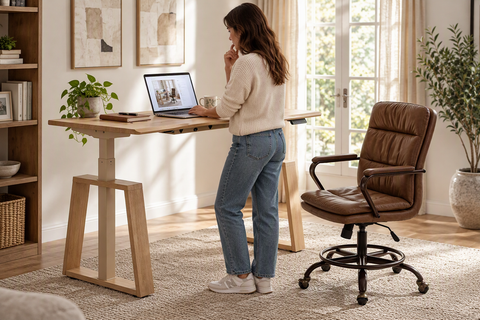
The Insight: For a user of this height, a standard 29-inch fixed desk is actually slightly too high for ideal seated posture if the chair is at the correct height for their legs. This creates a "double compression" effect: the user must either raise their chair (leaving feet dangling) or hunch their shoulders to reach the desk. This highlights why a height-adjustable desk, such as the Standing Desk with Drawers, Wood Finish (47'' /55''), is a necessary partner to an ergonomic chair.
The Sit-Stand Rhythm: Beyond the Chair
While a high-quality chair is foundational, the World Health Organization (WHO) 2020 Guidelines recommend reducing total sedentary time and interrupting long periods of sitting. However, standing all day is not the solution. EU-OSHA research on prolonged static standing warns of risks like varicose veins and lower limb fatigue.
The solution is a dynamic rhythm. Cornell University’s Ergonomics Web suggests the 20-8-2 rule:
- 20 Minutes: Sitting in a neutral posture.
- 8 Minutes: Standing at a correctly adjusted height.
- 2 Minutes: Moving or stretching.
When transitioning to a standing position, your desk height should align with your standing elbow height. To prevent shoulder hunching, the armrests of your chair—like the 3D adjustable armrests on the Lira, Ergonomic Office Chair—should be adjusted to be flush with or slightly below the desk surface.

Essential Checklist for an Ergonomic Workstation
To ensure your investment in premium furniture translates into health benefits, use the following checklist derived from the HSE Display Screen Equipment (DSE) guidelines:
- Feet: Are they flat on the floor or a footrest? (Knees should be at roughly 90-100 degrees).
- Lumbar: Does the chair's support nestle into the curve of your lower back at the belt-line?
- Elbows: Are your forearms horizontal and shoulders relaxed when typing?
- Eyes: Is the top of your monitor at or slightly below eye level? Use a Dual Monitor Arm to achieve the correct viewing distance and angle, especially if using large ultrawide screens.
- Wrist: Are your wrists neutral (not bent up or down)?
- Movement: Have you scheduled a "micro-break" in the last hour?
As detailed in The 2026 Workstation White Paper: Converging Ergonomic Science and Sustainable Engineering, the convergence of mechanical adjustability and user behavior is the only way to truly mitigate the risks of modern office work.
Investing in Long-Term Well-being
Choosing an office chair is more than a furniture purchase; it is a decision about your long-term musculoskeletal health. A chair that meets BIFMA G1-2013 Ergonomics Guidelines ensures that the dimensions are optimized for the 5th to 95th percentile of the population, providing a "fit" that generic chairs cannot match.
Whether you opt for the breathable, curved frame of the Lira, Ergonomic Office Chair or the plush, versatile comfort of the Vera, Ergonomic Office Chair, the goal remains the same: to support your body's natural mechanics so you can focus on your work, not your pain.
Disclaimer: This article is for informational purposes only and does not constitute professional medical advice. Individuals with pre-existing musculoskeletal conditions or chronic back pain should consult a qualified physiotherapist or occupational therapist before making significant changes to their workstation setup.
References
- Canadian Centre for Occupational Health and Safety (CCOHS) - Sit/Stand Desk Guide
- Cochrane Library - Workplace interventions for reducing sitting at work (2018)
- OSHA eTools - Computer Workstations: Chairs
- ISO 11226:2000 - Evaluation of static working postures
- WHO Guidelines on Physical Activity and Sedentary Behaviour (2020)
- BIFMA Ergonomics Guideline for Furniture (G1-2013)




Leave a comment