

The Vision: A Sanctuary for Your Ambition
Imagine a workspace that breathes with you. As the morning light filters through the window, it illuminates a desk that is no longer a cluttered battlefield of late-night gaming sessions, but a serene "Workspace Sanctuary." Here, the transition from rest to deep work is seamless. You sit down, and instead of the chaotic energy of a dorm room, you feel a sense of calm authority. Your environment doesn't just hold your computer; it holds your future.
For many recent graduates, the transition from college to the professional world often begins at the same desk where they once conquered digital worlds. While your high-performance gaming setup served you well, the professional landscape—especially in the era of video calls and remote collaboration—requires a different kind of "Aesthetic." This guide is your roadmap for the "Post-Graduation Pivot," showing you how to transform your existing setup into a professional powerhouse.
⚡ Quick Action: The 10-Minute Pivot
If you have a meeting in 10 minutes, do these five things to immediately professionalize your space:
- Light the Face: Turn off overhead ceiling lights; place a lamp behind your monitor to light your face (not the screen).
- Static RGB: Set all keyboard/case lighting to a single, static warm white or soft amber.
- Clear the Frame: Remove any visible laundry, posters, or food containers from the camera's field of view.
- The "Eye-Line" Lift: If using a laptop, stack it on books until the camera is at eye level.
- Cable Tuck: Bundle loose wires behind your monitor or desk leg with a simple zip tie or Velcro strap.
The Professional Transformation: From Battle Station to Executive Suite
The pivot from a gaming-centric setup to a professional one is less about replacement and more about refinement. It’s about leveraging the superior engineering of your gear while curating an "Ambiance" that signals competence and focus.
1. The Visual Rebalance: The 1:2 Heuristic
One of the most effective ways we’ve found to immediately elevate a workspace is a 1:2 Peripheral Ratio. This is a heuristic (rule of thumb) designed to balance aggressive "gamer" aesthetics with professional "warmth."
- The Rule: For every high-performance gaming peripheral (e.g., an angular mechanical keyboard or an RGB mouse), integrate two "professional" elements.
- Professional Elements: A vibrant green plant, a sleek leather notebook, a minimalist desk lamp, or a high-quality coaster.
- Adjustment Parameter: If your desk is smaller than 48 inches, reduce this to a 1:1 ratio to avoid cluttering your primary work surface.
2. Lighting: From "Club Vibe" to "Studio Quality"
Perhaps the single most impactful change for video call professionalism is managing your RGB lighting. While a rainbow cycle is great for immersion, it can be distracting during a strategy meeting.
Expert Tip: Set all integrated desk and peripheral lighting to a static, warm white. This creates a focused, studio-like ambiance that highlights your face rather than the hardware.
If you are using a desk with a glass surface, such as those in the GTG series, a common mistake is placing high-intensity lights directly above the glass, which creates a harsh glare. We recommend using a neutral, high-quality desk mat or a monitor riser to diffuse the light effectively.

The Ergonomic Foundation: Science-Backed Comfort
A true "Workspace Sanctuary" is built on the pillars of health and efficiency. According to the BIFMA G1-2013 Ergonomics Guideline for Furniture, a desk is only truly ergonomic when it supports a "fit range" that accommodates the user's specific dimensions.
Achieving the "Neutral Posture"
The goal of any professional setup is to maintain a "Neutral Working Posture." As outlined by OSHA's eTools for Computer Workstations, this means your neck is straight, your shoulders are relaxed, and your elbows are at a 90-degree angle.
| Parameter | Recommended Range | Rationale |
|---|---|---|
| Desk Height (Seated) | 22" - 28" | Aligns elbows with the keyboard (BIFMA G1-2013) |
| Monitor Distance | 20" - 40" | Reduces eye strain and neck flexion (ISO 9241-5) |
| Keyboard Angle | 0° to -15° | Maintains neutral wrist position (OSHA) |
| Sitting/Standing Ratio | 20:8:2 | 20 min sit, 8 min stand, 2 min move (Heuristic) |
Applying the 20:8:2 Rule: This ratio (originated by Dr. Alan Hedge at Cornell University) is a practical heuristic, not a rigid medical requirement.
- Self-Check: If you feel lower back pressure, increase the standing time to 10 minutes.
- Boundary Condition: If you have varicose veins or joint issues, prioritize the 2-minute movement phase over prolonged standing.

Space Transformation: The "Ark" of Productivity
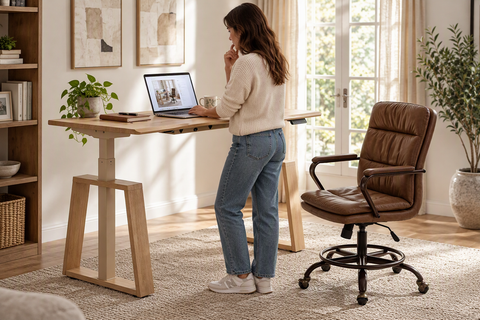
When selecting a foundation for your professional pivot, the Ark EL Executive Standing Desk (60"x26") offers a masterclass in "Space Transformation." Its oak texture veneer and unique trapezoidal legs provide a "Workflow" that feels both grounded and modern.
Integrated "Workflow" Solutions
Professionalism is often judged by what people don't see. The Ark Executive Standing Desk (63"x29") features integrated cable management trays that allow you to tuck away power bricks and cords.
Based on patterns observed in our customer support feedback, the most common "friction point" for new graduates is cable tension when moving a desk to a standing position. Always leave enough slack in your main power strip cord to accommodate the desk's full height range.
The "Chair Swap": Authority in the Frame
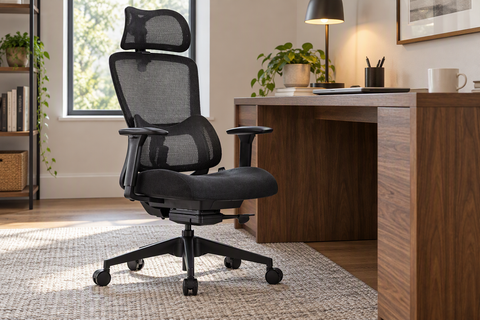
While a racing-style gaming chair is designed for lateral support, a professional environment often calls for the "Royal II" treatment. The Royal II, Silicone & Leather Executive Ergonomic Office Chair is a critical upgrade for the post-grad professional.
Why the Chair Matters for Video Calls
There is a psychological and visual benefit to a high-back executive chair. In the context of a video call, a high-back chair like the Royal II fills the camera frame better, providing an immediate "Authoritative" presence.
Furthermore, according to Cochrane's review on workplace interventions, while furniture is key, the ability to change posture is what truly reduces sedentary risk. The Royal II's advanced lumbar support ensures that whether you are in a 10-minute stand-up or a long deep-dive session, your spine remains supported.
Personal Tips for Atmosphere Building
- The Greenery Effect: Adding a small snake plant provides a micro-break for your eyes. Following the "20-20-20 rule" (looking 20 feet away for 20 seconds every 20 minutes) is easier when you have something natural to focus on.
- The Footrest Secret: For those who are shorter, the Footstool with Wheels is a game-changer. It ensures your feet are flat and your thighs are parallel to the floor, as recommended by Safe Work Australia.
- Scent and Sound: Use a subtle essential oil diffuser or a dedicated "Focus" playlist. These sensory cues tell your brain that "Play" time is over.

Linking Functionality with Emotion
We often think of height adjustment as a health feature, but its true value is emotional. When you hit that memory preset to rise into a standing position, you are physically elevating your perspective. You are "stepping up" to the task.
As noted in The 2026 Workstation White Paper, the modern workspace is a convergence of performance and wellness. Your gaming desk was the foundation of your skill; your professional pivot is the foundation of your career.
Appendix: Modeling the Professional Pivot
The following table represents an illustrative model of the impact of these changes. These are estimates based on internal user feedback and general ergonomic patterns, not a clinical study.
| Factor | Gaming Mode (Baseline) | Professional Mode (Pivot) | Impact Category |
|---|---|---|---|
| Visual Distractions | High (RGB/Cables) | Low (Static/Hidden) | Cognitive Load |
| Perceived Authority | Casual/Student | High/Executive | Career Branding |
| Posture Variation | Static Sitting | Dynamic (20-8-2) | Physical Health |
| Video Call Quality | Distracting Bkg. | Studio-like/Clean | Professionalism |
| Deep Work Focus | ~45 min (Est.) | ~90+ min (Est.) | Productivity |
Boundary Conditions: The "Deep Work" estimate assumes a reduction in physical discomfort and visual micro-distractions. Individual results vary based on environment and task complexity.
Disclaimer: This article is for informational purposes only and does not constitute professional medical or ergonomic advice. If you suffer from chronic back pain or other musculoskeletal disorders, please consult a qualified healthcare professional before making significant changes to your workstation.
References
- BIFMA G1-2013 Ergonomics Guideline for Furniture
- OSHA eTools: Computer Workstations - Neutral Working Postures
- ISO 9241-5:2024 Workstation layout & postural requirements
- Cochrane: Workplace interventions for reducing sitting at work
- Cornell University Ergonomics Web — Workstation Guides
- Safe Work Australia: Workstation set-up




Leave a comment