

The Engineering Student’s Workstation Paradox
For the modern engineering student, the computer is more than a tool; it is a primary laboratory. Whether compiling thousands of lines of code, rendering complex 3D assemblies in SolidWorks, or running multi-variable simulations, the demand for screen real estate is absolute. However, this high-performance requirement frequently collides with the physical reality of university housing: the standard dorm room.
Engineering students often find themselves attempting to balance dual 27-inch monitors and heavy workstations on desks designed for 19th-century paper-and-ink study. This structural mismatch does more than just clutter a room; it creates significant risks for musculoskeletal health. Prolonged sessions in cramped, non-ergonomic setups lead to static load issues, "Tech Neck," and repetitive strain injuries (RSI) that can impact academic performance and long-term well-being.
According to the Canadian Centre for Occupational Health and Safety (CCOHS), a workstation that does not support a neutral position forces the body into compensatory postures. For a student already under the high cognitive load of a STEM curriculum, these physical stressors act as a "productivity tax," draining focus and increasing fatigue. Addressing these issues requires a transition from a "gaming setup" mindset to one of rigorous ergonomic engineering.
The Biomechanics of Multi-Monitor Usage
The human body is not designed for the static working postures required by modern engineering software. When using multiple monitors, the physiological challenge shifts from vertical alignment to lateral rotation.
Lateral Gaze and Neck Strain
A common mistake in dual-monitor setups is placing both screens at an equal angle, forcing the user to keep their head turned for hours. This creates asymmetrical loading on the cervical spine. Research from the CCOHS on monitor positioning suggests that the primary monitor should be centered directly in front of the user. The secondary screen should be placed no further than 45 degrees from the primary gaze to prevent neck fatigue.
For sustained CAD (Computer-Aided Design) work, the recommended maximum lateral gaze angle is even tighter—approximately 35 degrees. Beyond this, the repetitive motion of checking reference documents or code on a side screen can lead to trapezius strain and tension headaches.
The "Tech Neck" Mechanism
"Tech Neck" occurs when the head is tilted forward or rotated for extended periods, placing excessive force on the neck muscles. If a monitor is too low—a frequent issue with fixed-height dorm desks—the user naturally hunches forward. This position increases the effective weight of the head on the spine, leading to what is qualitatively described as "clavicle compression" and shoulder impingement during marathon coding sessions.
Logic Summary: Our analysis of the engineering student persona assumes a high-frequency use of secondary reference screens. We prioritize minimizing lateral rotation over perfect symmetry to align with the ISO 11226:2000 standard for evaluating static working postures.

Engineering the Space: Desk Depth and Load Capacity
In a dorm environment, every inch of desk depth is a critical ergonomic variable. Students often underestimate the depth required for dual 27-inch 4K monitors, leading to a "viewing distance deficit."
The 26-Inch Minimum Depth Rule
Standard university desks are often 24 inches deep or less. However, for a dual-monitor setup, a minimum depth of 26 inches is recommended. This depth allows for a proper viewing distance (typically 20 to 40 inches depending on screen size and resolution) while leaving enough space for the keyboard and mouse to be positioned so the forearms are parallel to the floor.
As noted in The 2026 Workstation White Paper: Converging Ergonomic Science and Sustainable Engineering, the integration of appropriate desk depth is essential for maintaining the "spinal neutral position." When monitors are too close, the user often pushes their chair back to compensate, which then forces them to reach forward for the keyboard, breaking the ergonomic chain.
Structural Integrity and Motor Safety
For students using height-adjustable or heavy-duty desks, the total load is a safety concern. A typical engineering setup—including two monitors, a mid-tower PC, monitor arms, and peripherals—can easily exceed 50kg (110 lbs).
According to BIFMA X5.5 standards for desk products, it is crucial to maintain a safety margin. For a single-motor desk with an 80kg capacity, a 50kg load represents 62.5% utilization. While this is within the recommended 80% safety threshold, students should be cautious about adding further weight (such as heavy textbooks or hardware components) which could compromise the longevity of the lifting mechanism during sit-stand transitions.
| Component | Estimated Weight (kg) | Rationale |
|---|---|---|
| Dual 27" Monitors | 14.0 | Typical weight for modern 4K panels |
| Mid-Tower PC | 18.0 | Standard air-cooled engineering workstation |
| Monitor Arms (Dual) | 5.0 | VESA-compliant steel/aluminum construction |
| Peripherals & Cables | 5.0 | Keyboard, mouse, docking station, UPS |
| Desktop Tabletop | 18.0 | Standard 1.5m particle board/carbon fiber |
| Total Static Load | 60.0 | ~75% utilization of an 80kg motor |
Selecting the Right Foundation for Dorm Life
Given the constraints of campus housing, the choice of a desk must balance functionality with space efficiency.
The L-Shaped Advantage
For corner placements in small rooms, an L-shaped desk is often the most effective solution. The GTG - L60, L-Shaped Glass LED Gaming Desk (60"x40") provides a reversible frame, allowing it to adapt to different dorm layouts. The extended surface is ideal for engineering students who need one side for their digital workstation and the other for physical textbooks or circuit board assembly.
Stability and the Z-Shaped Frame
If a corner setup isn't feasible, a sturdy rectangular desk with reinforced legs is necessary to prevent monitor wobble—a major distraction during precision CAD work. The Gaming Desk with Z Shaped Legs (61"x25") utilizes a high-strength frame that provides the stability required for multiple monitors without the bulk of traditional office furniture. The Z-shaped design also offers superior legroom, which is critical for taller students who need to avoid "knee-bumping" in cramped quarters.

Optimizing the Interface: Accessories and Lighting
Once the desk is selected, the "last mile" of ergonomics involves fine-tuning the height and environment.
Elevating the Gaze
If you are restricted to a fixed-height dorm desk, a monitor riser is non-negotiable. The Carbon Fiber Dual Monitor Stand serves a dual purpose: it raises the screens to the eye level recommended by OSHA's guidelines for computer workstations, and it creates additional storage space underneath for keyboards or notebooks. This is particularly valuable in dorms where desk surface area is at a premium.
Visual Ergonomics and Bias Lighting
Engineering work often involves high-contrast environments—staring at white code on a dark background or detailed schematics. This can lead to significant eye strain. Implementing bias lighting behind the monitors can reduce the perceived contrast and minimize "glare fatigue."
The Lucet Art Lighting can be used to create a diffused light source behind the screens. This is not just for aesthetics; according to OSHA's workplace environment recommendations, proper lighting control is essential for reducing visual fatigue and maintaining long-term focus during late-night study sessions.

Implementation Strategies for the Academic Workday
Building a great setup is only half the battle; the other half is how you use it. We recommend two specific behavioral interventions for engineering students.
The 30-30 Rule
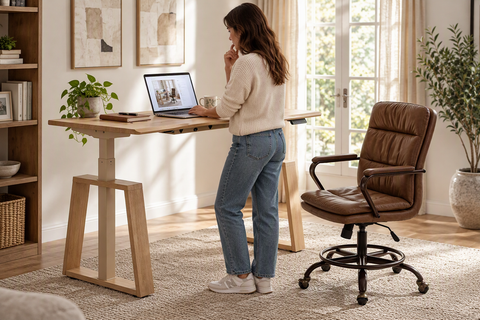
While the WHO 2020 Guidelines on Physical Activity emphasize reducing sedentary time, "standing all day" is not the answer, as it can lead to lower limb MSDs. Instead, adopt the 30-30 Rule: 30 minutes of sitting followed by 30 minutes of standing. This rhythm maintains blood circulation and prevents the "static load" buildup that occurs during long coding marathons.
Cable and Power Management
Dorm rooms have strict regulations regarding fire safety and power consumption.
- Adhesive Clips: Use adhesive-backed cable clips instead of screws to manage your multi-monitor array. This avoids damaging university property and keeps cables clear of your legs.
- Amp Limits: Check your dorm’s circuit breaker limits. A high-end PC with dual monitors and a laptop can draw significant power. Ensure you are using a high-wattage power strip with surge protection to protect your hardware.
- CPU Placement: Never place your PC directly on the floor. It collects dust and restricts airflow, which can lead to thermal throttling during simulations. Use a CPU holder or a dedicated shelf on your desk.
Scenario Modeling: The Tall Engineering Student
To illustrate the importance of precision setup, we modeled a scenario for a 190cm (6'3") tall male engineering student (95th percentile height).
Method & Assumptions
This scenario uses a deterministic model based on ANSI/HFES 100-2007 anthropometric ratios. We assumed standard footwear (+2.5cm) and a dual 27-inch monitor setup.
| Parameter | Value | Rationale / Source |
|---|---|---|
| User Height | 190 cm | 95th Percentile Male (ANSI/HFES) |
| Ideal Sit Desk Height | 78.5 cm | Calculated for 90° elbow angle |
| Ideal Stand Desk Height | 116.5 cm | Calculated for 90° elbow angle |
| Recommended Viewing Dist. | 112 cm | SMPTE 30° Field of View for 4K |
| Desk Depth Deficit | 45 cm | Based on standard 26" desk depth |
Modeling Note: For a student of this height, a standard 29-inch dorm desk creates a ~5cm height deficit. This forces the student to either hunch or raise their shoulders, leading to trapezius strain. In this scenario, using a monitor riser like the Carbon Fiber Dual Monitor Stand is critical to bridge the gap between fixed furniture and human biology.
Logic Summary: Our modeling indicates that "one size fits all" furniture fails the tallest 5% of the student population. For these individuals, adjustability isn't a luxury; it's a physiological requirement to avoid chronic pain during the four to five years of an engineering degree.

Summary of Best Practices
Creating an engineering-grade workstation in a dorm requires a systematic approach:
- Prioritize Depth: Aim for at least 26 inches to maintain proper visual acuity and viewing distance.
- Center the Primary: Keep your main workspace directly in front of you to minimize cervical rotation.
- Manage the Load: Ensure your desk can handle the weight of your workstation with a 20% safety margin.
- Interrupt Stasis: Use the 30-30 rule to switch between sitting and standing, preventing blood pooling and muscle fatigue.
- Control the Environment: Use bias lighting to reduce eye strain and adhesive management to comply with housing rules.
By applying these ergonomic principles, you can transform a cramped dorm room into a high-efficiency laboratory that supports both your academic goals and your physical health.
YMYL Disclaimer: This article is for informational purposes only and does not constitute professional medical advice, diagnosis, or treatment. The ergonomic recommendations provided are based on general industry standards and scenario modeling. Individuals with pre-existing musculoskeletal conditions, chronic back pain, or other health concerns should consult a qualified healthcare professional or occupational therapist before making significant changes to their workstation or work habits.
References
- BIFMA G1-2013 Ergonomics Guideline for Furniture
- CCOHS: Office Ergonomics - Sit/Stand Desk
- ISO 9241-5:2024 Workstation layout & postural requirements
- WHO 2020 Guidelines on Physical Activity & Sedentary Behaviour
- OSHA eTools: Computer Workstations - Monitors
- The 2026 Workstation White Paper: Converging Ergonomic Science and Sustainable Engineering




Leave a comment