
Why Does Your Back Ache After Dinner? The Hidden Impact of Furniture Dimensions
Many homeowners spend weeks selecting a dining table based on its aesthetic appeal or the number of guests it can host, only to find that after thirty minutes of sitting, they experience a dull ache in the lower back or a tingling sensation in the legs. These symptoms are often dismissed as a sign of a long day, but they are frequently the direct result of a fundamental mismatch between the user’s height and the furniture’s dimensions.
The common misconception is that "standard" dining furniture is designed to fit everyone. In reality, most mass-market tables and chairs are built to a "one-size-fits-most" average that often fails the 5th percentile of petite users and the 95th percentile of tall users. When a chair is too high, a shorter individual’s feet dangle, leading to increased pressure on the underside of the thighs. Conversely, when a table is too low for a tall individual, it forces a hunched posture that strains the cervical and thoracic spine. Understanding how user height interacts with furniture geometry is not just about comfort; it is a critical component of maintaining long-term musculoskeletal health.
The Science of Seated Comfort: Physiological Principles and MSDs
To understand why height matters, one must look at the physiological principles of the seated posture. Prolonged sitting is a form of static load on the body. According to OSHwiki regarding musculoskeletal disorders and prolonged static sitting, maintaining a fixed position for extended periods can lead to muscle fatigue and decreased blood circulation.
The Spinal Neutral Position
The primary goal of ergonomic seating is to maintain a spinal neutral position. This is the posture where the spine's natural curves—cervical, thoracic, and lumbar—are aligned and supported, minimizing the stress on ligaments and intervertebral discs. When a dining chair lacks proper lumbar support or is at an incorrect height, the pelvis often tilts backward (posterior tilt), flattening the lumbar curve and increasing the risk of Musculoskeletal Disorders (MSDs).
Blood Circulation and Popliteal Height
A critical but often overlooked measurement is the popliteal height—the distance from the underside of the foot to the crease behind the knee. If a seat is higher than the user's popliteal height, the front edge of the seat pan acts as a pressure point against the popliteal artery and nerves. This can impede blood circulation to the lower limbs, leading to the "pins and needles" sensation.
Logic Summary: Our analysis of seated comfort assumes that the user's feet must remain flat on the floor to distribute body weight effectively across the buttocks and thighs, rather than concentrating it on the soft tissues of the legs. This is based on standard anthropometric modeling used in BIFMA G1-2013 Ergonomics Guidelines.
The Eating Height Differential
The relationship between the seat and the tabletop is known as the "eating height" or "work height" differential. For the upper body to remain in a neutral position, the forearms should rest comfortably on the table surface at an angle of approximately 90 to 100 degrees at the elbow. If the table is too high relative to the seat, the user must elevate their shoulders, leading to tension in the trapezius muscles. If it is too low, the user must lean forward, placing excessive strain on the lower back.
Addressing the Height Gap with Ergonomic Solutions
Addressing these physiological challenges requires furniture that offers either adjustability or a design that accommodates a wide range of body types. While traditional dining furniture is static, modern ergonomic engineering focuses on "fit ranges" rather than single points.
The Multi-Functional Dining Hub
In modern homes, the dining table often serves as a secondary workspace. This makes the ergonomic requirements even more stringent. As noted in the The 2026 Workstation White Paper: Converging Ergonomic Science and Sustainable Engineering, the convergence of dining and working spaces requires furniture that supports diverse postures.
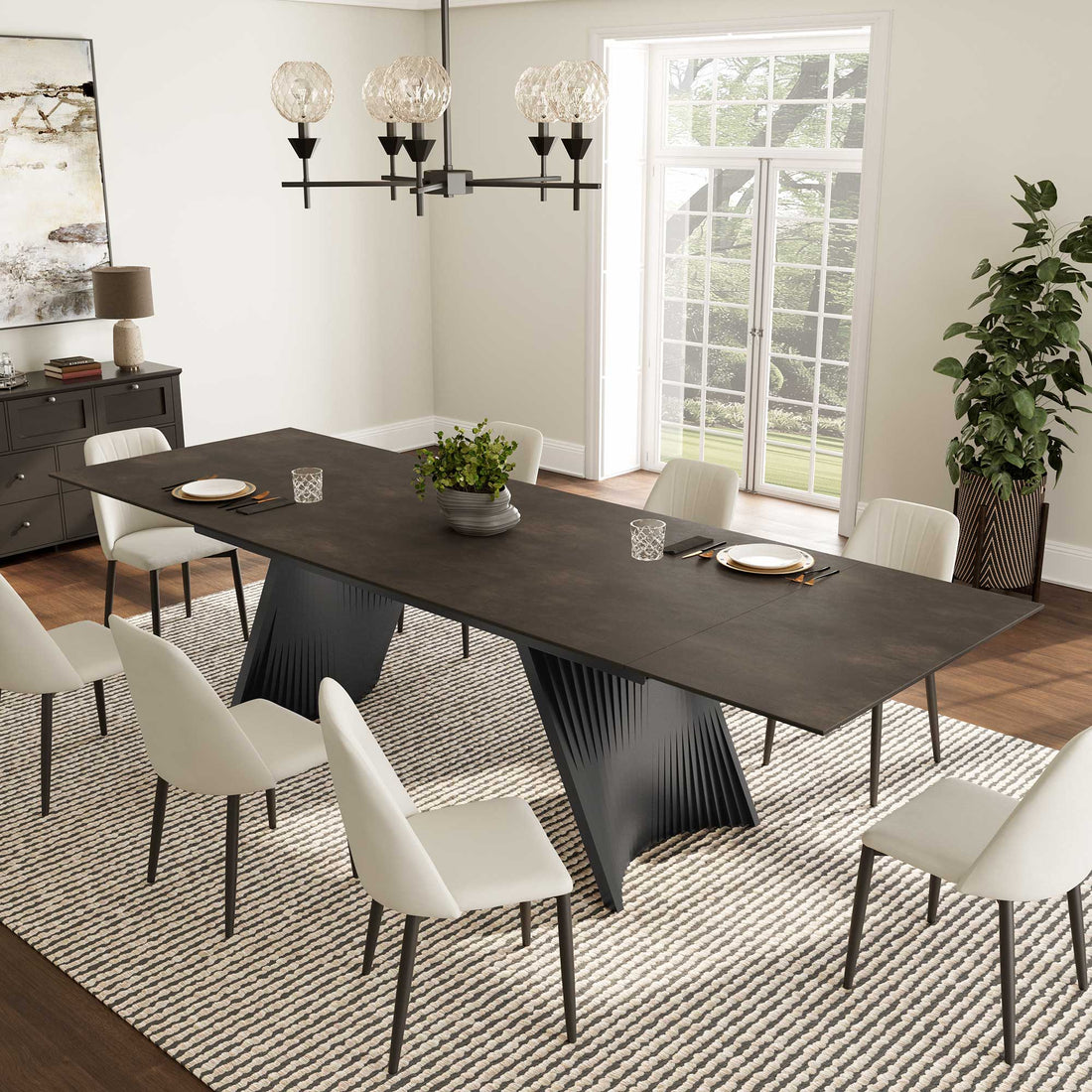
For households with significant height variations, selecting a table with a generous "eating height" clearance and pairing it with supportive seating is essential. The Charlotte, 90"-129" Extendable Dining Table With Sintered Stone Desktop provides a stable, expansive surface that allows for various seating arrangements. Its sintered stone top is not only aesthetically pleasing but also provides a durable surface for both dining and intensive tasks.

Managing Seat Height and Support
The chair is the most critical interface between the body and the environment. For users who find standard chairs uncomfortable, the Rlesana, Velvet Dining Side Chair 1 PC, Red/Green offers a petal-shaped backrest that provides a degree of lateral support and a plush cushion to help distribute pressure. While it is a fixed-height chair, its dimensions are designed to align with common ergonomic baselines for seat depth and width, which are vital for maintaining a neutral pelvic position.

Versatility for Diverse Households
In a family setting, a single table height must often accommodate a child, a petite adult, and a tall individual. The Edora Oak Extendable Dining Table (70.9" -92.5") offers a Parsons-inspired silhouette with clean lines that provide ample legroom. The absence of a thick apron (the wooden frame under the tabletop) is a significant ergonomic advantage, as it provides more vertical space for taller users to cross their legs or move freely without hitting the table frame.

For those preferring a modern industrial aesthetic, the Evelyn, 70"- 102" Extendable Dining Table with Slate, White utilizes an X-shaped leg design. This configuration is particularly beneficial for ergonomics because it maximizes knee clearance and floor space, allowing users of different heights to pull their chairs in closely to maintain an upright posture.

Practical Recommendations: How to Optimize Your Dining Setup
To ensure your dining area supports your health, follow these actionable steps based on ergonomic principles and industry heuristics.
1. Measure Your Popliteal Height
To find your ideal seat height, measure the distance from the floor to the crease of your knee while wearing the shoes you typically wear at home.
- The Heuristic: Your ideal seat height is approximately your popliteal height minus 1 to 1.5 inches. This allows for the compression of the seat cushion and ensures your feet remain firmly on the floor without the seat edge cutting off circulation.
- The Fix: If your chair is too high, use a discreet, low-profile footrest. This simple addition can instantly resolve lower back strain for petite users.
2. Calculate the "Eating Height" Differential
Measure the vertical distance from the top of your chair's seat to the top of the dining table.
- The Target: Industry ergonomists generally recommend a differential of 9 to 11 inches.
- The Test: Sit at the table and place your forearms on the surface. If your shoulders are pushed upward toward your ears, the table is too high or the chair is too low. If you have to lean forward to reach your plate, the table is too low.
3. Ensure Adequate Knee and Toe Clearance
Standard tables are often 28 to 30 inches high. However, the thickness of the tabletop and the apron can reduce the actual space available for your legs.
- The Requirement: Aim for at least 27 inches of vertical clearance from the floor to the lowest point under the table. This is consistent with ADA accessibility standards and ensures that even taller users can sit comfortably without their thighs being pressed against the underside of the table.
4. The 20-8-2 Rhythm for Multi-Use Spaces
If you use your dining table for work, adopt the rhythm recommended by the Cornell University Ergonomics Web:
- 20 minutes of sitting in a neutral posture.
- 8 minutes of standing (if using a height-adjustable surface).
- 2 minutes of moving or stretching.
- Even in a dining-only context, interrupting long periods of static sitting with brief movements can significantly reduce the risk of MSDs.
Modeling the Ergonomic Fit: A Practical Comparison
The following table models how different statures interact with standard furniture dimensions. This is a hypothetical scenario model based on average anthropometric data and intended for general guidance.
| User Stature (Estimated) | Popliteal Height (in) | Ideal Seat Height (in) | Table Height (in) | Resulting Differential (in) | Ergonomic Outcome |
|---|---|---|---|---|---|
| Petite (5'2") | ~15.5 | 14 - 14.5 | 30 | 15.5 | Poor: Table too high; shoulders strained. |
| Average (5'9") | ~17.0 | 15.5 - 16 | 30 | 14.0 | Fair: Slightly high; may need seat cushion. |
| Tall (6'2") | ~19.0 | 17.5 - 18 | 30 | 12.0 | Good: Near optimal forearm alignment. |
Method & Assumptions:
- Modeling Type: Deterministic parameterized model based on standard body proportions.
- Assumptions: Seat compression of 1 inch; shoe sole thickness of 0.5 inches included in popliteal height.
- Boundary Conditions: This model does not account for individuals with atypical torso-to-leg ratios or pre-existing spinal conditions.
Selecting for the Long Term
When choosing between different furniture options, prioritize the "clearance" and "support" factors over purely visual elements. In a household with multiple users, a fixed-height table set to the needs of the tallest user is often the most practical choice, provided that shorter users are equipped with appropriate chairs and footrests.
The Charlotte Extendable Dining Table and the Evelyn Extendable Dining Table both provide the structural integrity and legroom necessary to accommodate a variety of users. By combining these with a thoughtful understanding of your own body's measurements, you can transform your dining area from a source of discomfort into a sanctuary of well-being.
Investing in furniture that respects the principles of musculoskeletal health is a commitment to your long-term quality of life. As we continue to blur the lines between where we live, work, and eat, the importance of a scientifically grounded approach to our domestic environment has never been greater.
Disclaimer: This article is for informational purposes only and does not constitute professional medical advice, diagnosis, or treatment. Always seek the advice of a qualified health provider with any questions you may have regarding a medical condition or musculoskeletal pain. Ergonomic recommendations are general guidelines and may need to be adjusted based on individual physical requirements and pre-existing health conditions.
Sources
- BIFMA G1-2013 Ergonomics Guideline for Furniture
- ISO 9241-5:2024 Workstation layout & postural requirements
- OSHA eTools: Computer Workstations - Neutral Working Postures
- Cornell University Ergonomics Web — Workstation Guides
- OSHwiki: Musculoskeletal disorders and prolonged static sitting
- U.S. Access Board - ADA Standards for Tables
Leave a comment