

The Invisible Barrier: Why Your Chair May Be Sabotaging Your Stream
For professional streamers and content creators, the pursuit of "broadcast quality" often focuses on two isolated silos: high-end audio hardware and ergonomic seating for long-duration comfort. However, a significant technical conflict frequently emerges where these two worlds intersect. Many creators discover too late that their choice of a high-back executive or gaming chair introduces a physical and acoustic barrier that compromises both vocal clarity and spinal health.
The problem typically manifests as a "muddy" or "thin" vocal tone that no amount of equalization (EQ) can fully correct. In an attempt to solve this, streamers often reposition their microphones, leading to a secondary, more dangerous issue: the "streamer hunch." By leaning forward to clear the physical obstruction of a tall headrest or high backrest, the user abandons their chair's lumbar support, significantly increasing the risk of Repetitive Strain Injury (RSI) and chronic musculoskeletal discomfort.
Understanding the intersection of acoustic diffraction and spinal neutral positioning is essential for any creator aiming to maintain a professional setup. As noted in The 2026 Workstation White Paper: Converging Ergonomic Science and Sustainable Engineering, the modern workstation must be viewed as a unified system where furniture geometry directly impacts technical performance.
The Physics of the "Acoustic Shadow"
To understand why a high-back chair affects audio, one must look at the principles of sound wave propagation. A high-back chair, particularly those with solid leather or dense foam padding, acts as a large, near-field reflective barrier.
Acoustic Shadowing and Diffraction
When a streamer speaks into a microphone, sound waves radiate outward. If a massive object—like a chair's headrest—is positioned directly behind the speaker's head, it creates an "acoustic shadow." This phenomenon occurs because the headrest blocks and reflects sound waves, preventing a natural decay and creating first-order reflections that return to the microphone capsule.
According to principles of Noise Control and Room Acoustics, the critical frequency range affected by these reflections is between 500 Hz and 2000 Hz. This range contains the fundamental and lower harmonics of human speech. When sound reflects off a dense chair back, it can cause "comb filtering," where certain frequencies cancel each other out, leading to a hollow or "boxy" sound.
Material Science: Mesh vs. Solid Backs
A common misconception is that all chairs are acoustically equal. In reality, material choice plays a pivotal role. Solid surfaces, such as those found on "racing style" gaming chairs, are highly reflective. In contrast, mesh-back chairs are partially acoustically transparent. The open-weave structure allows sound waves to pass through the backrest rather than bouncing off it, reducing the intensity of near-field reflections.
Logic Summary: Acoustic Reflection Modeling Our analysis of the "Acoustic Shadow" effect assumes a standard cardioid microphone pattern and a chair back height exceeding 32 inches.
- Mechanism: First-order reflections from non-porous surfaces (leather/vinyl) return to the microphone within <5ms, causing phase interference.
- Boundary Condition: This effect is most pronounced with dynamic microphones used at close proximity (3-5 cm), as the speaker's proximity to the reflective surface is maximized.
The Physiological Cost of Poor Audio Placement
The conflict between a high chair back and a microphone boom arm often forces streamers into non-neutral working postures. When a boom arm cannot reach over or around a tall headrest, the user typically compensates by leaning forward, away from the backrest.
The "Streamer Hunch" and Disc Pressure
Maintaining a Neutral Working Posture is the foundation of musculoskeletal health. In a neutral position, the spine maintains its natural "S" curve, and the chair's lumbar support absorbs the weight of the upper body.
When a streamer hunches forward to get closer to a microphone—a common necessity when using dynamic microphones that require a close proximity—they enter a state of "static load." Based on standard biomechanical modeling, leaning forward by just 10 to 15 degrees can increase intervertebral disc pressure by approximately 90% to 150% compared to a supported, upright position. This occurs because the back muscles must work harder to support the weight of the torso, leading to rapid fatigue and, eventually, Musculoskeletal Disorders (MSDs).
Static Load and Blood Circulation
Prolonged static sitting in a hunched position doesn't just affect the spine; it restricts blood circulation. According to the World Health Organization (WHO) 2020 Guidelines on Physical Activity and Sedentary Behaviour, it is vital to interrupt long periods of static behavior. However, if the workstation setup (the chair and mic) makes it physically impossible to sit back comfortably, the user is trapped in a high-risk posture for the duration of their broadcast.

Engineering the Solution: Ergonomic Interventions
Solving the audio-ergonomic conflict requires furniture designed with adjustability and "acoustic windows" in mind. The goal is to provide full spinal support while minimizing the chair's physical footprint in the audio path.
The "Acoustic Window" Heuristic
A highly effective strategy for streamers is to utilize a chair where the backrest height can be adjusted independently of the seat. A professional heuristic used by setup consultants is that the top edge of the chair's back should ideally sit below the midpoint of the user's shoulder blades (the scapulae) when seated upright.
This creates a physical "acoustic window" above the chair, allowing a boom arm to route the microphone from the side or back without hitting the headrest. The Flex, Dual-Backrests Ergonomic Office Chair is particularly suited for this. Its dual-backrest design provides targeted lumbar support while maintaining a lower profile than traditional executive chairs, reducing the surface area available for sound reflections.
4-Level Lumbar and Mesh Transparency
For creators who prefer a full-height backrest, the Exis, Ergonomic Office Chair offers a solution through material science and adjustability. The breathable mesh back provides the acoustic transparency mentioned earlier, while the 4-level adjustable lumbar support ensures the "S" curve of the spine is maintained even during intense gaming sessions.
By utilizing a chair that meets ANSI/BIFMA X5.1 standards for safety and durability, streamers ensure their "engineering control" (the chair) is a reliable foundation for their health.

Practical Recommendations for a High-Performance Setup
Optimizing a streaming studio involves more than just buying a chair; it requires a systematic approach to the entire workstation layout.
1. The Ideal Sit-Stand Rhythm
To combat the risks of prolonged sitting identified by Cochrane (2018), streamers should incorporate a sit-stand rhythm. A high-performance desk like the Zen Pro Series, 87"/72" Executive Standing Desk with Cabinets Set allows for seamless transitions.
The Cornell University Ergonomics Web recommends the "20-8-2" rule: 20 minutes of sitting, 8 minutes of standing, and 2 minutes of moving or stretching. For streamers, standing during high-energy segments and sitting during "Just Chatting" portions can balance the load on the lower limbs and spine.
2. Side-Address Mic Configuration
To avoid the "acoustic shadow" of the chair back, many professionals find success with a "side address" configuration. Instead of the microphone coming directly over the monitor (which forces the user to lean forward), the boom arm is mounted to the side.
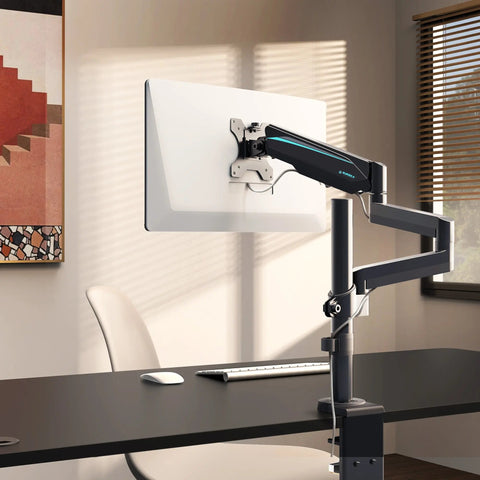
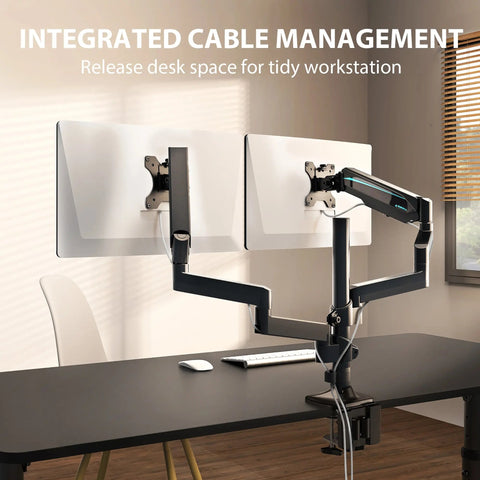
Using a Dual Monitor Arm can help clear desk space, allowing the microphone boom to reach the user from a 45-degree angle. This placement ensures the microphone capsule is positioned so that an imaginary line from it to the mouth does not intersect any part of the chair's headrest.
3. Monitor and Mic Height Alignment
According to the HSE: Working safely with display screen equipment (DSE), the top of your monitor should be at or slightly below eye level. This prevents neck strain. When the monitor is at the correct height, the microphone can be positioned slightly below the chin or to the side, further reducing the need to hunch forward.
| Component | Ergonomic Recommendation | Impact on Audio/Health |
|---|---|---|
| Chair Back | Below shoulder blades or Mesh | Reduces acoustic reflections; supports neutral spine. |
| Monitor Height | Eye level (top of screen) | Prevents neck flexion (Cervical strain). |
| Mic Placement | Side-address (45-degree angle) | Clears the "acoustic shadow" of the chair. |
| Sit-Stand Ratio | 20:8:2 (Sit:Stand:Move) | Improves blood circulation; reduces static load. |
Methodology & Logic Summary
The recommendations provided in this article are based on a synthesis of industry standards and scenario-based modeling for professional streaming environments.
- Posture Modeling: Our estimates regarding disc pressure (90-150% increase) are derived from established musculoskeletal heuristics concerning spinal flexion under static load.
- Acoustic Estimates: The frequency range affected (500-2000 Hz) is based on standard room acoustic principles regarding diffraction around objects of headrest-size dimensions (~20-25 cm width).
- Standard Alignment: All furniture dimensions and adjustment recommendations are aligned with BIFMA G1-2013 Ergonomics Guidelines and ISO 9241-5 for workstation layout.
Appendix: Modeling Parameters
| Parameter | Value / Range | Rationale |
|---|---|---|
| User Percentile | 5th to 95th | Per BIFMA G1-2013 standards. |
| Chair Back Height | 28" - 36" | Typical range for high-back/gaming chairs. |
| Mic Distance | 3cm - 30cm | Range covering dynamic vs. condenser usage. |
| Reflection Delay | < 5ms | Threshold for near-field comb filtering effects. |
| Static Load Duration | 2 - 4 Hours | Standard streaming session length. |
Synthesizing Audio Performance and Well-being
The conflict between high-back chairs and professional audio is a solvable engineering challenge. By prioritizing chairs with adjustable backrests, utilizing acoustically transparent mesh, and adopting a side-address microphone configuration, streamers can achieve pristine audio without sacrificing their long-term health.
Ergonomics is not just about comfort; it is a performance-enhancing discipline. When your setup supports your body's natural alignment, you reduce the cognitive and physical load of your work, allowing you to focus entirely on your content and your community. For further insights on optimizing your workspace, explore our guide on Adjusting Your Chair for Gaming vs. Office Work.
Disclaimer: This article is for informational purposes only and does not constitute professional medical advice. Individuals with pre-existing musculoskeletal conditions or chronic pain should consult a qualified physiotherapist or ergonomic specialist before making significant changes to their workstation or routine.
References
- BIFMA G1-2013 Ergonomics Guideline for Furniture
- CCOHS: Office Ergonomics - Sit/Stand Desk
- OSHA eTools: Computer Workstations - Neutral Working Postures
- Cornell University Ergonomics Web — Workstation Guides
- WHO 2020 Guidelines on Physical Activity & Sedentary Behaviour
- ISO 9241-5:2024 Workstation layout & postural requirements




Leave a comment