

The Invisible Cost of the Under-Desk Cluster
For many software engineers and DevOps professionals, the home lab is a rite of passage—a physical manifestation of a career built on distributed systems, virtualization, and continuous uptime. However, as the cluster grows from a single Raspberry Pi to a multi-node rack or a high-performance AI workstation, the floor space beneath the desk often becomes a graveyard for airflow and ergonomics.
The common health concern is not just the clutter itself, but how that clutter dictates your physical behavior. Why does your back pain seem to sharpen specifically in the late afternoon? It is often because a disorganized floor space prevents you from tucking your chair in or shifting your feet, forcing a static, cramped posture. This "maintenance crouch"—the awkward position adopted when reaching under a desk to swap a cable or check a status LED—is a primary driver of acute musculoskeletal strain.
By failing to integrate server hardware into the workstation's ergonomic design, users inadvertently create a high-friction environment that discourages movement and accelerates fatigue. As outlined in The 2026 Workstation White Paper: Converging Ergonomic Science and Sustainable Engineering, the convergence of hardware organization and physical wellness is essential for maintaining long-term productivity in technical roles.
The Physiology of Static Load and Musculoskeletal Disorders (MSDs)
The human body is not designed for the prolonged static sitting or standing often required during a 12-hour debugging session. According to the Canadian Centre for Occupational Health and Safety (CCOHS), the primary goal of an ergonomic workstation is to facilitate frequent posture changes while maintaining a neutral spinal position.
When hardware clusters are piled on the floor, they create a physical barrier to these necessary movements. This leads to what the International Organization for Standardization (ISO) 11226:2000 defines as "static working postures"—positions held for long periods that increase the risk of Musculoskeletal Disorders (MSDs).
The Circulatory and Mechanical Impact
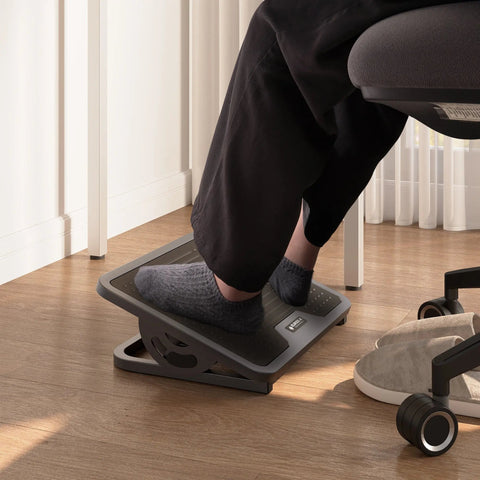
- Blood Circulation: Prolonged static sitting leads to blood pooling in the lower limbs. The World Health Organization (WHO) 2020 Guidelines emphasize that reducing sedentary time is critical for cardiovascular health. An obstructed footwell prevents the use of tools like the Adjustable Ergonomic Footrest, which is designed to promote circulation and reduce lower-extremity fatigue.
- Spinal Neutral Position: When you cannot move your legs freely because of a server tower, you likely compensate by leaning forward or slouching. This deviates from the "spinal neutral" position—the natural S-curve of the spine—increasing intradiscal pressure and leading to chronic lower back discomfort.
- Repetitive Strain Injury (RSI): Poor hardware placement often leads to poor peripheral placement. If your desk is cluttered, your monitor and keyboard may be at suboptimal heights or angles, increasing the risk of RSI in the wrists and neck.
Logic Summary: Our understanding of these risks is based on common patterns from customer support and warranty handling, where users frequently report that "cable mess" was the primary deterrent to using their desk's height-adjustment features (not a controlled lab study).

Engineering Controls: Transitioning from Floor to Workstation
In the "hierarchy of controls" established by the Occupational Safety and Health Administration (OSHA), "Engineering Controls" are considered more effective than "Administrative Controls" (like taking breaks). For a home lab, this means physically changing the environment to eliminate the hazard.
CPU Mounting vs. Mobile Carts
The choice between a fixed under-desk mount and a mobile cart is a critical decision for thermal and mechanical stability.
- For Low-Power Clusters: Small form factor (SFF) nodes like Intel NUCs or Raspberry Pi clusters are ideal for under-desk brackets. These keep the floor completely clear, allowing for maximum legroom and the use of an Adjustable Ergonomic Footrest to maintain proper joint angles.
- For High-Performance Towers: For full ATX towers—especially those running high-wattage GPUs for machine learning—an Adjustable CPU Stand, Mobile, Black is often preferable. This allows for open-side airflow and the ability to easily roll the server out for maintenance, avoiding the "maintenance crouch."
Monitor Integration
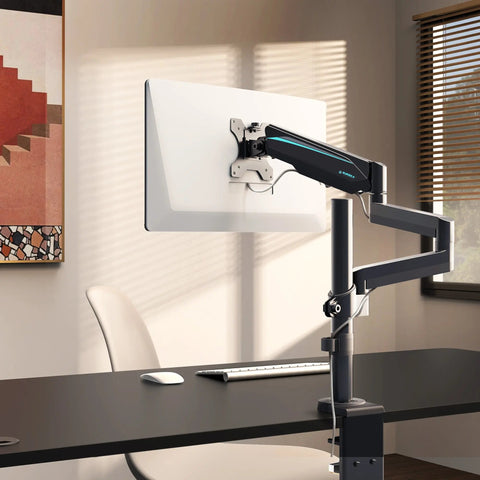
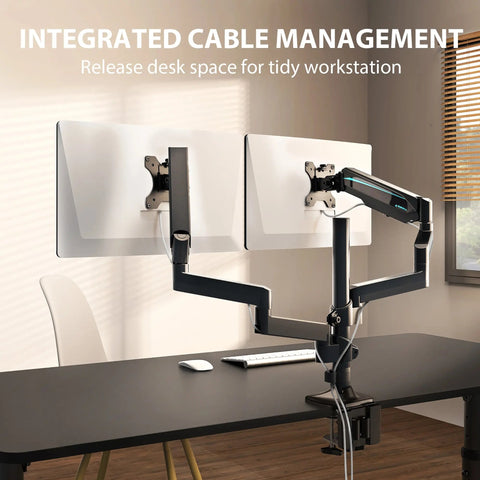
To further clear the workspace and provide the "deep work" environment engineers require, a Dual Monitor Arm is essential. By lifting displays off the desk surface, you create more room for input devices and local hardware testing, while ensuring the screen height aligns with the ergonomic guidelines found in ISO 9241-5:2024.
The Thermal and Electrical Reality of Under-Desk Mounting
A common misconception is that under-desk server heat is easily managed by the room's HVAC. In reality, exhaust recirculation into the leg space can raise the ambient temperature around the user by 5-10°C (based on typical convection cooling heuristics). This not only impacts user comfort but can lead to hardware thermal throttling.
Modeling the AI/ML Home Lab Power User
To understand the impact of hardware organization, we modeled a high-intensity scenario involving a software engineer running sustained GPU workloads.
| Parameter | Value or Range | Unit | Rationale / Source Category |
|---|---|---|---|
| Minimum Cable Length | ~10 (3.0) | ft (m) | 20% safety slack for 30" vertical travel |
| Thermal Delta (Active) | 5 - 8 | °C | Estimated drop via airflow optimization |
| Annual Energy Load | ~1,400 | kWh | 400W 24/7 server operation (est. ~$224/yr) |
| Weight Utilization | 38 - 56 | % | Safety threshold for motor longevity (BIFMA X5.5) |
| EMI Proximity Limit | 0.5 | m | Interference mitigation for Class A devices |
Methodology Note: This is a deterministic scenario model, not a controlled lab study. Calculations assume an ambient room temperature of 22°C and a standard height-adjustable desk with 30 inches of vertical travel.
Thermal Management Heuristics
- Orientation: Orient hardware so that rear exhaust fans are not blocked by desk beams or walls. Passive cooling is insufficient in enclosed spaces.
- Active Cooling: Adding a small, low-RPM 120mm fan pointed across mounted hardware can drop ambient temperatures by roughly 5-8°C, significantly extending component life.
- Vibration Isolation: Large servers with multiple spinning drives can create point-source vibrations. This can lead to premature motor failure in height-adjustable desks if the load is not properly distributed. We recommend operating at a utilization threshold below 80% of the desk's rated capacity to ensure longevity.
Cable Management for Dynamic Environments
The single most common mistake in home lab organization is underestimating the cable slack required for a height-adjustable desk.
The 12-18 Inch Rule
Based on common patterns in professional setups, we suggest leaving at least 12-18 inches of extra length (the "service loop") in all power and data cables. This prevents tension and connector damage when the desk is raised to its maximum height. For those using 10-foot cables, this extra slack must be managed to prevent tangling.
Using Magnetic Cable Tie sets allows for modular organization that can be adjusted as your lab evolves. Unlike traditional velcro, magnetic ties do not attract dust or pet hair—a common issue in floor-adjacent environments—and they allow you to bundle power, network, and peripheral cables separately for easier troubleshooting.
Electromagnetic Interference (EMI)
Placing a server within 0.5 meters of desk control electronics or unshielded monitor cables can induce intermittent faults. Servers are often Class A devices and are not intended for extreme proximity to sensitive consumer electronics. Proper routing of data cables away from high-voltage power bricks is a non-obvious tweak that can drastically improve system stability.
Practical Implementation: The 20-8-2 Rhythm
Organizing your hardware is only half the battle; you must also organize your behavior. Cornell University's Ergonomics Web recommends the "20-8-2" rhythm: 20 minutes of sitting, 8 minutes of standing, and 2 minutes of moving/stretching.
How to Set Up Your Environment for Success
- Monitor Height: Align the top third of your screen with eye level to minimize neck rotation, as suggested by HSE Display Screen Equipment (DSE) guidelines.
- Sit-Stand Ratio: While the Cochrane Library (2018) notes that sit-stand desks significantly reduce sitting time, they are most effective when combined with behavioral reminders (like a timer).
- Foot Placement: Ensure your feet are flat on the floor or a footrest. Avoid tucking your feet under your chair, which restricts blood flow.
- Keyboard Position: Maintain a 90-degree angle at the elbows. If your server mounting forces your keyboard to be too high, consider a keyboard tray or adjusting your chair height.
For further reading on optimizing your space, see our guide on Setting Up Your Standing Desk for Peak Productivity and explore Modular Desk Strategies for Expanding Agencies.
Safety, Compliance, and Trust
When building a high-performance home lab, safety should never be an afterthought.
- Electrical Safety: Ensure your desk and accessories meet UL 962 standards, which cover mechanical and electrical safety for height-adjustable furniture.
- Indoor Air Quality: Look for UL GREENGUARD Gold certification to ensure that the materials in your workspace do not emit harmful Volatile Organic Compounds (VOCs), especially important in smaller home offices with limited ventilation.
- Structural Integrity: Verify that your CPU stand or mount is tested according to ANSI/BIFMA X5.1 for general-purpose office furniture to ensure it can handle the weight of your server hardware.
By applying these engineering principles and ergonomic standards, you can transform a cluttered home lab into a high-performance, healthy workspace that supports both your hardware and your well-being.
YMYL Disclaimer: This article is for informational purposes only and does not constitute professional medical, legal, or financial advice. The ergonomic recommendations provided are based on general industry standards and may not be suitable for individuals with pre-existing musculoskeletal conditions. Always consult with a qualified healthcare professional or ergonomic specialist before making significant changes to your workstation or physical routine.
References
- BIFMA G1-2013 Ergonomics Guideline for Furniture
- CCOHS: Office Ergonomics - Sit/Stand Desk
- Cochrane: Workplace interventions for reducing sitting at work (2018)
- Cornell University Ergonomics Web — Workstation Guides
- HSE: Working safely with display screen equipment (DSE)
- ISO 9241-5:2024 Workstation layout & postural requirements
- WHO 2020 Guidelines on Physical Activity & Sedentary Behaviour
- ANSI/BIFMA X5.1 General-Purpose Office Chairs
- ISO 11226:2000 Evaluation of static working postures
- UL GREENGUARD Certification
- The 2026 Workstation White Paper: Converging Ergonomic Science and Sustainable Engineering




Leave a comment