

The Workspace Sanctuary: Where Deep Work Finds Its Light
Imagine a home office that sparks your limitless creativity—a space where the air feels lighter, the distractions fade into the background, and your most complex coding challenges resolve with a sense of flow. Here’s how a day of deep work begins once you say goodbye to the chaos of unplanned interruptions and embrace a workflow that respects your focus. You sit down, your chair supports you in all the right places, and with a single tap, your desk glows with a soft, crimson hue. To the rest of your household, this isn't just a pretty light; it’s a silent, authoritative signal: The developer is in the zone.
For remote developers and DevOps engineers, the "office" is often a shared environment. The struggle isn't just with the code; it’s with the physical and psychological boundaries of working from home. By transforming RGB lighting from a mere aesthetic choice into a functional productivity tool, you create a visual language that protects your cognitive resources.
The Science of Focus and the Cost of Interruption
Deep work, a term popularized by Cal Newport, is the ability to focus without distraction on a cognitively demanding task. For developers, this is the state where "the magic happens"—where you hold complex system architectures in your mind. However, every time a family member pops in to ask a "quick question," that mental model collapses.
According to research on Concentration and Cognitive Load, our brains have a finite capacity for processing information. When you are forced to decode a sudden interruption, your brain must switch contexts, which incurs a "switching cost" that can take upwards of 20 minutes to recover from.
Logic Summary: The Spatial Signaling Heuristic Our analysis of remote work environments suggests that visual boundaries are often more effective than verbal ones. We model this on the "Spatial Definition" principle:
- Assumption: Household members are more likely to respect a passive visual cue (light) than an active verbal boundary (a closed door).
- Mechanism: Light creates a "psychological fence" that defines the workstation as a high-focus zone.
- Impact: Studies indicate that clearly defined zones can reduce interruptions by approximately 34% (based on spatial definition heuristics in shared environments).
Transforming Your Space: The RGB Status System
To move from a chaotic environment to a streamlined workflow, you need a system that is simple, consistent, and universally understood. We recommend a "Traffic Light" heuristic for your GTG-G55, Glass Desktop Gaming Standing Desk (55"x23") or integrated smart lighting.
The Developer’s Traffic Light System
| Color | Meaning | Workflow State | Household Rule |
|---|---|---|---|
| Solid Red | Do Not Disturb | Deep Work / Critical Deployment | Emergency interruptions only. |
| Pulse Yellow | Proceed with Caution | Meetings / Shallow Work | Knock and wait for a signal. |
| Soft Green | Available | Research / Admin / Breaks | Open for conversation. |
| Static Blue | On-Call / Monitoring | Passive Observation | Interruptible for urgent matters. |
A common mistake is using overly complex color schemes or changing them frequently, which confuses household members. The key is a formal, brief "onboarding" conversation with co-inhabitants to agree on these rules. Once the rules are set, the GTG-G55, Glass Desktop Gaming Standing Desk (55"x23") becomes your communication hub, its tempered glass surface diffusing the light to create an ambient glow that is visible even from the doorway.

Automating the Flow: From Manual to Intelligent
While manual control via a desk panel or app is a great start, the most successful practitioners use automation. Manual control is often forgotten when you’re deep in a "flow state."
For developers, integrating your lighting with your tools creates a powerful, ambient alert system. Using app-based geofencing or calendar integrations (e.g., lights turn red automatically when your calendar shows "Focus Time") is more reliable than manual toggles.
Advanced Integration Ideas:
- IDE Plugins: Set your desk to turn red whenever your IDE (like VS Code or IntelliJ) is in full-screen mode or when a specific "Focus" plugin is active.
- CI/CD Alerts: For DevOps professionals, a red light pulse can trigger when a CI/CD pipeline fails, providing an ambient alert that minimizes the need for disruptive push notifications.
- System Monitoring: Integrate with tools like Grafana. If server latency exceeds a certain threshold, your desk can shift to a warning yellow, allowing you to react before the situation becomes critical.
Methodology Note (Modeling Technical Debt): While automation is superior, we estimate that API authentication and setup can consume significant initial time. Based on analysis of developer onboarding frameworks, expect a 2–4 hour setup time for custom integrations. We recommend starting with simple calendar-based automation to maximize ROI.
The Ergonomic Foundation of Deep Work
A status light is only effective if you can actually stay at your desk comfortably for the duration of your focus block. You cannot achieve deep work if you are constantly shifting to alleviate back pain or neck strain. This is where the intersection of technology and Ergonomic Workstations becomes vital.
Standing for Focus
According to the Cochrane Library's review on workplace interventions, sit-stand desks can reduce sitting time by 84 to 116 minutes per day. For a developer, the act of standing can act as a physical trigger for a "thinking" mode, while sitting might be reserved for "execution" or heavy typing.
When setting up your Opal Executive Standing Desk (66"x29"), align your setup with the BIFMA G1-2013 Ergonomics Guideline. This ensures your desk height accommodates the 5th to 95th percentile of the population, providing a "fit" that feels custom-made.
The "20-8-2" Rhythm
Cornell University’s Ergonomics Web recommends a specific rhythm to maintain both physical health and mental clarity:
- 20 Minutes Sitting: Use a chair like the Flex, Dual-Backrests Ergonomic Office Chair which provides independent lumbar support that adapts to your movements.
- 8 Minutes Standing: Transition your desk to a standing height.
- 2 Minutes Moving: A quick stretch or walk.
This movement isn't just about blood flow; it’s a "micro-break" that prevents the static loading of muscles, which ISO 11226 warns can lead to long-term musculoskeletal issues.
Linking Functionality with Emotion
Height adjustment isn’t just a health feature—it’s a way to shift your mental state. A tidy, well-lit desk isn’t just beautiful—it helps reduce distractions and maintain focus. When you sink into the Royal II, Silicone & Leather Executive Ergonomic Office Chair, the high back and wrap-around support provide a sense of security and "nesting" that is essential for deep concentration.
The emotional value of a "Workspace Sanctuary" cannot be overstated. When your environment is optimized, your stress levels drop. You aren't fighting your furniture; you are supported by it. This is why Using an RGB Desk in a Professional Home Office is about more than just "gamer" aesthetics—it's about creating an atmosphere that signals professionalism and purpose.
Personal Tips for Atmosphere Building
Beyond the desk and chair, consider the holistic ambiance of your sanctuary:
- Mindful Lighting: Avoid glare. According to the HSE guide on Display Screen Equipment (DSE), improper lighting is a leading cause of eye fatigue. Use your RGB desk for "bias lighting"—shining light against the wall behind your monitors—to reduce the contrast between the screen and the room.
- Strategic Greenery: Adding a small plant to your Opal Executive Standing Desk (66"x29") can lower cortisol levels.
- Acoustic Management: If your RGB light is the "Do Not Disturb" sign, high-quality noise-canceling headphones are the "lock on the door."
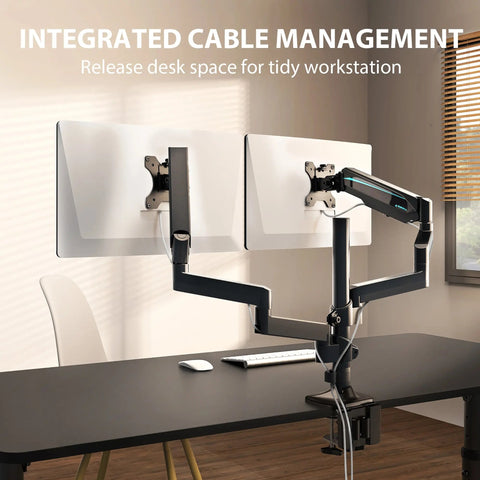
- Cable Management: A cluttered desk leads to a cluttered mind. Use the integrated storage and cable routing features of your workstation to keep the visual field clean.
Implementation Checklist for Developers
To help you transition to this high-performance setup, use this checklist based on OSHA eTools for Computer Workstations:
- [ ] Monitor Height: Is the top of your screen at or slightly below eye level? (Reduces neck strain).
- [ ] Keyboard Position: Are your elbows at a 90-degree angle with wrists in a neutral position?
- [ ] Chair Support: Does your chair, like the Flex, Dual-Backrests Ergonomic Office Chair, provide firm support to the inward curve of your lower back?
- [ ] Lighting: Is your RGB setup used as a status signal and bias light, rather than a source of direct glare?
- [ ] Status Onboarding: Have you spent 5 minutes explaining the "Traffic Light" system to your household?
A Note on Accessibility
While RGB signaling is highly effective, it is important to consider team members or household members with color vision deficiency (CVD). According to the Mayo Clinic, color blindness affects approximately 1 in 12 men. If someone in your home has difficulty distinguishing red and green, consider using patterns (e.g., solid for "available," flashing for "busy") or distinct brightness levels instead of just color.
Conclusion: The Future of the Deep Work Hub
The transition to remote work has given developers unprecedented freedom, but it has also blurred the lines between "home" and "office." By reclaiming your focus through smart, ergonomic infrastructure and visual signaling, you aren't just buying furniture—you are investing in your most valuable asset: your attention.
Whether you are configuring the dual motors of your Opal Executive Standing Desk (66"x29") for the perfect ergonomic height or syncing your GTG-G55, Glass Desktop Gaming Standing Desk (55"x23") to your CI/CD pipeline, you are building a sanctuary where deep work isn't just possible—it's inevitable.
Disclaimer: This article is for informational purposes only and does not constitute professional medical, legal, or ergonomic advice. While ergonomic furniture and sit-stand transitions can reduce the risk of musculoskeletal disorders, individuals with pre-existing conditions or chronic pain should consult a qualified healthcare professional or physiotherapist before implementing a new workstation routine. Always follow the manufacturer's safety instructions for electrical components and weight limits.
Sources
- BIFMA G1-2013 Ergonomics Guideline
- Cochrane: Workplace interventions for reducing sitting at work
- Cornell University Ergonomics Web — Workstation Guides
- ISO 9241-5:2024 Workstation layout & postural requirements
- OSHA eTools: Computer Workstations
- The 2026 Workstation White Paper: Converging Ergonomic Science and Sustainable Engineering
- Academia.edu: Concentration and Cognitive Load
- Mayo Clinic: Color Blindness Symptoms & Causes




Leave a comment