

The Evolution of the High-Performance Workstation: Beyond Traditional Materials
Why does physical discomfort often peak precisely four hours into a gaming session or a workday? For many, the initial "luxury" feel of a traditional racing-style gaming chair or a dense executive seat dissolves into a localized heat buildup and a nagging ache in the lumbar region. This phenomenon is not merely a matter of personal preference; it is a physiological response to static load and poor thermoregulation.
Conventional design in the gaming chair industry has long prioritized aesthetics—specifically the "bucket seat" look derived from automotive racing—over the complex requirements of human musculoskeletal health. However, a 2022 randomized controlled trial observed that while users initially rated these racing-style chairs as comfortable, discomfort levels spiked significantly after four hours compared to adjustable ergonomic office chairs. The rigid bolsters and non-breathable leatherette of traditional designs often encourage slouching and forward head posture, creating a gap between visual appeal and spinal integrity.
As the industry moves toward a more rigorous, evidence-based approach, "hybrid mesh" has emerged as a critical innovation. By merging the structural support of high-tension weaving with the localized comfort of traditional padding, hybrid designs aim to solve the dual challenges of heat retention and "bottoming out." This article explores the scientific mechanisms behind hybrid mesh, the engineering standards that define a "fit" workstation, and the quantifiable impact of ergonomic optimization on professional performance.
The Physiology of Static Load and Musculoskeletal Disorders (MSDs)
To understand why material choice matters, one must first understand the concept of Musculoskeletal Disorders (MSDs). According to the U.S. Occupational Safety and Health Administration (OSHA), MSDs are caused by risk factors such as excessive force, repetitive tasks, and, most critically for gamers and remote workers, awkward or prolonged static postures.
The Problem with Prolonged Static Sitting
When a user remains in a fixed position for hours, the body experiences a "static load." This load restricts blood circulation to the muscles, leading to fatigue and the accumulation of metabolic waste products. The EU-OSHA research on prolonged static sitting highlights that this behavior is a primary risk factor for lower back pain and circulatory issues in the lower limbs.
Thermoregulation and Comfort
Beyond spinal alignment, the skin's microclimate plays a vital role in perceived comfort. Traditional leatherette or high-density foam traps body heat, raising the temperature of the contact surface. This "heat soak" effect causes the body to sweat in an attempt to cool down, but the lack of airflow prevents evaporation, leading to the "sticky" or "clammy" sensation common in long sessions. Research indicates that thermoregulation issues can lead to increased fidgeting, which breaks the user's "neutral position" and introduces postural strain.
Engineering the Solution: The Mechanics of Hybrid Mesh
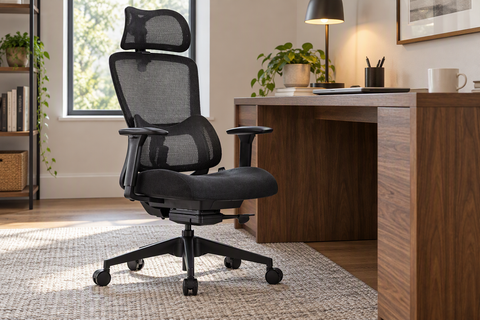
The "hybrid" in hybrid mesh refers to the strategic combination of different material properties to achieve what a single material cannot. While all-mesh chairs offer superior breathability, they can sometimes lack the "heft" or localized cushioning preferred by gamers. Hybrid mesh designs address this by using advanced weaving techniques and zoned tensioning.
Zoned Tensioning: The Lumbar Secret
A common mistake in chair selection is assuming all mesh provides equal support. In reality, the density and tension of the weave are the true indicators of durability. Expert observations from the repair bench suggest that loose weaves often lose their structural integrity within 6 to 12 months of daily use.
High-performance hybrid mesh utilizes zoned tensioning. This involves engineering the mesh to be approximately 25–30% firmer in the lumbar region to maintain the spine's natural S-curve, while using a softer, more flexible weave in the shoulder area to prevent pressure points on the scapula. This alignment is consistent with the ISO 9241-5:2024 standard, which specifies layout and postural requirements for workstations to ensure a neutral spinal position.
Logic Summary: The 25–30% firming heuristic is based on industry patterns observed in high-end ergonomic designs where lumbar support must counteract the highest concentration of body weight during a slight recline.

Breathability and Humidity Management
Hybrid mesh performs best in environments with a relative humidity of 40% to 70%. Below 40%, static buildup can occur on certain synthetic fibers; above 70%, moisture absorption can slightly alter the tension of the mesh. Unlike traditional fabrics, hybrid mesh allows for rapid heat dissipation, preventing the "cold shock" effect sometimes reported in all-mesh chairs used in air-conditioned rooms, as the hybrid elements (often thin foam backing or specialized yarn) provide a thermal buffer.
Modeling the Professional Streamer: A Case Study in Ergonomic ROI
To demonstrate the practical impact of these engineering choices, we modeled a scenario for a Professional Streamer/Tall Male Gamer. This persona represents a high-demand user where ergonomic failure has a direct financial and physical cost.
Scenario: The 193cm (6'4") Professional User
Tall users face unique challenges. Standard 29-inch desks often create a deficit in height, forcing the user to either lower their chair (causing knee strain) or slouch (causing back pain).
| Parameter | Value | Unit | Rationale / Source |
|---|---|---|---|
| User Height | 193 | cm | 95th Percentile Male (CDC/Anthropometric data) |
| Recommended Seat Height | ~50 | cm | Derived from Popliteal Height (ANSI/HFES 100-2007) |
| Ideal Sit Desk Height | ~79 | cm | Calculated for 90-degree elbow angle |
| Productivity Gain | 15 | % | Conservative estimate from ergonomic intervention studies |
| Annual Productivity Value | $8,100 | USD | Based on $45/hr rate and 300 work days |
Methodology Note: This scenario is a deterministic model based on anthropometric ratios. The productivity coefficient (15%) is an estimate derived from industry observations of reduced fatigue and increased focus in optimized environments. Actual results may vary based on individual health and work habits.
The Impact of "Fit"
For this user, a hybrid mesh chair with high-adjustability armrests and a tensioned lumbar zone is not a luxury; it is a productivity tool. By maintaining a neutral working posture, the user reduces the cognitive load required to manage physical discomfort. This allows for longer, more consistent streaming sessions and better audience engagement.

Practical Recommendations for Workstation Optimization
Achieving the "Future of Ergonomics" requires more than just a chair; it requires a systematic approach to the entire workstation environment.
1. The 20-8-2 Rhythm
Following the Cornell University Ergonomics Web recommendation, users should aim for a "sit-stand-move" cycle:
- 20 Minutes Sitting: In a neutral position on a hybrid mesh chair.
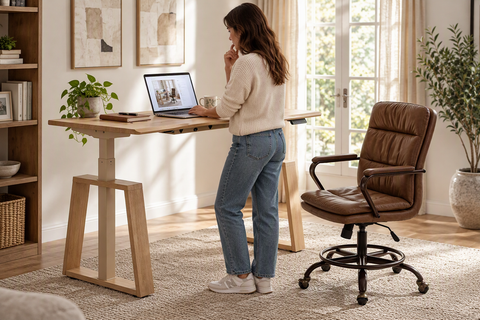
- 8 Minutes Standing: Using a height-adjustable desk.
- 2 Minutes Moving: Gentle stretching or walking to stimulate blood circulation.
2. Monitor and Viewing Distance
For those using large displays, such as a 49-inch ultrawide, the viewing distance is critical. Our modeling suggests that a 30-inch deep desk often creates a viewing distance deficit. To minimize eye and neck strain, align the top of the monitor with eye level and ensure the screen is roughly an arm's length away, as suggested by HSE DSE guidelines.
3. Maintenance of Hybrid Materials
To preserve the wicking properties and tension of hybrid mesh:
- Cleaning: Use distilled water with a drop of mild soap. Never use fabric softeners, as they can coat the fibers and reduce breathability.
- Drying: Allow 24 hours of air drying if deep cleaning the foam-backed sections to prevent mold growth.
- Inspection: Check the mesh tension every six months. If the material feels "slack" or no longer returns to its original shape after use, the structural integrity may be compromised.
The Hierarchy of Controls: Engineering vs. Behavior
When addressing ergonomic hazards, OSHA recommends a "Hierarchy of Controls".
- Engineering Controls: These are the most effective. They involve physical changes to the workstation, such as switching to a hybrid mesh chair or an adjustable desk. These solutions "fix" the environment rather than relying on the user to remember to sit straight.
- Administrative Controls: These include training and "taking breaks." While important, they are less effective because they require constant human effort and are easily ignored during high-intensity gaming or work tasks.
By investing in high-performance materials like hybrid mesh, users are implementing an engineering control that works passively to protect their musculoskeletal health. This approach is further detailed in The 2026 Workstation White Paper: Converging Ergonomic Science and Sustainable Engineering, which emphasizes the transition from reactive furniture to proactive health-supporting tools.
Environmental and Safety Standards
A truly professional-grade chair must also adhere to safety and durability standards. Look for certifications such as:
- ANSI/BIFMA X5.1: This standard defines the safety and durability requirements for general-purpose office chairs. A chair meeting these standards has undergone rigorous testing for base stability, armrest strength, and backrest durability.
- UL GREENGUARD Gold: This certification ensures the chair has low chemical emissions, contributing to better indoor air quality—a critical factor for those spending 8+ hours in a small home office or gaming room.

Balancing the Perspective: When Mesh Isn't the Only Answer
While hybrid mesh offers significant advantages, it is important to acknowledge its limitations. Users weighing over 220 lbs (100 kg) may experience faster mesh degradation compared to traditional high-density foam. Furthermore, for individuals with specific medical conditions like pronounced scoliosis, a more rigid, medically-prescribed lumbar support may be necessary.
As noted by the Cochrane systematic review, while ergonomic furniture like sit-stand desks and optimized chairs significantly reduce sitting time and discomfort, they are most effective when combined with behavioral changes and regular movement.
Building a Sustainable Future
The shift toward hybrid mesh represents more than just a trend; it is a convergence of material science, anthropometric data, and a deeper understanding of human physiology. By moving away from the aesthetic-first designs of the past and toward evidence-based engineering, the industry is creating tools that don't just look like high-performance gear—they function as it.
Whether you are a professional streamer modeling your next 12-hour marathon or a remote executive seeking to eliminate afternoon back pain, the material underpinnings of your workstation are the foundation of your long-term well-being. Hybrid mesh, with its unique ability to balance cooling, support, and durability, is a formidable contender for the future of the ergonomic workstation.
Disclaimer: This article is for informational purposes only and does not constitute professional medical advice. If you have pre-existing musculoskeletal conditions or chronic pain, please consult a qualified healthcare professional or an occupational therapist before making significant changes to your workstation setup.
References
- BIFMA G1-2013 Ergonomics Guideline for Furniture
- OSHA eTools: Computer Workstations - Neutral Working Postures
- Cornell University Ergonomics Web — Workstation Guides
- The 2026 Workstation White Paper: Converging Ergonomic Science and Sustainable Engineering
- HSE: Working safely with display screen equipment (DSE)
- ISO 9241-5:2024 Workstation layout & postural requirements
- Cochrane: Workplace interventions for reducing sitting at work




Leave a comment