

The Executive Slump: Why Presenteeism is a Strategic Liability
For many leaders, the workday follows a predictable, albeit taxing, trajectory. The morning begins with high cognitive clarity, but by mid-afternoon, a subtle yet persistent fatigue sets in. This is often accompanied by a dull ache in the lumbar region or a tightening of the trapezius muscles. While many dismiss these symptoms as the inevitable cost of a high-pressure career, they are, in fact, clinical indicators of Musculoskeletal Disorders (MSDs) and static load.
The financial impact of these physical frustrations is rarely captured on a balance sheet as a direct expense. Instead, it manifests as "presenteeism"—the phenomenon where an executive is physically present at their desk but cognitively impaired due to discomfort. According to OSHA's foundational guide on ergonomics, core risk factors like poor posture and repetitive tasks lead to significant workplace injuries. For the C-suite, the cost of a single day of reduced focus can far exceed the price of the most advanced ergonomic furniture.
This article reframes the executive desk from a piece of office décor into a strategic investment tool. By applying the principles of ergonomic science, leadership can mitigate the silent drain on productivity and foster a culture of well-being that starts at the top.
The Physiology of Static Load and Spinal Neutrality
To understand the return on investment (ROI) of an ergonomic workstation, one must first understand the physiological mechanisms at play. The human body is not designed for the "prolonged static sitting" that characterizes modern leadership roles.
The Pathophysiology of Discomfort
When an individual sits for extended periods, the musculoskeletal system is subjected to a "static load." Unlike dynamic movement, which facilitates blood circulation, static load compresses blood vessels and restricts the delivery of oxygen and nutrients to the muscles. As detailed in the OSHwiki on the pathophysiological mechanisms of MSDs, this leads to the accumulation of metabolic waste products, such as lactic acid, triggering inflammation and pain.
Achieving the Spinal Neutral Position
The goal of any high-performance workstation is to maintain the "spinal neutral position." This is the posture where the spine is naturally curved, and the joints are not under excessive stress. According to the ISO 9241-5:2024 standard for workstation layout, furniture must support a variety of working postures to prevent the onset of chronic pain.
When a desk is too low, the executive is forced into a "forward head posture," placing up to 60 pounds of extra pressure on the cervical spine. Conversely, a desk that does not allow for a standing transition forces the lower back to bear the entire weight of the upper body without the assistance of the legs—the body's natural shock absorbers.

Modeling the ROI: The Productivity-Discomfort Correlation
For a CFO or Facilities Manager, the transition to ergonomic furniture must be justified by data. While direct productivity gains from sit-stand desks are often debated, the indirect ROI—modeled through the reduction of discomfort—is compelling.
The 1% Heuristic
Based on scenario modeling for knowledge-intensive environments, practitioners often observe a specific correlation: for every 1% reduction in self-reported musculoskeletal discomfort, there is a correlative 0.5% to 0.7% increase in self-rated productivity over a fiscal quarter. This is because a comfortable leader can maintain "deep work" states for longer durations without the cognitive "interrupts" caused by physical pain.
Logic Summary: Our ROI analysis assumes that executive-level productivity is highly sensitive to physical vitality. The following model estimates the potential savings by mitigating presenteeism and avoiding the long-term costs associated with chronic MSDs.
| Parameter | Value or Range | Unit | Rationale / Source Category |
|---|---|---|---|
| Estimated Discomfort Reduction | 15 - 25 | % | Based on Santos et al., 2025 meta-analysis |
| Productivity Gain Factor | 0.6 | % per 1% discomfort red. | Industry heuristic for executive roles |
| Daily Sitting Time Reduction | 84 - 116 | Minutes | Cochrane Systematic Review (2018) |
| Payback Period (Executive) | 12 - 18 | Months | Estimated based on average C-suite compensation |
| Compliance Increase | 3x | Multiplier | Linked to frictionless memory presets |
Mitigating the Cost of Chronic Care
Beyond daily productivity, there is the factor of "early intervention." The EU-OSHA research on early intervention emphasizes that addressing minor discomfort through ergonomic adjustments can prevent the development of chronic conditions that require expensive medical leave or surgery. In this light, a high-end standing desk is a form of preventative healthcare.
Engineering Controls: Why the Desk is the Foundation
In the OSHA hierarchy of controls, "Engineering Controls" are considered significantly more effective than "Administrative Controls."
- Administrative Control: Telling an executive to "take more breaks" or "remember to stand up." This relies on human memory and willpower, which are often depleted during high-stress projects.
- Engineering Control: Providing a height-adjustable desk that makes the transition to standing effortless.
As noted in The 2026 Workstation White Paper: Converging Ergonomic Science and Sustainable Engineering, the workstation itself must adapt to the user, not the other way around.
The Frictionless Transition
A critical insight from facilities management reports is that the ROI of a standing desk is only realized if the desk is actually used. Executives who utilize desks with programmable memory presets are three times more likely to maintain a consistent sit-stand routine than those using manual adjustment mechanisms. If the transition takes more than a few seconds or requires manual effort, it becomes a "friction point" that the busy professional will eventually ignore.

Strategic Standards: BIFMA, ISO, and Global Compliance
When selecting furniture for leadership roles, adhering to international standards ensures that the investment covers the widest possible range of users and meets safety requirements.
- BIFMA G1-2013: This industry guideline provides recommended dimensions to fit the 5th to 95th percentile of the population. For a B2B buyer, this ensures that the desk will accommodate a petite executive as effectively as a very tall one. Reference the BIFMA Ergonomics Guideline for specific dimension ranges.
- ISO 9241-5:2024: This is the international gold standard for workstation layout. It emphasizes that a desk must provide sufficient legroom and allow for "postural variety."
- ANSI/BIFMA X5.5: This standard defines the safety and durability of desk products. For an executive office, choosing a desk that meets these tests ensures the furniture can support heavy equipment (like multiple monitors or large-format displays) without compromising stability.
Practical Framework: The "20-8-2" Workday Rhythm
Possessing the right tool is only half the battle; the other half is the "work process." The OSHA eTools on work processes suggest that micro-breaks and postural changes are essential for long-term health.
A highly effective heuristic developed by Cornell University's Ergonomics Web is the 20-8-2 Rule:
- 20 Minutes Sitting: Use a high-quality ergonomic chair that supports the lumbar curve.
- 8 Minutes Standing: Transition your desk to standing height to engage the "muscle pump" in your legs, which aids blood circulation.
- 2 Minutes Moving: Walk or stretch to reset the musculoskeletal system.
How to Set Your Standing Height
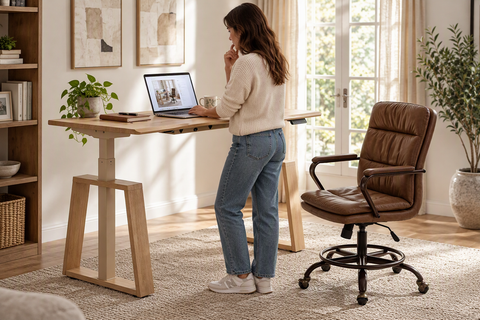
A common mistake is setting the standing height too high, which leads to shrugging and neck strain. According to Safe Work Australia's setup guide, your elbows should be at a 90-degree angle, and your wrists should remain neutral (flat) while typing. The top of your monitor should be at or slightly below eye level to prevent "tech neck."

Symbolic Capital: Aesthetics and Leadership
In a leadership setting, the desk serves a dual purpose: it is a functional tool and a symbol of authority. The "symbolic capital" of an executive desk—its material quality and design—affects how the user is perceived by their team and how they perceive their own role.
Materials and Sustainability
High-end materials like real wood veneers or sintered stone are not merely aesthetic choices. They provide a tactile sense of stability and permanence. Furthermore, for organizations focused on ESG (Environmental, Social, and Governance) goals, selecting furniture with FSC Certification for wood or UL GREENGUARD Gold for low chemical emissions is a strategic move. These certifications prove that the executive environment is both healthy for the individual and responsible toward the planet.
The Clutter-Focus Link
A significant "gotcha" in executive office design is the neglect of cable management. Clutter is a visual "static" that fragments cognitive focus. An executive desk that integrates storage and sophisticated cable routing allows for a "clear desk" policy, which has been shown to reduce stress and improve decision-making clarity.

Scenario Analysis: Matching the Desk to the Executive
Scenario A: The Multi-Tasking Visionary
- The Need: This executive manages multiple projects, uses three monitors, and holds frequent "stand-up" meetings in their office.
- The Solution: A large-format standing desk (66" or wider) with a high weight capacity and integrated power hubs. The stability of the dual-motor system is paramount here to prevent "monitor wobble" at standing heights.
Scenario B: The Focused Strategist
- The Need: This leader spends long hours in deep concentration, often in a home office environment. They value aesthetics and a quiet workspace.
- The Solution: A desk featuring premium wood finishes and "silent" motor technology. Integrated storage is essential to keep the workspace minimalist and distraction-free.
Summary of Strategic Benefits
Investing in an ergonomic executive desk is not a luxury; it is a calculated decision to protect the organization's most valuable asset: its leadership. By reducing the physical toll of static work, organizations can:
- Mitigate Presenteeism: Ensure leaders are performing at 100% cognitive capacity throughout the day.
- Improve Retention: Show a commitment to executive well-being, which is a key factor in long-term leadership stability.
- Enhance Decision-Making: Use postural variety to maintain the energy levels required for high-stakes choices.
As the boundary between home and office continues to blur, the executive workstation must evolve. It is no longer just a place to sit; it is a platform for performance.
Disclaimer: This article is for informational purposes only and does not constitute professional medical advice. Individuals with pre-existing musculoskeletal conditions or chronic back pain should consult a qualified healthcare professional or an occupational therapist before making significant changes to their workstation setup or work routine.
References
- BIFMA G1-2013 Ergonomics Guideline for Furniture
- Cochrane Library: Workplace interventions for reducing sitting at work
- Cornell University Ergonomics Web — Workstation Guides
- ISO 9241-5:2024 Workstation layout & postural requirements
- OSHA eTools: Computer Workstations - Neutral Working Postures
- WHO 2020 Guidelines on Physical Activity & Sedentary Behaviour
- Santos et al., 2025 – Ergonomic Interventions & Work-Related Musculoskeletal Pain




Leave a comment