

Quick Action Summary: IT-Ready Deployment Essentials
For IT managers and office planners overseeing bulk workstation rollouts, long-term ROI depends on infrastructure, not just aesthetics. Prioritize these four actions for a "day-one" successful deployment:
- Specify High-Capacity Cable Trays: Use the "50% Buffer Rule"—select trays with 50% more volume than your current heaviest cable load to accommodate future hardware refreshes.
- Verify Power Density: Ensure integrated power strips are UL 962 certified and rated for at least 15A to support high-performance workstations without tripping breakers.
- Standardize Grommet Sizes: Require a minimum 3-inch (76mm) diameter for desk grommets to allow standard UK/EU power plugs and multiple DisplayPort cables to pass through simultaneously.
- Implement Postural Variety: Deploy height-adjustable desks that meet the BIFMA G1-2013 range (approx. 22" to 48") to accommodate the 5th to 95th percentile of your workforce.
The Hidden Costs of Scale: Why IT Workstations Fail in Bulk Deployment
Office planners and IT managers frequently face a recurring frustration: a workstation that looks functional in a single-unit pilot often faces challenges under the weight of a 50-unit bulk deployment. The afternoon hours in a high-density office environment often reveal the cracks in workplace design—tangled cable "nests" beneath desks, tripped circuit breakers during hardware refreshes, and an increase in employee reports of neck strain.
The problem is rarely the furniture's aesthetic but rather its technical infrastructure. Based on common patterns observed in large-scale office transitions, IT teams can underestimate cable volume by an estimated 30–40% when moving from a prototype to a full floor rollout. Furthermore, the physiological impact of "static load"—the physical stress of remaining in one position—compounds when workstations are not calibrated to the diverse anthropometric needs of a large workforce. According to the Canadian Centre for Occupational Health and Safety (CCOHS), properly configured sit-stand workstations are essential tools for mitigating the risks associated with sedentary work.
This article provides a technical blueprint for moving beyond aesthetic selection. It details the engineering requirements for "IT-ready" bulk desks, focusing on power density, cable management at scale, and the physiological principles that drive long-term ROI.
The Physiology of Static Load and Musculoskeletal Disorders (MSDs)
To understand why a desk must be more than a flat surface, one must understand the human body’s response to the modern work environment. Prolonged sitting is recognized as a primary risk factor for Work-related Musculoskeletal Disorders (WMSDs).
The Mechanics of Spinal Neutrality
The human spine is designed for movement, not static compression. When an employee sits for eight hours, the lumbar spine can lose its natural curve, potentially leading to increased pressure on intervertebral discs. This is known as "static load." According to ISO 11226:2000, static working postures should be evaluated based on duration and joint angles; exceeding these limits often leads to localized muscle fatigue.
The transition to a standing position helps reintroduce the "spinal neutral position," where the head, shoulders, and hips are aligned, reducing the torque on the lower back. A systematic review published by Cochrane concluded that sit-stand desks can significantly reduce sitting time by approximately 84 to 116 minutes per day.
The "20-8-2" Rule: A Practical Heuristic
A common misconception in office planning is that "standing is the solution to sitting." However, OSHA eTools and experts at Cornell University suggest a more nuanced approach. The "20-8-2" rhythm is a widely cited heuristic for maintaining office productivity:
- 20 minutes of sitting in a neutral posture.
- 8 minutes of standing to encourage blood flow.
- 2 minutes of micro-movement or stretching.
Note: This ratio is a general guideline. Individual needs may vary based on existing health conditions or specific task requirements.
Engineering the IT-Ready Workstation: Power and Cable Integration
For a B2B environment, "IT-ready" means a workstation must act as a modular hub for evolving technology.
The 50% Buffer Rule for Cable Management
Standard cable trays often have a weight capacity that is inadequate for modern IT needs. A single high-performance setup—comprising a docking station, dual monitor power bricks, a laptop charger, and peripheral adapters—can easily reach significant weight and volume.
A practical rule of thumb derived from IT deployment experience is to specify heavy-duty cable trays with at least 50% extra volume capacity beyond current needs. This accommodates the "dongle creep" that occurs during hardware refreshes. The most effective designs use removable covers or split-tray systems, allowing technicians to reroute cables without dismantling the entire desk.
Power Density and Amperage Constraints
A major challenge in bulk deployment is the power strip's amperage rating. Most standard power strips are rated for 15A. In a tech-heavy environment, clustering high-draw devices like high-resolution monitors and high-performance workstations can trip circuits if power distribution is not planned.
According to the UL 962 standard for height-adjustable desks, electrical components must meet safety assessments for mechanical and fire safety. When ordering in bulk, ensure that power strips are integrated into the desk's frame to prevent "cable tension" during height adjustments—a common cause of equipment damage.
Modeling ROI: The High-Frequency Trading (HFT) Scenario
To demonstrate the value of integrated workstation engineering, we modeled a high-density deployment scenario based on a high-frequency trading floor. In this environment, downtime is costly, and cable safety is a priority.
Scenario Modeling: HFT Workstation Stress Test
This model assumes a 50-unit deployment where each trader utilizes dual 34" ultrawide monitors and high-performance workstations.
| Parameter | Value / Range | Unit | Rationale/Assumption |
|---|---|---|---|
| Equipment Density | 2.5 | Devices/Sq Ft | Dual monitors + Workstation + Peripherals |
| Estimated Cable Weight | 12–15 | lbs | Based on standard power bricks and shielded data cables |
| Peak Power Draw | 800–1200 | Watts | High-performance PC (500W+) + Dual 4K Monitors |
| Height Adjustment Cycles | 4–6 | Per Day | Based on the 20-8-2 rhythm over an 8-hour shift |
| Deployment Footprint | 70 x 30 | inches | Minimum for dual-ultrawide stability and clearance |
Model Assumptions: Calculations assume a maximum floor load capacity and a 15A circuit limit shared per four workstations. Results are illustrative of high-demand environments.
In this scenario, a desk like the Blossom Dynamics® Office Standing Desk (70"x46") (an example from our high-capacity line) becomes a strategic asset. Its expansive surface area and dual-motor stability are designed to handle the weight of multi-monitor arrays without the "oscillation" or "wobble" often found in single-motor units at maximum height.
Monitor Arms and the Physics of Torque
When deploying monitors in bulk, the interface between the screen and the desk is a critical failure point. Standard "clamp-on" monitor arms exert significant torque on the desk edge. On a standing desk in motion, this torque is magnified, potentially leading to surface cracking or "monitor bounce."
Reinforcement and Alignment
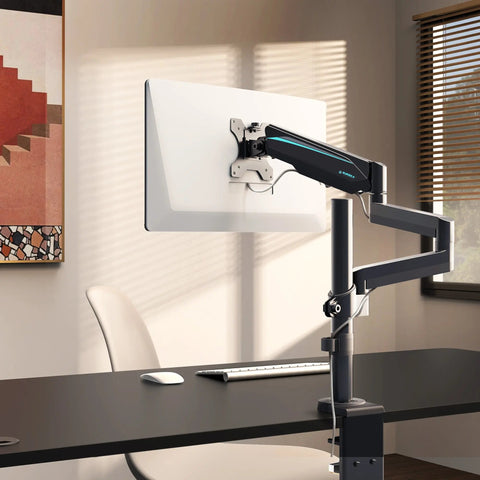
Ensuring desk grommet holes or clamp zones are reinforced prevents the base plate from shifting. For bulk orders, verify that the desk's core material—often high-density fiberboard or solid wood—can sustain the concentrated load of a Single Monitor Arm holding a 32-inch display.
Proper monitor positioning, as outlined by OSHA's guidelines for monitors, requires the top of the screen to be at or slightly below eye level to reduce neck extension.

Space Optimization: L-Shaped vs. Linear Layouts
In B2B floor planning, the choice between linear and L-shaped desks involves a balance between density and functionality. While linear desks allow for higher "packing" of employees, L-shaped desks provide an ergonomic advantage for "reach zones."
The L-Shaped Standing Desk with Accessories Set (60"x23") (Example: Eureka Ergonomic L-Series) allows users to keep essential peripherals within the "primary reach zone" (within 14–16 inches of the body). This minimizes the need for repetitive reaching, which Safe Work Australia identifies as a risk factor for shoulder MSDs.
For executive suites where aesthetics are prioritized alongside functionality, the Faux Saddle Leather Adjustable Standing Desk (55"x23") offers a refined solution. The integration of "soft-touch" materials can reduce contact stress on forearms during long typing sessions.

The "IT-Ready" Checklist for Bulk Procurement
To ensure a successful deployment, IT managers should use the following checklist derived from industry standards and field experience:
- BIFMA Certification: Does the furniture meet ANSI/BIFMA X5.1 for safety and durability?
- Adjustability Range: Does the desk accommodate the 5th to 95th percentile of your workforce? Per BIFMA G1-2013, a range of roughly 22" to 48" is recommended.
- Cable Tray Volume: Spec for 50% more than your current heaviest setup.
- Power Modularization: Prioritize under-desk mounted surge strips and swappable hubs rather than fixed, non-replaceable USB ports to preserve the desk’s longevity.
- Grommet Alignment: Ensure grommet holes are large enough (3" diameter recommended) to pass through standard power plugs.
Future-Proofing the Workplace
The transition to a healthy work environment is an investment in human capital. As detailed in The 2026 Workstation White Paper: Converging Ergonomic Science and Sustainable Engineering, the future of office design lies in the convergence of modular technology and physiological health.
By focusing on the infrastructure—the cable trays, the power strips, and the mechanical stability—IT departments can ensure that bulk deployments support both the hardware and the people who use it. Reducing sedentary time is a critical step, but doing so safely requires a rigorous, engineering-first approach.
References and Authoritative Sources
- BIFMA G1-2013 Ergonomics Guideline for Furniture
- OSHA eTools: Computer Workstations Checklist
- ISO 9241-5:2024 Workstation Layout & Postural Requirements
- Cochrane Library: Workplace Interventions for Reducing Sitting
- WHO 2020 Guidelines on Physical Activity & Sedentary Behaviour
Disclaimer: This article is for informational purposes only and does not constitute professional medical, legal, or occupational health advice. The ergonomic recommendations provided are based on general industry standards and may not be suitable for individuals with pre-existing musculoskeletal conditions. Always consult with a qualified health professional or an ergonomic specialist before implementing significant changes to your workstation.
Related Reading:




Leave a comment