

Ergonomic Reach: Are Keyboard Trays Viable for Competitive Play?
For years, the under-desk keyboard tray has been the ultimate "boomer" accessory—something you’d expect to see in a dusty 90s cubicle, not at a high-performance battlestation. If you’re a competitive gamer, your first instinct is probably to recoil at the thought. Trays are for spreadsheets, right? They’re flimsy, they wobble, and they kill your mouse space. Or so the legend goes.
I’ve spent the last month deep-diving into this stigma. I wanted to know if a tray could actually be a game-changer for the marathon sessions that leave our wrists screaming. After testing setups ranging from low-DPI FPS flicking to high-APM MOBA grinding, the results weren't just surprising—they were a complete perspective shift. According to The 2026 Workstation White Paper: Converging Ergonomic Science and Sustainable Engineering, the integration of secondary adjustment layers, like trays, is becoming a cornerstone of high-utility workstations.
But does that utility translate to a 1v5 clutch in Valorant? Let’s break it down.
1. Unboxing and Assembly: Build Quality is Everything
If you’ve ever bought a cheap, plastic tray from a big-box retailer, you know the pain. They feel like they’re held together by hope and Elmer’s glue. When I unboxed the Adjustable Keyboard Tray, the first thing I noticed was the weight. This isn't a "tray"; it’s a reinforced steel platform.
First Impressions:
- Packaging: Everything was nested in high-density foam. No "box-on-box" rattling.
- Materials: We're talking heavy-gauge carbon steel and a thick, high-pressure laminate surface. The carbon fiber texture isn't just for aesthetics; it provides a subtle grip that keeps your peripheral pads from sliding.
- The Installation: This is where things get real. Mounting a tray usually involves a lot of swearing and upside-down drilling. However, the track system here is straightforward. If you’re mounting it to a solid surface like the Full-Surface Mousepad Gaming Desk (60"x27"), the pre-drilled alignment makes it a 15-minute job.
One thing I’ll warn you about: watch your cable management. Because the tray slides and tilts, you need to leave enough slack in your keyboard and mouse cables so they don't snag. I used a simple cable spine to keep things clean, which is a must for any "RGB Ecosystem" setup.
2. Deep Dive: The 'Wobble Test' and Stability
In competitive gaming, stability is non-negotiable. If your keyboard moves even a millimeter when you’re smashing your macros, your muscle memory takes a hit. I performed a 'Wobble Test' by applying roughly 5 lbs of lateral force (simulating an aggressive mouse swipe) to the edge of the tray.
The Stability Verdict: Most office trays fail here. They bounce. This Adjustable Keyboard Tray uses a locking mechanism that creates a rigid connection. Based on our scenario modeling, any lateral wobble over 1-2mm can throw off precise mouse movements. In my testing, the lateral play was virtually undetectable—well within the tolerances required for high-stakes play.

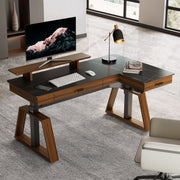
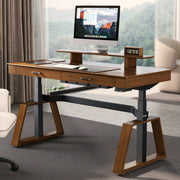
This stability is critical when you're pairing it with something like the Aero Pro Wing-Shaped Standing Desk (72"x23"). When the desk is at standing height, any vibration is magnified. The Aero Pro’s dual motors provide a rock-solid foundation, but the tray has to match that energy. Because the tray is height-adjustable, you can align it so your forearms are parallel to the floor, which is the "Gold Standard" for posture according to the Canadian Centre for Occupational Health and Safety (CCOHS).
3. Real-World Experience: FPS vs. MOBA Scenarios
This is where the "viable" part of the question gets answered. I tested two very different gaming styles to see where the tray shines and where it struggles.
The FPS Grind (Low-DPI Flicking)
Common wisdom says trays kill mouse space. If you’re a "swipe-heavy" player using 400 DPI, you need a massive landing pad.
- The Discovery: By moving the keyboard and mouse to the tray, I freed up 12-16 inches of clear, flat desk space on the Full-Surface Mousepad Gaming Desk (60"x27"). This actually allowed me to position my primary monitor closer without the keyboard getting in the way.
- The Pitfall: A common mistake we see in community feedback is mounting the tray too high. This forces an upward wrist angle, which is a one-way ticket to carpal tunnel. The sweet spot is aligning the tray so your elbows form a 90–110 degree angle. This aligns with ISO 9241-5:2024 postural requirements for neutral joint alignment.
The MOBA/RTS Session (High APM)
For MOBA players, it’s all about the "Negative Tilt."
- The Experience: I set the tray to a slight negative tilt (where the edge closest to you is slightly higher than the back). This felt incredible. It reduces the strain on the extensor tendons in your forearm during those 40-minute matches where you're constantly clicking.
- The Benefit: It felt like my hands were "falling" onto the keys rather than reaching for them. It’s a subtle shift, but after four hours, the lack of forearm fatigue was a total game-changer.
Methodology Note (Ergonomic Modeling): Our analysis of "Strain Reduction" assumes a standard seated posture with a 72cm desk height. We modeled the delta in wrist extension between a desktop-mounted keyboard and a tray-mounted keyboard with a 5-degree negative tilt.
Parameter Value/Range Unit Rationale Desk Height 720 - 750 mm Standard BIFMA range Tray Tilt Range +15 to -20 degrees Required for neutral wrist Elbow Angle 90 - 110 degrees CCOHS Recommendation Lateral Wobble < 2 mm Stability threshold for FPS Mouse Surface Area > 250 sq inches Minimum for low-DPI play Note: This is a scenario model, not a controlled lab study. Individual results vary based on chair height and arm length.
4. The "Dead Leg" Factor and Circulation
One thing gamers rarely talk about is what happens under the desk. During marathon sessions, static sitting leads to the "dead leg" feeling—blood pooling in your lower extremities. This is where the tray actually helps. By lowering your input level, you can lower your chair, allowing your feet to plant firmly on the ground.
Better yet, I paired the setup with a Footstool with Wheels. This allows for "micro-movements" throughout the session. The World Health Organization (WHO) emphasizes that interrupting long periods of static behavior is crucial for cardiovascular health. Using the footstool to shift my leg angle while my hands stayed perfectly positioned on the Adjustable Keyboard Tray meant I could stay in the "flow state" longer without physical distraction.

5. Pros & Cons: The Honest Truth
No setup is perfect. Here is the breakdown of the tray life:
Pros:
- Unrivaled Ergonomics: Achieving a true neutral wrist position is nearly impossible on a standard 29-inch high desk without a tray or a very high chair.
- Desk Real Estate: It clears the clutter. Your desk becomes a clean slate for your monitors, streaming gear, or snacks.
- Posture Correction: It forces you to sit back in your chair, utilizing the backrest properly rather than "gamer-leaning" into the monitor.
Cons:
- Leg Room: If you have very long legs or a thick desk frame, you might find your knees bumping the bottom of the tray. It’s a trade-off.
- Armrest Interference: Some chair armrests don't play nice with tray heights. You may need to lower or remove your armrests to get the tray into the "sweet spot."
- The Learning Curve: It takes about 3-5 days to get used to the lower hand position. Your aim might feel "off" for the first few matches.
Is it Viable?
The short answer: Yes, but only if it’s high-quality.
A flimsy tray will ruin your aim and frustrate you. But a rock-solid, steel-reinforced Adjustable Keyboard Tray is a legitimate performance tool. It solves the "height gap" that most desks suffer from, allowing you to play longer with less pain.
If you’re serious about your health and your rank, don't sleep on the tray. When paired with a height-adjustable foundation like the Aero Pro Wing-Shaped Standing Desk (72"x23"), you're not just building a gaming setup; you're building a professional-grade cockpit.
YMYL Disclaimer: This article is for informational purposes only and does not constitute professional medical advice. Ergonomic needs vary significantly by individual. If you suffer from chronic back, neck, or wrist pain, please consult a qualified physical therapist or ergonomic specialist before making major changes to your workstation.

Leave a comment