

Crafting Your Workspace Sanctuary: The Evolution of the L-Desk
Imagine a home office that sparks your limitless creativity. It is a space where the morning’s high-stakes corporate strategy meeting transitions seamlessly into an evening of high-fidelity content creation. Here, your environment doesn't just house your tools; it anticipates your needs, protects your well-being, and fuels your inspiration. This is the "Workspace Sanctuary"—a concept that moves beyond the utilitarian desk and chair to create a holistic ecosystem for the modern multi-hyphenate professional.
For those of us juggling a professional career with a creative passion, the traditional straight desk often feels like a bottleneck. We find ourselves constantly shifting peripherals, untangling cables, and compromising our posture to fit "just one more" monitor. The transformation begins when we say goodbye to this chaos and embrace the spatial intelligence of the L-shaped workstation.
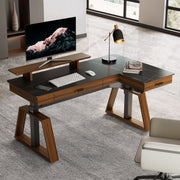
By physically separating your "thinking" zone from your "execution" zone, an L-desk allows you to Declutter your mental load. It provides the canvas for a dual-purpose life, where one side of the desk is dedicated to the deep work of professional productivity, and the other serves as a specialized studio for streaming, editing, or design.
The Ergonomic Blueprint: Science Meets Sanctuary
Before we dive into layout ideas, we must ground our vision in ergonomic science. A beautiful workspace is only truly effective if it supports the human body. According to the ISO 9241-5:2024 Workstation layout & postural requirements, the primary goal of any workstation is to encourage a "Neutral Working Posture."
A neutral posture is one where your joints are naturally aligned, reducing stress on muscles and tendons. For the content creator, this is particularly challenging because of the high density of hardware. We often see creators leaning forward or twisting their necks to view secondary screens—a habit that OSHA's eTools on Computer Workstations warns can lead to chronic musculoskeletal disorders.
The L-shape provides a unique advantage here. It allows you to wrap your tools around you, keeping frequently used items within the "Primary Work Zone" (the area reachable with your elbows at your side).
Methodology Note (Workstation Modeling): Our layout recommendations are based on a scenario model assuming a user height within the 5th to 95th percentile (approx. 5'0" to 6'2") as outlined in the BIFMA G1-2013 Ergonomics Guideline.
Parameter Value/Range Unit Rationale Desk Height (Seated) 22 - 33 inches BIFMA G1-2013 standard range Monitor Distance 20 - 40 inches Arm's length heuristic Viewing Angle 15 - 20 degrees Optimal downward tilt to reduce eye strain Knee Clearance 19 inches Minimum depth for leg comfort Primary Zone Radius 14 - 16 inches Neutral reach zone
The Power of Dynamic Movement
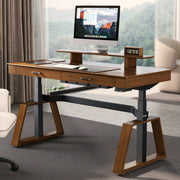
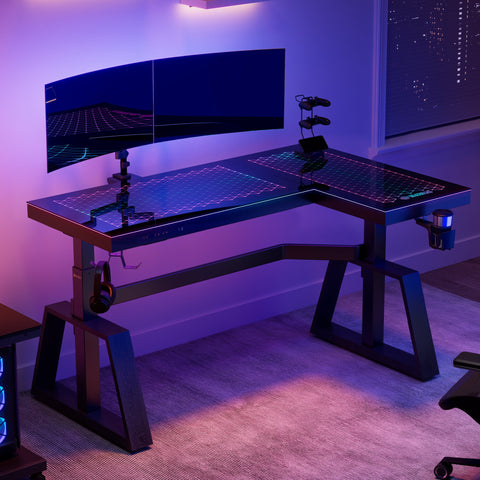
The most impactful change you can make to your Workflow is the transition from a static to a dynamic workstation. The L-Shaped Standing Desk with Accessories Set (60"x23") is designed specifically for this shift. With its dual-motor system, it moves at a smooth 1 inch per second, allowing you to change your state of mind as easily as you change your height.
Height adjustment isn’t just for physical health—it’s a way to shift between "thinking" and "execution" modes. Many creators find that standing during a live stream or a brainstorming session increases energy and vocal projection, while sitting is better suited for deep, focused editing. We recommend following the "20-8-2" rhythm developed by Cornell University Ergonomics Web: sit for 20 minutes, stand for 8 minutes, and move or stretch for 2 minutes.

Zoning the L-Desk: Professional vs. Creative
The biggest productivity leap for WFH creators comes from physically separating "work" and "creative" zones on the L-desk. This reduces the cognitive load associated with Context Switching, which studies suggest can cost up to 40% of a person's productive time.
The Professional Zone (The Long Side)
A common mistake is placing the primary editing monitors on the shorter "return" of the L-desk. This often leads to a cramped, uncomfortable posture because the return lacks the depth required for proper monitor distance.
The correct heuristic is to use the longer side for your primary visual task zone. This provides deeper desk space (typically 24-30 inches) to place your monitors at an arm's length, which is vital for minimizing eye strain as per CCOHS guidelines on monitor positioning.
The Creative Studio (The Return)
Use the shorter return for your creative peripherals: your audio interface, stream deck, or MIDI controller. This creates a "Studio Wing" that you can pivot to when it's time to create. For left-handed creators, we've observed a strong preference for a left-return L-desk. This places the dominant-hand mouse area on the more spacious long side, a nuance often overlooked in generic setup guides.
Monitor Mastery and the "Visual Arc"
For a content creator, monitors are the windows to their world. However, managing multiple screens on an L-desk requires a strategic approach. If you place a primary monitor directly in front and secondary screens on the far ends of the "L," you force your neck into extreme visual zones (+15 to -30 degrees). Over time, this constant swiveling leads to "Tech Neck."
A Dual Monitor Arm is the solution for creating a seamless "Visual Arc." By lifting the monitors off the desk surface, you not only reclaim valuable "Aesthetic" real estate but also gain the ability to align the top of your screens with your eye level—a key recommendation from the HSE: Working safely with display screen equipment (DSE).
When setting up your arc, ensure the primary monitor is centered. The secondary monitor (used for chat, timelines, or asset folders) should be angled inward so that you only need to move your eyes, not your entire head, to see the content.
Expert Tip: For those using a 32-inch primary and a 27-inch secondary, we estimate that a desk width of at least 60 inches is required to maintain the 15-degree downward viewing angle without the screens overlapping or pushing too far into your peripheral vision.

Cable Management: The "Umbilical" Strategy
Nothing shatters the "Ambiance" of a Workspace Sanctuary faster than a "cable nest" under the desk. Beyond the visual clutter, dense, unmanaged cable bundles in a confined corner create significant heat buildup. Based on common patterns from customer support and hardware troubleshooting, we've found that heat-related performance throttling in PCs is often exacerbated by poor airflow around cable-heavy zones.
The "Umbilical" strategy is the pro's secret to a clean L-desk. Instead of having multiple power strips, mount a single, high-quality power strip under the central corner of the desk. Feed all your devices into this single point. This creates one "umbilical" cord that goes to the wall, allowing the desk to move up and down without snagging.
To further Declutter the floor, use a Knob-operated Adjustable CPU Holder. By mounting your PC tower directly to the underside of the desk, you ensure that your display and power cables move with the desk. This eliminates the risk of cables being pulled out when you transition to a standing position.
Logic Summary (Heat Management): Our recommendation to separate power and data lines is a heuristic to reduce electromagnetic interference and improve heat dissipation. In high-density creator setups (12+ cables), active cable routing away from the PC exhaust is essential.
Storage and Atmosphere: Building the Sanctuary
A sanctuary is more than just a desk; it’s the environment surrounding it. To maintain Mindfulness and focus, your immediate line of sight should be free of clutter. This is where vertical storage becomes a game-changer.
The Ark EL, 71'' Display Bookshelf with Storage Cabinet, Oak allows you to move non-essential items—like reference books, extra lenses, or decorative inspiration—off your desk and into an elegant display. The oak texture adds a touch of "Aesthetic" warmth that balances the coldness of tech hardware, creating a more "Inspirational" atmosphere.
Personal Tips for Atmosphere Building:
- Greenery: Adding a small plant (like a Pothos or Snake Plant) near the corner of your L-desk can reduce stress and improve air quality.
- Lighting: Avoid harsh overhead lights. Use a desk lamp with a warm color temperature (around 3000K) for your creative sessions to signal to your brain that it's time to shift out of "corporate" mode.
- Sound: If you're an editor, consider acoustic panels on the walls flanking your L-desk to reduce echo and create a more immersive audio environment.
The Holistic Workflow
Creating a benchmark-level workspace is an iterative process. As noted in The 2026 Workstation White Paper: Converging Ergonomic Science and Sustainable Engineering, the future of work is about the integration of health, technology, and personal expression.
Your L-desk setup should be a reflection of your unique workflow. Whether you are a streamer who needs a dedicated "broadcast corner" or a developer who needs three monitors for code review, the principles remain the same:
- Prioritize Depth: Keep your primary tasks on the deepest part of the desk.
- Enable Movement: Use a sit-stand mechanism to break up static postures.
- Manage the Chaos: Use tools like monitor arms and CPU holders to keep the surface clear.
- Curate the Vibe: Use storage and lighting to turn a workstation into a sanctuary.
By following these guidelines, you do more than just organize a room; you build a platform for your best work. You create a space where productivity feels effortless and creativity feels at home.
Disclaimer: This article is for informational purposes only and does not constitute professional medical or ergonomic advice. If you have pre-existing musculoskeletal conditions or chronic pain, please consult with a qualified physical therapist or ergonomic specialist before making significant changes to your workstation setup.
Sources
- BIFMA G1-2013 Ergonomics Guideline for Furniture
- ISO 9241-5:2024 Workstation layout & postural requirements
- OSHA eTools: Computer Workstations - Neutral Working Postures
- Cornell University Ergonomics Web — Workstation Guides
- Canadian Centre for Occupational Health and Safety (CCOHS) - Monitor Positioning
- HSE: Working safely with display screen equipment (DSE)
- The 2026 Workstation White Paper: Converging Ergonomic Science and Sustainable Engineering
- Asana: Context Switching and Productivity
Leave a comment