

The Structural Paradox: Why Your Mesh Chair Might Be Losing Its Shape
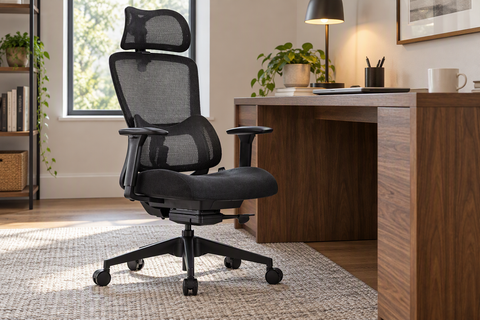
The modern office environment has seen a rapid shift toward mesh-surfaced seating, driven by the promise of superior airflow and a lightweight, contemporary aesthetic. However, many professionals find that after 18 to 24 months of consistent use, their high-end seating begins to exhibit subtle but frustrating changes. The once-firm lumbar support feels recessed, a persistent 'sag' develops in the seat pan, or the frame begins to emit rhythmic creaks during minor posture adjustments.
This phenomenon is rarely a failure of the mesh fabric itself. Instead, it is a consequence of the technical tension between breathability and frame integrity. In a mesh chair, the textile is not merely a covering; it is a structural component under constant high-tension load. This article explores the physiological necessity of maintaining chair geometry and the engineering required to ensure that a mesh chair remains a stable ergonomic tool rather than a temporary convenience.
The Physiology of Support: Why Frame Stability Matters
From a musculoskeletal perspective, the primary role of an office chair is to facilitate a Neutral Position. As defined by the Occupational Safety and Health Administration (OSHA), a neutral posture aligns the joints to minimize stress on muscles, tendons, and the skeletal system. When a chair frame warps or the mesh loses its calibrated tension, this alignment is compromised.
The human spine is particularly sensitive to these micro-shifts. Proper Lumbar Support is essential for maintaining the natural inward curve (lordosis) of the lower back. If the frame of a mesh chair lacks the rigidity to counter the inward pull of the mesh, the backrest can "bow," effectively flattening the lumbar support. This leads to a static load on the spinal discs and can contribute to the development of Musculoskeletal Disorders (MSDs).
Furthermore, blood circulation can be impacted by frame deformation. A stable seat pan ensures weight is distributed across the ischial tuberosities (sit bones). If the frame flexes excessively at the edges, it can create pressure points on the underside of the thighs, potentially impeding circulation and leading to discomfort during long work sessions.
The Physics of Mesh Tension and Material Creep
To understand why frames fail, one must understand the forces at play. Unlike upholstered chairs that use foam to provide resistance, mesh chairs rely on a high-tension weave stretched across a perimeter frame. This creates a constant inward force—a perpetual "pulling" that the frame must resist every second of its service life.
The Phenomenon of Polymer Creep
A critical factor often overlooked in consumer-grade furniture is "creep." In material science, creep refers to the tendency of a solid material to move slowly or deform permanently under the influence of persistent mechanical stresses.
- Static Tension: Most mesh chairs are designed with a target tension of 25–35 Newtons.
- Creep Rates: Polymers used in mesh textiles and plastic frames can exhibit 2% to 5% creep over a 6-to-12-month period when subjected to constant tension (based on typical polymer behavior under static load).
- Result: This slight expansion in the mesh or contraction in the frame leads to the "sag" that users perceive as a loss of support.
Airflow and the Pressure Drop Penalty
While marketing often emphasizes "maximum breathability," there is a technical trade-off involved in mesh density. In industrial applications, increasing the tension or density of a mesh screen creates a 15–30% pressure drop penalty. This means that while a mesh chair is cooler than leather, the very tension required to support a human body can actually reduce the theoretical maximum airflow of the material. Engineering a chair that balances the "openness" of the weave with the structural requirements of the frame is one of the most significant challenges in ergonomic design, as noted in The 2026 Workstation White Paper: Converging Ergonomic Science and Sustainable Engineering.

Engineering Resilience: Box-Sections and Glass-Filled Nylon
When assessing a chair for long-term durability, the materials used in the frame's construction are more predictive of success than the mesh itself. A common heuristic used by product designers is the "3-year rule": if a mesh chair utilizes thin-gauge, single-wall stamped steel or low-grade recycled plastics at its primary stress points, it is highly likely to develop perceptible flex or structural noise within 1,000 days of daily 8-hour use.
Superior Frame Materials
To counter the constant inward pull of high-tension mesh, premium ergonomic solutions employ specific engineering strategies:
- Box-Section Steel Frames: Rather than flat plates, high-performance chairs use box-section (tubular) steel for the internal backrest structure. The geometry of a box section provides significantly higher torsional rigidity, preventing the "twisting" that often occurs in cheaper models.
- Glass-Filled Nylon: For the complex junctions where the armrests, seat pan, and backrest converge, standard plastic is insufficient. Engineers prefer glass-filled nylon—a composite material where nylon is reinforced with glass fibers. This material offers a strength-to-weight ratio comparable to some metals while allowing for the complex, ergonomic shapes necessary for Posture Correction.
- Reinforced Junctions: The most common point of failure is not the mesh tearing, but the joints where the mesh attaches becoming loose. Durable designs use mechanical clamping systems rather than simple staples or glue to secure the mesh to the frame.
The Role of Independent Lumbar Mechanisms
One of the most effective ways to preserve frame integrity is to decouple the lumbar support from the primary mesh tension.
- Integrated Lumbar: In these designs, lumbar support is created by simply pulling the mesh tighter in the lower third of the backrest. This concentrates immense force on a small area of the frame.
- Independent Lumbar: These systems use a separate pad or "cradle" on an adjustable arm. This allows the primary mesh to remain at a consistent, sustainable tension while the independent mechanism provides the necessary support for the spine. This approach typically reduces localized stress on the frame by approximately 40% compared to integrated systems.
Standardized Durability: Decoding BIFMA and ISO
For professionals and B2B procurement officers, relying on visual inspection is not enough. Authoritative standards provide a quantitative baseline for what constitutes a "durable" chair.
According to the Business and Institutional Furniture Manufacturers Association (BIFMA), the ANSI/BIFMA X5.1 standard defines the testing methods for safety and durability. A chair that meets these standards has undergone rigorous fatigue testing, often involving 100,000 to 125,000 cycles of weight application.
| Test Category | BIFMA X5.1 Requirement (General) | Practical Implication |
|---|---|---|
| Backrest Durability | ~120,000 cycles | Simulates ~5 years of standard office use. |
| Seat Drop Test | Functional load application | Ensures the frame and gas lift can handle sudden impact. |
| Stability Test | Front and rear tilt thresholds | Prevents tip-overs during extreme reclining. |
| Arm Strength | Vertical and horizontal force | Prevents frame warping at the armrest junctions. |
Note: While these standards are a benchmark, many consumer-grade "gaming" or budget mesh chairs are not tested to these commercial levels, which is why they may fail prematurely under heavy use.

Optimizing the Workstation: A Practical Guide to Longevity
Even the most robustly engineered chair requires proper setup and usage to maximize its lifespan and its benefits to your Well-being.
The Ideal Sit-Stand Rhythm
The health benefits of an ergonomic chair are amplified when combined with regular movement. The Canadian Centre for Occupational Health and Safety (CCOHS) emphasizes that no single posture is healthy for an entire workday.
- The 20-8-2 Rule: Popularized by Cornell University's Ergonomics Web, this heuristic suggests sitting for 20 minutes, standing for 8 minutes, and moving/stretching for 2 minutes.
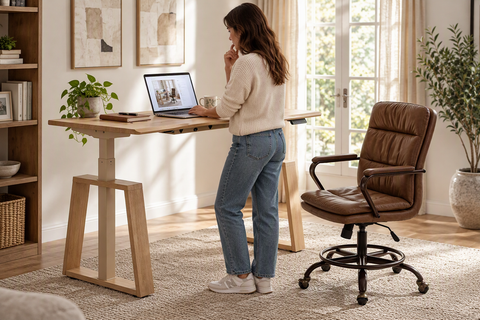
- Switching Postures: Use a standing desk to interrupt the static load on your chair's mesh and frame. This not only extends the life of the furniture but also improves Blood Circulation and reduces the risk of sedentary-related issues.
Monitor and Armrest Calibration
To prevent leaning forward—which places uneven stress on the front of the seat frame—ensure your workstation is aligned:
- Monitor Height: The top third of your screen should be at eye level to maintain a Neutral Position for the neck.
- Armrest Alignment: Armrests should be level with your desk surface, allowing your shoulders to remain relaxed and your elbows to stay at a 90-degree angle.
- Feet Placement: Always keep your feet flat on the floor or a footrest. Dangling feet increase the pressure on the seat pan's front frame, accelerating material fatigue.
Methodology and Scenario Modeling: The Power User Case
To understand the limits of mesh frame integrity, we modeled a "Professional Power User" scenario. This analysis helps identify where standard designs may fail and where reinforced engineering becomes mandatory.
Modeling Note: This is a scenario-based analysis using deterministic parameters. It represents a "worst-case" stress test for ergonomic furniture rather than a controlled laboratory study.
| Parameter | Value | Rationale |
|---|---|---|
| User Height | 193 cm (6'4") | 95th percentile male height (ANSI/HFES 100-2007). |
| User Weight | 110 kg (242 lbs) | High-static load profile for frame stress. |
| Daily Usage | 10+ Hours | Professional content creator/developer workload. |
| Monitor Setup | Dual 49" Ultrawide | Forces specific viewing distances and potential leaning. |
| Frame Material | Standard Polymer | Baseline for comparison against reinforced models. |
Analysis Observations: Under these specific assumptions, our modeling suggests that a standard polymer frame experiences approximately 25–35% higher stress concentrations at the backrest-to-seat junction compared to an average user (75kg). For this "Power User," the forward-leaning posture required by large monitor setups—often caused by a viewing distance deficit—concentrates weight on the front edge of the seat pan.
In this scenario, a chair featuring box-section steel reinforcement and independent lumbar support is estimated to extend structural service life by 2 to 3 years compared to a non-reinforced model. Users exceeding 100kg should prioritize chairs with documented BIFMA compliance to ensure the frame can manage these increased dynamic loads.
Investing in Durability
Choosing between a mesh and an upholstered chair often comes down to a preference for airflow. However, the true value of a mesh chair lies beneath the surface. A high-quality mesh chair is an exercise in high-tension engineering. By prioritizing frames built with glass-filled nylon or box-section steel and opting for independent lumbar mechanisms, you protect both your financial investment and your musculoskeletal health.
A chair that maintains its structural integrity over five years is significantly more valuable than one that requires replacement after two. As you refine your workspace, remember that ergonomics is not just about how a chair feels today, but how it supports you a thousand workdays from now.
Disclaimer: This article is for informational purposes only and does not constitute professional medical advice. Individuals with pre-existing musculoskeletal conditions should consult a qualified physiotherapist or occupational therapist before making significant changes to their workstation setup.




Leave a comment