

The Impact of Minimalist Design on Cognitive Focus
Quick Take: Yes, a minimalist desk setup can significantly improve focus by reducing "visual noise" and physical discomfort. To optimize your workspace, we recommend three core actions: adopting the 20-8-2 sit-stand rhythm, implementing the "one-touch" storage rule, and ensuring your monitor height aligns with your eye level.
Editorial Note: This guide is produced by the Eureka Ergonomic team. It combines established ergonomic standards with observations from our product development and customer support data. Featured products are included as illustrative examples of these principles.
The modern professional often encounters a paradoxical struggle: as digital tools become more streamlined, the physical workspace tends to accumulate clutter. You may find your focus waning by mid-afternoon, or perhaps a persistent tightness in your upper trapezius makes it difficult to engage with complex tasks. While many attribute this to "burnout," a common contributing factor is the immediate physical environment.
A common misconception is that a minimalist desk is merely an aesthetic choice. However, when viewed through the lens of musculoskeletal health and cognitive load theory, minimalism emerges as a rigorous strategy for maintaining a Spinal Neutral Position and reducing the sensory static that competes for your brain's limited attentional resources.
The Scientific Connection: Visual Noise and Cognitive Load
To understand why a minimalist setup can improve focus, one must first examine the physiological impact of "visual noise." Objects within your peripheral vision—tangled charging cables, stacks of mail, or non-essential items—can trigger a low-level cognitive process known as "attentional capture."
The brain is biologically wired to scan its environment for stimuli. In a cluttered workspace, the prefrontal cortex often works harder to filter out irrelevant visual data. This creates a state of Static Load, not just on your muscles, but on your executive function. When the physical environment is curated with "intentional reduction," you can lower this cognitive tax, potentially allowing more mental energy to be directed toward deep work.
Furthermore, a cluttered desk often leads to compromised postures. For instance, reaching over piles of documents to use a mouse often causes a deviation from the Neutral Position recommended by the Occupational Safety and Health Administration (OSHA). These deviations can lead to repetitive strain and localized fatigue, which serve as significant distractions.
Ergonomic Integration: The Foundation of Minimalist Productivity
A truly effective minimalist setup is not about having nothing on your desk; it is about ensuring every item earns its place through functional necessity. This is where the integration of high-performance furniture becomes critical.
According to the BIFMA G1-2013 Ergonomics Guideline, furniture should accommodate a wide range of the population. In a minimalist context, this means selecting a desk that offers adjustability to facilitate frequent posture changes without requiring a cluttered array of external risers.

The Opal Executive Standing Desk (a Eureka Ergonomic design) exemplifies this principle. By incorporating a central drawer and storage cabinets within a sleek frame, it allows users to maintain a clear desktop while keeping essential tools accessible but out of sight. Based on our observations of high-performance work patterns, accessibility does not have to mean visibility.
Addressing the Sedentary Trap
The World Health Organization (WHO) 2020 Guidelines emphasize that adults should reduce sedentary time. A fixed-height desk, while visually pleasing, can lead to "prolonged static sitting," a condition documented by EU-OSHA as a risk factor for musculoskeletal disorders.
The solution lies in height adjustability. A systematic review by Cochrane suggests that sit-stand desks can significantly reduce sitting time (by an estimated 84–116 minutes per day). Transitioning from sitting to standing helps dissipate physical tension and can provide a "cognitive reset" during the workday.
The Role of Cable Management and Monitor Placement
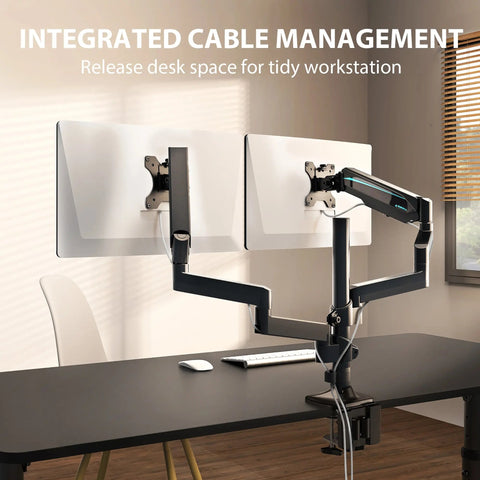
A foundational principle of minimalist design is the management of visible cables. Beyond reducing visual distraction, organized cables ensure the desk's range of motion is not restricted.
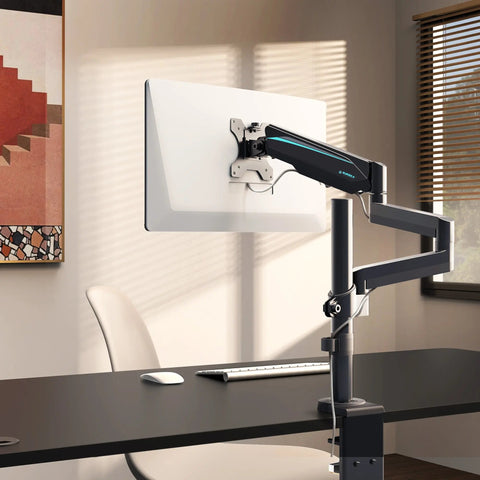
Equally important is the placement of your primary display. The HSE: Working safely with display screen equipment (DSE) guidelines suggest the top of your monitor should be roughly at eye level to prevent neck flexion.

Utilizing a Dual Monitor Arm allows for a "floating" screen aesthetic. This clears the desktop for "intentional workspace" and provides the adjustability needed to meet ISO 9241-5:2024 requirements for workstation layout.
Practical Recommendations for a Focus-Driven Setup
To transition to a focus-optimized workstation, we suggest following this structured blueprint, derived from our 2026 Workstation White Paper.
1. The 20-8-2 Sit-Stand Rhythm
Based on the Cornell University Ergonomics Web heuristic, an ideal work rhythm consists of:
- 20 minutes of sitting in a neutral posture.
- 8 minutes of standing (using a desk that meets safety standards like UL 962).
- 2 minutes of moving or stretching.
2. The "One-Touch" Storage Rule
We recommend that every item on your desk be something you use at least once every hour. Everything else—notepads, extra pens, reference manuals—should be stored in integrated drawers. Desks like the Ark Executive Standing Desk provide these storage solutions without breaking the minimalist silhouette.
3. Monitor Depth and Visual Angles
Maintain a distance of 20 to 40 inches (approx. 50–100 cm) between your eyes and the screen. This aligns with CCOHS recommendations to reduce eye strain and prevent "forward head posture."
Illustrative Model: Potential Focus Gains
To illustrate the impact of these changes, we have modeled a typical workday scenario.
Methodology & Assumptions: This model compares a "Standard Cluttered Fixed Desk" against a "Minimalist Ergonomic Standing Desk." It assumes a high-cognitive-load professional (e.g., developer or writer) over an 8-hour shift. Efficiency gains are estimates based on the reduction of micro-distractions and postural fatigue mitigation.
| Parameter | Standard Setup | Minimalist Ergonomic Setup | Rationale / Source Category |
|---|---|---|---|
| Cognitive Switch Cost | High (Visual Clutter) | Low (Curated Space) | Attentional Capture Theory |
| Postural Transitions | 0 - 1 per day | 12 - 16 per day | Cornell 20-8-2 Heuristic |
| Static Load (Neck/Back) | Cumulative | Intermittent (Reset) | ISO 11226:2000 Evaluation |
| Estimated Focus Window | ~4.5 Hours / Day | ~6.5 Hours / Day | Scenario Modeling Estimate |
Note: These values are illustrative heuristics based on behavioral observations. Individual results vary significantly based on task type and personal habits.
Materiality and Environmental Trust
Minimalism also emphasizes quality over quantity. Choosing furniture that meets UL GREENGUARD Certification can help ensure your "clean" space is also maintaining indoor air quality by limiting Volatile Organic Compounds (VOCs).

The Ark X Executive Standing Desk integrates power sources directly into the frame, addressing the "digital minimalism" trend by reducing the need for external hubs and messy cables.
Overcoming the "Sterile" Pitfall
A common mistake in minimalist design is creating a sterile, uncomfortable environment. Our customer support patterns suggest that a desk that looks "clean" but feels "cold" or "sharp" can be as distracting as a messy one. Intentional minimalism should include tactile comfort, using natural textures like walnut or leather to support mental well-being.
Summary of Ergonomic Best Practices
| Component | Recommendation | Supporting Authority |
|---|---|---|
| Desk Height | Elbows at ~90° with shoulders relaxed | OSHA eTools |
| Chair Support | Lumbar curve must be supported | ANSI/BIFMA X5.1 |
| Monitor Height | Top 1/3 of screen at eye level | Safe Work Australia |
| Movement | Change posture every 30-60 minutes | ISO 11226:2000 |
The Final Verdict on Focus
Does a minimalist desk setup boost focus? The evidence suggests it can, provided "minimalism" is used as a framework for ergonomic excellence. By reducing cognitive load through organization and supporting the body's need for movement, you create an environment where a "flow state" is more achievable. Investing in an integrated system—rather than just a surface—is a proactive step toward protecting your musculoskeletal health and supporting professional output.
Disclaimer: This article is for informational purposes only and does not constitute professional medical advice. Individuals with pre-existing musculoskeletal conditions should consult a qualified physiotherapist or ergonomic specialist before making significant changes to their workstation.
References
- BIFMA G1-2013 Ergonomics Guideline for Furniture
- CCOHS: Office Ergonomics - Sit/Stand Desk
- Cochrane Library: Workplace interventions for reducing sitting at work
- Cornell University Ergonomics Web — Workstation Guides
- HSE: Working safely with display screen equipment (DSE)
- ISO 9241-5:2024 Workstation layout & postural requirements
- OSHA eTools: Computer Workstations - Neutral Working Postures
- WHO 2020 Guidelines on Physical Activity & Sedentary Behaviour




Leave a comment