

Imagine a home office that sparks your limitless creativity—a workspace sanctuary where the air feels light, the surfaces are clear, and every tool you reach for serves a purpose. For many of us living in urban apartments or cozy suburban homes, the dream of a sprawling executive suite is often met with the reality of a compact corner. However, we believe that a small footprint should never dictate the size of your potential.
Building a minimalist standing desk setup in a tight space is more than just a furniture choice; it is a commitment to mindfulness and deep work. It is about saying goodbye to the chaos of a cluttered kitchen table and hello to a dedicated environment that honors your physical health and mental clarity. By focusing on the essentials—ergonomic precision, spatial efficiency, and an inspiring aesthetic—you can transform even the smallest nook into a powerhouse of productivity.
The Science of the "Fit Range": Why One Size Does Not Fit All
When we talk about ergonomics in a small space, we aren't just talking about comfort; we are talking about biological compatibility. A common mistake we see in our community is the pursuit of a single "ideal height" for a desk. In reality, according to the BIFMA G1-2013 Ergonomics Guideline for Furniture, the goal is to achieve a "fit range" that accommodates the 5th to 95th percentile of the population.
For many users, especially those of petite stature, standard fixed desks (which typically sit at 29 inches) are fundamentally too high. This mismatch creates a "double compression" effect: you are forced to shrug your shoulders to reach the keyboard, while the limited depth of a small desk often forces the monitor too close to your eyes.
Modeling Note: The Petite Professional Scenario To understand the impact of precision adjustment, we modeled a scenario for a professional of 155cm (5'1") stature in a compact 8ft x 10ft room.
Parameter Value Unit Rationale User Stature 155 cm 5th Percentile North American Female Sitting Desk Height (Calc) ~63 cm Based on ANSI/HFES 100-2007 Ratios Standing Desk Height (Calc) ~92 cm Elbow height for neutral posture Room Depth 96 in Standard small bedroom dimension Desk Depth 26 in Minimalist footprint for circulation Boundary Conditions: This model assumes minimal indoor footwear and a standard task chair. Results may vary if using thick-soled shoes or a non-adjustable chair.
As our analysis shows, a standard 29-inch desk is nearly 10cm (4 inches) too high for a seated petite user. This is why a height-adjustable solution is essential—not just for standing, but to bring the desk down to a level that supports neutral wrists and stable shoulder posture. We often observe that the most profound "aha" moment for our customers isn't when they first stand up; it’s when they finally lower their desk to a height that lets their shoulders drop and their neck relax.

Space Transformation: Selecting the Minimalist Anchor
In a small room, every inch is a precious commodity. The most common pitfall we encounter is the "depth trap"—choosing a desk that is too deep, which sacrifices floor area for a surface you rarely fully utilize. While a 30-inch depth is standard in large offices, a depth of 26 inches is often the "sweet spot" for minimalist setups. It provides enough room for a keyboard and monitor while preserving vital circulation space.
The visual weight of your furniture also plays a psychological role in how "cramped" a room feels. We recommend looking for desks with trapezoidal or tapered leg designs. For example, the Ark X Executive Standing Desk (60"x26") utilizes a personalized K-shaped leg structure. This design isn't just about stability; it creates a sense of openness at the floor level, making the room appear larger than it is.
Stability vs. Footprint: The Hidden Trade-off
It is a common misconception that all minimalist desks are created equal. Research into desk stability, such as that discussed by industry practitioners regarding standardized wobble testing, suggests that desks with narrow bases (under 30 inches) can experience significantly more wobble at standing heights.
When selecting your desk, don't just look at the tabletop; look at the frame. A high-quality single-motor or dual-motor system should provide a stable foundation. Based on our battlestation load modeling, a single-motor desk is typically sufficient for a minimalist setup (one monitor, one laptop, light peripherals), utilizing only about 40% of its rated capacity. This allows you to invest more in the aesthetic and ergonomic accessories that define your sanctuary.
Maximizing the "Dynamic Zone" and Workflow
Once you have your anchor, the next step is the "before and after" transformation of your floor plan. A functional workspace requires a "Dynamic Zone"—the area needed for you to move, shift your chair, and transition between sitting and standing.
According to the OSHA eTools for Computer Workstations, proper legroom and clearance are vital. We recommend maintaining at least 36 inches of clearance behind your desk. In our 8ft x 10ft room model, a 26-inch deep desk paired with a 40-inch chair zone and a 30-inch secondary walkway uses exactly 96 inches. This leaves zero margin for error, meaning your cable management and storage must be integrated, not added on.
The "20-8-2" Rhythm
To truly benefit from a standing desk, you must move. The Cornell University Ergonomics Web recommends a "20-8-2" rhythm: 20 minutes of sitting, 8 minutes of standing, and 2 minutes of moving or stretching. This isn't just about physical health; it’s a way to shift your brain between "execution mode" (sitting) and "thinking/creative mode" (standing).

Decluttering the Mind: Accessories That Create Space
In a minimalist setup, the desk surface is sacred. To maintain a "Workspace Sanctuary," you must move as much as possible off the desktop. This is where the marriage of functionality and emotion becomes clear: a tidy desk isn't just beautiful; it reduces visual "noise," allowing you to maintain focus during deep work.
The Power of Monitor Arms
On a 26-inch deep desk, a standard monitor stand can take up nearly 25% of your usable surface. More importantly, it often places the screen too close to your eyes. Our modeling of SMPTE viewing distances shows that a 27-inch 4K monitor ideally requires a viewing distance of about 44 inches for a comfortable 30-degree field of view.
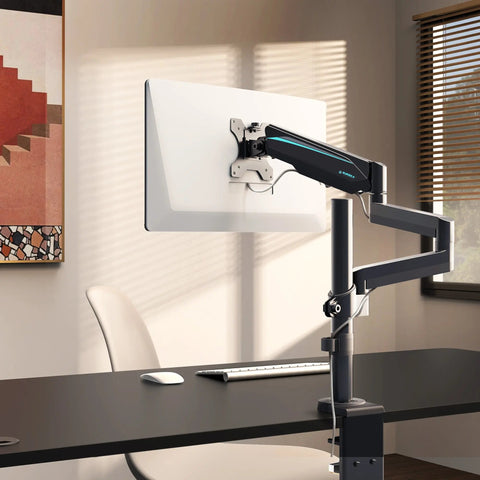
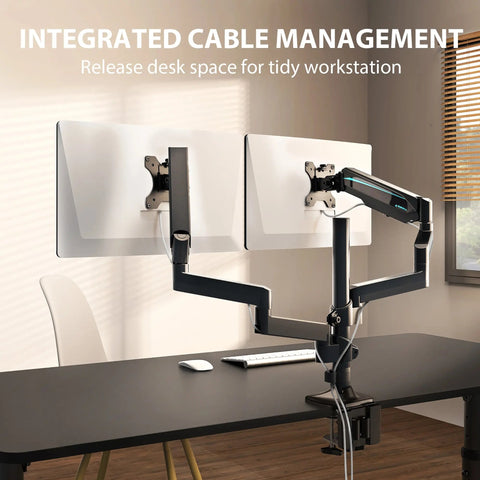
By using a Single Monitor Arm or a Dual Monitor Arm, you can "float" your screens. This allows you to push the monitor back beyond the desk's edge or raise it to the exact eye level required by ISO 9241-5 standards, effectively solving the depth deficit of a small desk.
Integrated Storage: The Ark ES Strategy
Minimalism doesn't mean you don't have things; it means your things have a home. For documents and tech peripherals that don't need to be on your desk, a dedicated unit like the Ark ES, 29" File Storage Cabinet, White is essential. Placing storage beside or under the desk (if height allows) keeps your workflow clean.

Cable Management: The Silent Hero
Nothing shatters a minimalist aesthetic faster than a "cable octopus." For standing desks, cable management is a safety requirement, not just a stylistic one. Based on NFPA 70 (National Electrical Code) principles, cables must have enough slack to accommodate the desk's full range of motion without straining the ports.
Pro Tip: We have found that adhesive-backed cable ties often fail over time due to humidity or surface texture. Instead, look for desks with integrated steel trays or use magnetic cable channels that stay secure through thousands of sit-to-stand cycles.
Ambiance, Mindfulness, and Personal Touches
A minimalist workspace shouldn't feel cold or clinical; it should feel like you. Once you have mastered the ergonomics and the layout, it is time to layer in the elements that spark inspiration.
- Lighting: Position your desk near natural light if possible, but be mindful of glare. OSHA's environment guidelines suggest that controlled lighting reduces eye strain and fatigue.
- Greenery: A single, low-maintenance plant (like a Snake Plant or Pothos) adds life to a minimalist setup without creating clutter.
- The "One-In, One-Out" Rule: To keep your sanctuary clear, adopt the habit of removing one item for every new item you bring into your workspace.
As highlighted in The 2026 Workstation White Paper: Converging Ergonomic Science and Sustainable Engineering, the future of the home office lies in the seamless integration of health-focused technology and sustainable design. By choosing products that meet high safety standards—such as UL 962 for height-adjustable desks—you are investing in a workspace that supports you for years to come.
Creating Your Sanctuary
Transitioning to a minimalist standing desk setup is a journey of refinement. It begins with the vision of a clearer mind and a healthier body, and it is realized through the careful selection of tools that respect your space.
Start by measuring your "Dynamic Zone" and identifying your personal "fit range." Choose a desk like the Ark X Executive Standing Desk (60"x26") that offers the depth efficiency and stability required for a small room. Complement it with a Single Monitor Arm to reclaim your desktop and protect your posture.
Remember, a minimalist workspace is not about having the least; it’s about making the most of what you have. When you say goodbye to the chaos and hello to a setup designed specifically for your needs, you don't just change your desk—you change your entire day.
YMYL Disclaimer: This article is for informational purposes only and does not constitute professional medical, ergonomic, or architectural advice. The ergonomic measurements provided are based on population averages and scenario modeling; individual needs may vary. If you have pre-existing musculoskeletal conditions or chronic pain, please consult with a qualified physical therapist or ergonomics professional before making significant changes to your workstation.
References
- BIFMA G1-2013 Ergonomics Guideline for Furniture
- Canadian Centre for Occupational Health and Safety (CCOHS) - Sit/Stand Desk Guide
- Cornell University Ergonomics Web — Workstation Guides
- ISO 9241-5:2024 Workstation layout & postural requirements
- OSHA eTools: Computer Workstations
- World Health Organization (WHO) 2020 Guidelines on Physical Activity & Sedentary Behaviour
- The 2026 Workstation White Paper: Converging Ergonomic Science and Sustainable Engineering




Leave a comment