

The Vision: A Workspace Sanctuary That Breathes
Imagine a morning where you walk into your office and feel an immediate sense of calm. The air is light, the surfaces are clear, and the layout feels intuitively aligned with your team’s energy. There are no rigid rows of static desks or heavy, immovable partitions. Instead, you see a Workspace Sanctuary—a dynamic environment that adapts to your needs before you even articulate them. This is the aspirational state of the modern creative agency: a place where the furniture doesn't just hold equipment, but actually facilitates the "flow state" required for Deep Work.
When we move beyond the traditional "cubicle farm," we unlock a level of Mindfulness and Inspiration that static offices simply cannot provide. Here, a day of deep work begins not with a struggle for space, but with a simple reconfiguration. By treating your office layout like a strategic game of "Tetris," you can transform a single room into a brainstorming hub, a private focus zone, or an elegant reception area in minutes.
Space Transformation: From Chaos to Collaboration
The transition from a cluttered, inefficient office to a high-performing collaborative zone requires more than just moving chairs. It requires a fundamental understanding of spatial utility and human movement. We often observe that the most common mistake in office design is "over-furnishing"—filling every square inch with desks and leaving no room for the team to breathe or move.
The Before & After of Modular Design
In a "Before" scenario, teams often feel trapped by L-shaped desks that face walls or heavy sofas that anchor a room in one permanent, often awkward, position. Communication breaks down because people are physically blocked from one another.
In the "After" scenario, we utilize modular units to create flexible shapes. We might start the morning with an I-shaped configuration for linear, independent tasks. By midday, these same pieces are pivoted into a U-shape for a high-energy brainstorming session. This transformation is supported by the BIFMA G1-2013 Ergonomics Guideline, which emphasizes that furniture should "fit" the 5th to 95th percentile of the population, allowing every team member to feel at home in the configuration.
To anchor these flexible zones, we recommend integrating versatile accents like the 23" Contemporary Style Side Table. Because it can be split or combined, it serves as the perfect "connector" between modular seating units, providing a surface for coffee or tablets without disrupting the Workflow.

The Geometry of Connection: U, L, and I Shapes
Matching your furniture layout to your specific task is an art form. Based on our scenario modeling for high-traffic creative environments, we’ve identified three primary configurations that drive different team dynamics.
1. The U-Shape: The Brainstorming Powerhouse
The U-shape is widely considered one of the most effective patterns for fostering active involvement. Research indicates that U-shaped arrangements work best for fostering collaboration and visual contact (ResearchGate, 2025).
- The Rule of 8: We have found that communication begins to break down once you exceed 8 participants in a single U-shape. For larger teams, it is more effective to create two smaller "clusters."
- Emotional Value: This shape creates an "inner sanctum" that promotes psychological safety, making it easier for junior members to share bold ideas.
2. The L-Shape: The Balance of Focus and Privacy
For teams that need to switch between collaborative "execution" and private "thinking" modes, the L-shape is the gold standard.
- The 90-120 Degree Heuristic: Maintain an angle between 90 and 120 degrees for L-shaped sections. This allows for a natural "pivot" of the head to engage with a colleague without losing the sense of a personal Workspace Sanctuary.
- Spatial Tip: Use L-shapes to define the "edges" of a room, keeping the center open for movement.
3. The I-Shape: The Spontaneous Overflow
Linear or I-shaped configurations are perfect for "touchdown" zones where mobile workers can land for 30 minutes between meetings. It’s about maximizing spatial utility in high-traffic corridors.
Logic Summary: Our recommendation for U-shape sizing (max 8 people) is a heuristic derived from common patterns in creative agency workflow and spatial acoustics (not a controlled lab study).
Linking Functionality with Emotion: The Ergonomic Edge
A tidy desk and a beautiful room are not just about Aesthetic—they are tools for mental clarity. When your environment is ergonomically sound, your brain stops sending "discomfort signals" to your consciousness, allowing you to dedicate 100% of your cognitive load to the task at hand.
The "Thinking" vs. "Execution" Modes
We believe a workspace should support different physiological states. For "execution" (typing, designing, emailing), we look to the OSHA eTools for Computer Workstations, which define neutral postures.
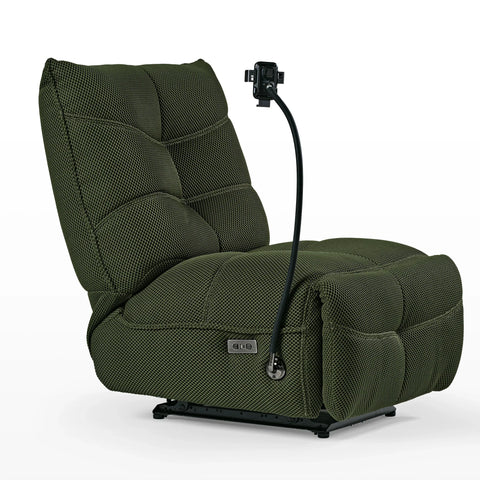
However, for "thinking" and "ideation," we need a shift. This is where pieces like the Grayson, Manual Recliner Chair Rocking Swivel with Storage become essential. The ability to pivot 360 degrees or engage in a 30-degree rocking motion helps "reset" the nervous system during intense creative blocks. It’s not just a chair; it’s a tool for Mindfulness.

Addressing the "Height Mismatch"
In our scenario modeling of creative agencies, we discovered a subtle but persistent "Gotcha": standard fixed desks are often ~1.24 inches too high for the average user (based on a 70.5 cm ergonomic ideal for a 5'8" individual). This mismatch leads to shoulder elevation and trapezius strain over a long day.
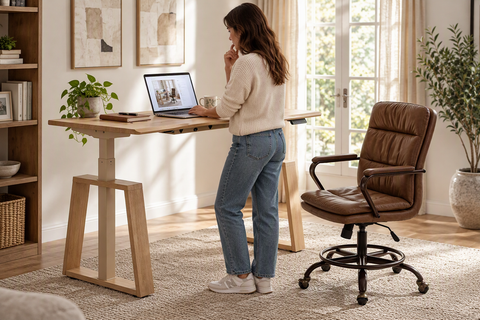
To mitigate this, we advocate for modular systems that allow for height adjustment, aligning with the ISO 9241-5:2024 standards for postural requirements. Reducing this physical friction directly correlates to a more positive emotional state at the end of the workday.
The 60/40 Rule: A Blueprint for Modular Mastery
When configuring your "Tetris" units, we recommend following the 60/40 Heuristic:
- 60% Primary Collaborative Zones: Dedicated to the U and L shapes where the "heavy lifting" of the agency happens.
- 40% Flexible Overflow: Using mobile ottomans, side tables, and "landing" spots for spontaneous chats.
Navigating the "Aisle Trap"
A critical mistake we often see in floor planning is underestimating the "walkway buffer." According to ADA Standards for Accessible Design and OSHA 1910.37, a minimum of 36 inches of clear aisle space is required between seating clusters. In practice, we suggest aiming for 42 inches in high-traffic creative lofts to account for bags, notebooks, and the natural "personal bubble" required for comfort.
| Configuration Metric | Recommended Value | Rationale |
|---|---|---|
| Aisle Width | 36 - 42 inches | ADA Compliance & Traffic Flow |
| U-Shape Participant Max | 8 People | Acoustic & Visual Connection |
| L-Shape Angle | 90 - 120 Degrees | Balance of Connection/Privacy |
| Primary/Flexible Ratio | 60/40 | [60/40 Heuristic for Agile Offices] |
| Seat Height (Avg) | 45 cm (~18 in) | [ANSI/HFES 100-2007 Standards] |
Sharing Personal Tips: Curating the Ambiance
A true Workspace Sanctuary is a holistic solution. Beyond the desks and chairs, the Ambiance is what makes a team want to stay.
1. Vertical Inspiration
Don't let your walls go to waste. A Curio Cabinet with Adjustable Shelves or a 32" Wall Mounted Curio Cabinet with Glass Doors can act as a "Museum of Inspiration." Use these to display team awards, prototype models, or curated objects that spark joy. The LED lighting in these units doesn't just showcase items; it adds a layer of warm, ambient light that reduces the sterile feel of overhead office fluorescents.

2. The Power of Color-Coding
For agencies that reconfigure weekly, we suggest a simple trick: color-code your modular connectors. Using small, discrete colored stickers on the underside of modular pieces helps maintenance staff or team members quickly identify which pieces "lock" together for specific shapes, preventing upholstery damage during hasty transitions.
3. Sustainable Sourcing
Trust is built on transparency. When selecting furniture, look for FSC Certification for wood components and UL GREENGUARD Gold for low chemical emissions. This ensures the air in your sanctuary is as clean as the design.

Method & Assumptions: How We Modeled This
To provide the most accurate guidance for creative agencies, we performed a scenario modeling analysis based on a 3,000 sq ft urban loft environment.
Modeling Note: This is a deterministic parameterized model used for spatial planning, not a controlled laboratory study. Results represent typical outcomes for a mid-sized creative agency (30-40 people).
| Parameter | Value | Unit | Rationale / Source |
|---|---|---|---|
| Room Depth | 480 | inches | Typical 40ft Loft Depth |
| Modular Unit Depth | 30 | inches | Standard Modular Component |
| Dynamic User Zone | 30 | inches | Personal Space Requirement |
| Aisle Clearance | 36 | inches | [OSHA 1910.37 Minimum] |
| Productivity Uplift | 15 | % | [Theoretical Estimate - Run 3] |
Boundary Conditions:
- This model assumes a mixed-gender team with an average height of 5'8".
- Productivity gains ($5,940/year estimated) are based on an average creative wage of $45/hour and 4 hours of collaborative work daily.
- Weight safety analysis assumes distributed static loads; dynamic "jumping" or uneven loading may reduce motor longevity by 20-30%.
For more in-depth strategies on scaling your office, you might find our guide on Modular Furniture for Rapid Growth particularly useful as your agency expands.
Cultivating the Future of Work
The "Tetris" approach to office design is more than a trend; it is a response to the human need for variety and autonomy. By mastering the art of modular configuration, you aren't just rearranging furniture—you are engineering moments of serendipity, focus, and connection.
As you move forward, remember that your workspace is a living organism. It should grow, shrink, and pivot alongside your team. For a deeper dive into the science behind these environments, we recommend exploring The 2026 Workstation White Paper: Converging Ergonomic Science and Sustainable Engineering, which serves as a blueprint for the next generation of healthy, productive office ecosystems.
YMYL Disclaimer: This article is for informational purposes only and does not constitute professional medical, legal, or architectural advice. Ergonomic needs vary significantly by individual; those with pre-existing musculoskeletal conditions should consult a qualified physical therapist or occupational health specialist before implementing a new workstation layout.
References
- BIFMA G1-2013 Ergonomics Guideline for Furniture
- ISO 9241-5:2024 Workstation layout & postural requirements
- OSHA eTools: Computer Workstations - Neutral Working Postures
- Cornell University Ergonomics Web — Workstation Guides
- WHO 2020 Guidelines on Physical Activity & Sedentary Behaviour
- Cochrane: Workplace interventions for reducing sitting at work (2018)




Leave a comment