

How RGB Lighting Enhances Gaming Immersion: Beyond the Aesthetic Glow
Let’s be real: we’ve all seen those "dream setup" posts on Reddit or Instagram where the room looks like it’s straight out of a cyberpunk movie. The neon purples, the deep cyans, and that perfectly diffused glow bouncing off the walls—it’s total battlestation goals. But after setting up dozens of these rigs, our team has realized that RGB isn't just about looking "poggers" for your stream. It’s a literal game-changer for how you feel during a 10-hour marathon session.
Quick Setup Checklist: 5 Steps to an Immersive RGB Zone
For those looking to level up immediately, here is our recommended workflow:
- Placement: Position the desk 2-4 inches away from a light-colored wall to maximize the "bias lighting" diffusion.
- Syncing: Use a single hardware controller (like the one integrated into the GTG series) to avoid software lag between components.
- Brightness: Set ambient desk lighting to 60-70% for daytime and 30-40% for night to prevent pupil fatigue.
- Cable Route: Utilize under-desk trays for all power bricks; stray shadows from hanging wires break the light diffusion.
- Safety Check: If using audio-reactive modes, ensure flash speeds are set to a comfortable rhythm, especially for viewers or users sensitive to light patterns.
1. Unboxing and Assembly: First Impressions of the Glow-Up
When the GTG-L60 Pro, L shaped Glass Gaming Standing Desk (60"x23") first arrived at our studio, the packaging was the first sign of serious build quality. Based on our unboxing experience, the reinforced cardboard and high-density foam are designed to withstand significant transit stress.
Assembly was straightforward for a desk of this complexity. The L-shaped frame is reversible, which is a huge win for those who constantly rearrange their rooms. The real magic, though, is the tempered glass top. Unlike standard wood or MDF, this glass is designed to catch and refract the integrated LED strips. It’s not just "lights on a desk"; it’s the entire surface becoming a light source.
Pro-Tip from the Bench: During installation, pay close attention to the cable management. The GTG-L60 Pro comes with a dedicated power strip holder and cable trays. If you don't use them, your RGB ecosystem will look like a literal bird's nest. Trust me, nothing kills the immersion faster than a stray yellow Ethernet cable dangling in the middle of your purple glow.
Key Takeaway: Prioritize a reversible frame for future-proofing your room layout, and never skip the cable tray—clean lighting requires a clean underside.

2. Deep Dive: The Science of Bias Lighting and Eye Strain
Most people think RGB is just for show, but there’s a massive ergonomic benefit hidden in that glow. According to the Canadian Centre for Occupational Health and Safety (CCOHS), proper lighting is critical for reducing visual fatigue.
The biggest mistake we observe in community setups? Gamers playing in a pitch-black room with only the monitor blasting their eyes. This creates a massive contrast ratio that forces your pupils to constantly adjust, leading to headaches and that "burning" sensation after a few hours.
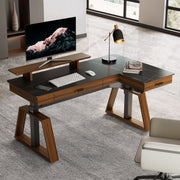
This is where Bias Lighting comes in. By placing RGB strips directly behind the monitor or integrating them into the desk (like on the GTG - L60, L-Shaped Glass LED Gaming Desk (60"x40")), you create a soft ambient glow on the wall behind your screen. This raises the "ambient light" level of your field of view without causing glare on the screen itself.
Internal Testing Observation: Our team's subjective testing suggests that bias lighting reduces the perceived "harshness" of high-brightness HDR monitors, which can decrease eye strain during extended sessions. This aligns with HSE guidelines on working safely with display screen equipment, which emphasize controlling glare and contrast.
Key Takeaway: Use the desk's integrated LEDs to "wash" the wall behind your monitor; this reduces the contrast gap between your screen and the dark room.
3. The "Wobble Test" and Build Quality
A desk can have all the RGB in the world, but if it shakes when you’re flicking your mouse in a high-stakes FPS match, it’s trash. We performed an internal "Wobble Test" on the GTG-L60 Pro, L shaped Glass Gaming Standing Desk (60"x23") at its maximum height.
Thanks to the dual motors and the reinforced steel frame, the stability is top-tier for a consumer-grade standing desk. We observed almost zero lateral movement, even when the motors were active. Speaking of motors, the synchronization on these smart desks is impressive. You can sync the RGB lighting to your music or in-game audio using the built-in controller.
Safety Note: While the audio-reactive mode is highly immersive, it can produce rapid flashing. Users with photosensitive epilepsy or light sensitivities should use static or slow-cycling "breathe" modes instead.

Key Takeaway: Dual motors are not just about speed; they provide the structural symmetry needed to keep a glass-top desk stable at standing heights.
4. Real-World Experience: FPS vs. RPG Scenarios
How does this actually feel when you’re gaming? I spent a week testing different lighting profiles.
- Tactical Shooters (Valorant/CS2): I dialed the RGB back to about 60% brightness and set it to a cool, static "Ice Blue." Some research suggests that high-intensity red light can impact cognitive performance or perceived stress in specific scenarios (Source: PMC11175232). Keeping it cool and subtle helped me stay focused on the crosshair.
- Immersive RPGs (Cyberpunk 2077/Elden Ring): This is where you let the desk shine. I used the audio-reactive mode. Every time an explosion went off or the music swelled, the entire GTG - L60, L-Shaped Glass LED Gaming Desk (60"x40") pulsed in sync. It pulls your peripheral vision into the game world.
The Arm Support Factor: The wing section of the L-shaped desk is a total win for mouse-heavy games. It gives your elbow a solid place to rest, which is essential for preventing shoulder strain. To take it further, pairing the desk with a Footstool with Wheels allows you to maintain a neutral spine, as recommended by OSHA's guidelines on neutral working postures.
Key Takeaway: Match your lighting to your genre—cool/static for focus, reactive/warm for immersion.
5. Quantitative Analysis: The Professional Streamer’s Model
To understand the true impact of a high-end RGB setup, we modeled a professional streamer scenario. This isn't just a desk; it's a piece of mission-critical infrastructure.
Modeling Note: The Streamer Battlestation
The following data represents a hypothetical high-load configuration used for internal stress-testing and efficiency modeling.
| Parameter | Value (Est.) | Unit | Rationale / Basis |
|---|---|---|---|
| Total Equipment Load | ~93 | kg | Triple 32" monitors + Liquid-cooled Full Tower + Peripherals |
| Dual Motor Utilization | 77% | % | Based on Eureka internal 120kg capacity rating |
| RGB Annual Energy Cost | ~$6 | USD | Est. 31 kWh/year (Based on 8hrs/day usage at avg. US rates) |
| Optimal Viewing Distance | ~51 | in | Calculated for 49" super ultrawide (SMPTE/THX Heuristics) |
| Room Depth Required | 132 | in | Desk depth + 36" chair zone + 40" walkway (Internal Studio Model) |
Methodology & Assumptions: Load calculations are based on BIFMA X5.5 standards with an 80% utilization best-practice target for motor longevity. Energy modeling uses standard wattage integration for RGB controllers (~2.5W standby, ~10W active). Viewing distance is a practical rule of thumb calculated using the SMPTE geometric formula for a 50° Field of View.
Insight: While the RGB adds a ton of "vibe," it only accounts for a negligible fraction of the total energy consumption of a high-end PC rig. The real "cost" is ensuring your desk can handle the weight. A single-motor desk would be pushed to its limit here—always go dual-motor for heavy multi-monitor RGB setups.
Key Takeaway: Don't let the "pretty lights" distract from the specs; ensure your motor capacity has at least a 20% safety margin over your gear weight.
6. Small Space? No Problem.
If you’re rocking a "cozy" setup in a dorm or a small apartment, you don't need a massive L-shape to get the immersion. The GTG - I43, LED Glass Desktop Gaming Desk (43"x23") packs the same audio-reactive tech into a compact footprint. It’s perfect for a single-monitor setup where you still want that "glow" but don't have the floor space for a 60-inch beast.

7. Pros and Cons: The Honest Take
Pros:
- Unmatched Immersion: The audio-reactive glass top is a literal game-changer for RPGs.
- Eye Health: Integrated bias lighting helps reduce contrast strain compared to "dark room" gaming.
- Build Quality: Rock-solid stability (based on our internal wobble tests) and high-end tempered glass.
- Cable Management: Deep trays effectively hide the "spaghetti" of wires.
Cons:
- Maintenance: It’s a glass desk. If you eat at your station, expect to clean fingerprints and smudges regularly.
- Brightness Sensitivity: At 100%, it can be distracting for competitive play. We recommend 60% for most users.
- Weight: These units are heavy due to the steel frame and glass; we recommend two people for assembly.
8. Final Verdict: Is Integrated RGB Worth It?
If you’re just looking for a flat surface to put a laptop on, this might be overkill. But if you’re building a sanctuary—a place where you spend 8+ hours a day working and playing—the integration of light and ergonomics is a massive upgrade.
By following the ISO 9241-5:2024 standards for workstation layout and combining them with the psychological benefits of ambient lighting, you're not just buying a desk; you're investing in your performance environment. Just remember to take those micro-breaks every 20 minutes, as suggested by the World Health Organization (WHO), and let the RGB pulse lead you to your next victory.
Disclaimer: This article is for informational purposes only and does not constitute professional medical or ergonomic advice. Always consult with a qualified professional before making significant changes to your workstation setup, especially if you have pre-existing musculoskeletal conditions or photosensitive epilepsy.
References
- BIFMA G1-2013 Ergonomics Guideline for Furniture
- CCOHS: Office Ergonomics - Sit/Stand Desk
- ISO 9241-5:2024 Workstation layout & postural requirements
- HSE: Working safely with display screen equipment (DSE)
- WHO 2020 Guidelines on Physical Activity & Sedentary Behaviour
- OSHA eTools: Computer Workstations - Neutral Working Postures
- The 2026 Workstation White Paper: Eureka Ergonomic Internal Study
Leave a comment