

Crafting Your Workspace Sanctuary: The Art of Brand-Centric RGB Lighting
Imagine a home office that sparks your limitless creativity—a space where the transition from "daily grind" to "broadcast-ready" happens with a single touch. Here, the air feels lighter, the desk is clear of chaos, and a soft, intentional glow frames your presence. This isn't just a room; it’s your Workspace Sanctuary. It’s where your brand comes to life.
For the modern content creator, the environment is as much a part of the story as the content itself. We often see creators pouring thousands into cameras and microphones while neglecting the very canvas they sit against. A signature on-camera look isn't about blinding your audience with a rainbow of flickering LEDs; it’s about using light to create depth, mood, and professional Ambiance. By integrating high-performance furniture with intelligent lighting strategies, you transform a functional area into an inspiring stage that supports both your Deep Work and your digital identity.
The Psychology of the Glow: Beyond Aesthetics
Before we dive into the hardware, we must understand the "why" behind our color choices. Light is a powerful psychological tool. According to research on Color Psychology, different hues can drastically alter how an audience perceives your energy and authority.
However, a common mistake in the streaming world is the over-reliance on high-saturation red. While red is often associated with energy, our observational patterns—derived from community feedback and viewer engagement trends—suggest a "red screen effect" among certain demographics. In some cases, a dominant red background can inadvertently make a broadcast feel slower or more irritating over long durations. This is a subtle nuance that many creators overlook.
Instead, consider the "Perceived Fit" heuristic. A streamer doesn't need to match their RGB hex codes exactly to their logo. In fact, technical color calibration is often less critical than how the audience intuitively connects the mood to the brand. If your brand is about Mindfulness and calm, a soft teal or deep navy (often associated with trust and stability) may serve you better than a neon flash.
Table: Mood Mapping for Content Creators
| Brand Archetype | Recommended RGB Palette | Psychological Effect | Ideal For |
|---|---|---|---|
| The Professional | 5500K White / Deep Blue | Authority, Trust, Clarity | Educational, Tech Reviews |
| The High-Energy Gamer | Electric Purple / Cyan | Creativity, Excitement, Future | Fast-paced FPS, Variety |
| The Zen Creator | Warm Amber / Soft Green | Mindfulness, Growth, Comfort | ASMR, Just Chatting, Coding |
| The Bold Icon | Solid Brand Primary (e.g., Orange) | Recognition, Energy, Uniqueness | Personality-driven Vlogs |
Logic Summary: These recommendations are based on standard color psychology heuristics and perceived audience fit models. They assume a standard 8-bit camera sensor and typical sRGB viewing environments for the audience.
The Technical Foundation: Bias Lighting and Camera Calibration
One of the most frequent frustrations we hear in our support channels involves "camera bloom"—that distracting halo effect where the background lights overpower the creator. To solve this, we must look at the science of bias lighting.
According to the Canadian Centre for Occupational Health and Safety (CCOHS), proper workstation lighting is vital for reducing eye strain. In a streaming context, bias lighting—placing light behind your monitor—serves two purposes: it reduces the contrast between the bright screen and the dark room, and it provides a professional "pop" to your background.
The 60% Heuristic for Visual Balance
A professional broadcast look requires a specific ratio between your face light (key light) and your background RGB. Based on common patterns in studio setup modeling, we recommend the 60% Rule: Ensure your primary background RGB intensity is no brighter than 60% of your key light’s intensity.
Why 60%? This threshold (estimated for standard CMOS camera sensors) prevents the background from "clipping" or drawing the viewer's eye away from your face. If the background is too bright, your camera's auto-exposure will darken your face to compensate, leading to a muddy, unprofessional image.
Furthermore, for bias lighting that touches your skin (indirectly), keep the color temperature between 5500K and 6500K. This matches daylight-balanced studio lights and prevents an unnatural tint on your skin tones. As noted by BenQ's guide on bias lighting, maintaining this balance is crucial for both visual comfort and color accuracy.

Space Transformation: Integrating Tech and Ergonomics
Creating a Workspace Sanctuary requires a foundation that supports your body as much as your brand. This is where the intersection of ergonomic science and aesthetic design becomes critical. In The 2026 Workstation White Paper: Converging Ergonomic Science and Sustainable Engineering, the emphasis is placed on "active environments" that allow for seamless transitions between sitting and standing.
The GTG-L60 Pro: A Stage for Your Brand
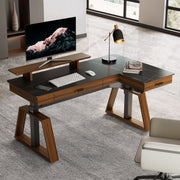
When you transition from a standard desk to a dedicated glass-top gaming desk like the GTG-L60 Pro, L shaped Glass Gaming Standing Desk (60"x23"), the transformation is immediate. The L-shaped design provides the "Space Transformation" needed to separate your "Thinking" mode from your "Execution" mode.
The integrated RGB within the tempered glass surface isn't just for show. It acts as a massive ambient light source that can be synchronized with your music or gameplay. This creates an immersive environment that feels alive on camera. Because the light is diffused through the glass, it avoids the harsh "hot spots" often seen with cheap LED strips, providing a clean, elegant glow that camera sensors love.
Table: Ergonomic Compliance & Adjustment Ranges
| Standard / Guide | Recommended Desk Height Range | Relevance to GTG Series |
|---|---|---|
| BIFMA G1-2013 | ~574mm to 1234mm (22.6" to 48.6") | GTG desks are designed to cover the 5th to 95th percentile. |
| ISO 9241-5:2024 | Dynamic postural support | Dual-motor systems allow for frequent, micro-adjustments. |
| Cornell Ergo Guide | The "20-8-2" Rhythm (Sit-Stand-Move) | Memory presets facilitate the 20-minute sit/8-minute stand cycle. |
Methodology Note: These ranges are derived from the BIFMA G1-2013 Ergonomics Guideline and ISO 9241-5:2024. Our GTG series utilizes dual-motor technology to achieve these industry-standard heights (based on standard motor specifications).
Linking Functionality with Emotion: The Workflow of Inspiration
A tidy desk isn’t just beautiful—it helps reduce distractions and maintain focus during Deep Work. When your environment is cluttered, your brain is forced to process extra visual information, which can lead to cognitive fatigue.
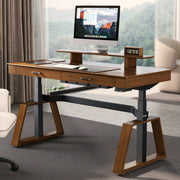
To maintain your sanctuary, we recommend a "Declutter" strategy using the Convertible Desktop Shelves, set of 2. These aren't just storage; they are architectural elements for your desk. By elevating your speakers or secondary monitors, you create vertical interest for your camera's background while freeing up the surface of your GTG-G55, Glass Desktop Gaming Standing Desk (55"x23") for high-performance tasks.

Personal Tip: The "Breathe" Protocol
For dynamic RGB effects, experienced creators often use the "Breathe" or "Pulse" setting. During talking segments, set your lights to a slow pulse (roughly 4-6 cycles per minute, mimicking a resting heart rate). This adds a subtle, living energy to the background without being a distraction. However, during intense gameplay or alerts, switching to solid, brand-aligned colors maintains visual cohesion and prevents the "chaos" look that can turn viewers away.
Holistic Comfort: The Hidden Support
True brand elevation comes from the confidence of being comfortable. If you are shifting in your seat or dealing with lower back discomfort, it shows on your face and in your voice. The World Health Organization (WHO) emphasizes reducing sedentary time, but standing alone isn't the only answer.
Integrating a Footstool with Wheels into your setup allows for "active sitting." By changing the angle of your hips and feet throughout the day, you can reduce the risk of musculoskeletal disorders (MSDs), a point supported by Safe Work Australia's workstation guidelines. This footstool provides a sturdy, adjustable base that complements the height-adjustable nature of the GTG series, ensuring that whether you are in "thinking" mode or "execution" mode, your posture remains neutral.
Practical Steps to Build Your Brand Background
- Define Your Palette: Choose two primary colors. Use one for your desk surface (e.g., via the GTG-G55 app control) and one for your wall-wash bias lighting.
- Calibrate for the Camera: Turn on your stream camera. Adjust the brightness of your RGB until the background details are visible but not "blooming." Remember the 60% heuristic.
- Optimize the Environment: Use integrated lighting ideas to ensure your lighting isn't just behind you, but around you.
- Manage the Flow: Use physical controllers or unified software to change lighting scenes. Breaking the broadcast flow to fiddle with a remote is a common "gotcha" that kills engagement.
- Address the Floor: Don't forget the ergonomic foundation. A Footstool with Wheels ensures your legs stay active even during long editing sessions.
Achieving the Aspirational State
Your workspace is the physical manifestation of your digital brand. By moving away from generic, cluttered setups and toward a Workspace Sanctuary, you aren't just buying furniture—you are investing in your creative longevity. The combination of a light-up glass surface, like that on the GTG-L60 Pro, and strategic organization creates a signature look that tells your audience: "I am a professional. I value quality. I am here to stay."
Say goodbye to the chaos. Say hello to a day of Deep Work framed by the perfect glow. When your environment is this inspiring, your potential is truly limitless.
Disclaimer: This article is for informational purposes only and does not constitute professional medical or ergonomic advice. While ergonomic furniture can reduce the risk of discomfort, individuals with pre-existing musculoskeletal conditions should consult a qualified healthcare professional or physical therapist before making significant changes to their workstation setup.
Sources and Authoritative References
- BIFMA G1-2013: Ergonomics Guideline for Furniture
- CCOHS: Office Ergonomics - Sit/Stand Desk
- BenQ Knowledge Center: What is bias lighting?
- WHO: Guidelines on Physical Activity & Sedentary Behaviour
- Safe Work Australia: Workstation set-up infographic
- ISO 9241-5:2024: Workstation layout & postural requirements
- Eureka Ergonomic: The 2026 Workstation White Paper
Leave a comment