

The Business Case for Standing Desks in Early-Stage Teams
In the high-velocity environment of an early-stage startup, capital allocation is often viewed through the lens of immediate survival: server costs, customer acquisition, and engineering talent. However, a critical oversight in many "hacker house" or open-plan office setups is the physical infrastructure supporting that talent. Founders often default to fixed-height desks to save on upfront burn, but this can create a silent tax on productivity and long-term team health.
Quick Summary: ROI Snapshot
For founders and HR leads, the decision to invest in ergonomic workstations can be summarized by these key performance indicators:
- Payback Period: Approximately 4 months for a high-quality $1,500 workstation (based on a $100k/year developer salary).
- Productivity Heuristic: Research suggests a potential 10–15% increase in productivity as users habituate to sit-stand transitions (Texas A&M Health Science Center).
- Budget Rule: Allocate 1–2% of an employee’s annual salary for their physical workstation to mitigate long-term Musculoskeletal Disorder (MSD) risks.
- Core Recommendation: Prioritize dual-motor stability and independent monitor arms to ensure ergonomic compliance across different body types.
The Physiology of the High-Performance Workstation
To understand why a desk matters, one must understand the impact of "static load." When an individual sits for prolonged periods, the lumbar spine often loses its natural curvature, leading to increased pressure on the intervertebral discs. According to the Occupational Safety and Health Administration (OSHA), poor posture and repetitive tasks are core risk factors for MSDs.
In a seated position, lower limbs remain inactive, which can impede blood circulation. Conversely, prolonged standing is not a universal fix. The EU-OSHA research on static standing highlights that standing for too long can lead to lower limb disorders. The solution is the "Neutral Position"—a state where the body is aligned and balanced, minimizing stress through movement.
The Cochrane systematic review (2018) concluded that sit-stand desks significantly reduce sitting time by approximately 84 to 116 minutes per day. For a startup team, these minutes represent a transition from static load to dynamic movement, which ISO 11226:2000 identifies as essential for maintaining acceptable working postures.
Quantifying the Startup ROI: A Heuristic Model
For decision-makers, health benefits are most actionable when translated into business metrics. The following model estimates the payback period for an ergonomic investment.
Methodology & Modeling Assumptions
This analysis uses a deterministic parameterized model. These figures are illustrative heuristics based on common tech industry benchmarks and should be adjusted for your specific team parameters.
| Parameter | Value | Unit | Rationale / Source |
|---|---|---|---|
| Team Size | 5 | People | Standard early-stage pod |
| Hourly Wage (Avg) | $50 | USD/hr | ~$100k/year salary (BLS tech average) |
| Standing Time | 180 | min/day | Target 1:1 or 1:2 sit-stand ratio |
| Productivity Coefficient | 0.1 | Ratio | 10% uplift (Based on Garrett et al., 2016) |
| Desk Investment | $1,500 | USD/unit | High-quality dual-motor workstation |
Calculation Formula:
Annual Productivity Value = (Daily Standing Mins / 60) * Work Days * Hourly Wage * Productivity Coefficient
Analysis Results:
- Annual Productivity Value Gain: Under these assumptions, a single developer standing for 3 hours a day generates approximately $4,500 in recovered productivity value.
- Payback Period: The $1,500 investment per desk is typically recouped in 4 months.
- Metabolic Estimate: Based on metabolic equivalent (MET) values, the model estimates an extra 100–130 calories burned per day, correlating to a theoretical 2–4 lbs of fat loss annually, assuming no compensatory caloric intake.
Sensitivity Analysis: Payback by Team Scale
| Team Size | Avg. Annual Salary | Est. Annual Productivity Gain | Payback Period |
|---|---|---|---|
| 5 (Seed) | $100,000 | ~$22,500 | ~4.0 Months |
| 10 (Series A) | $120,000 | ~$54,000 | ~3.3 Months |
| 20 (Series B) | $140,000 | ~$126,000 | ~2.8 Months |

Engineering Controls: Why "Just Taking Breaks" Fails
In the "Hierarchy of Controls" defined by OSHA, "Engineering Controls" (physical changes to the workspace) are significantly more effective than "Administrative Controls" (reminders to take breaks).
Early-stage teams often make the mistake of purchasing manual hand-crank models. Internal observations from our support teams suggest that if the transition is not effortless, adoption rates drop significantly. A quality dual-motor desk with programmable presets reduces "friction," which can increase daily usage by an estimated 50–70% compared to manual alternatives.
Furthermore, a professional-grade workstation must meet industry durability standards. The BIFMA G1-2013 Ergonomics Guideline provides the dimensions necessary to fit the 5th to 95th percentile of the population. For a diverse team—from a 5'2" designer to a 6'4" backend engineer—a desk like the Ark EL Executive Standing Desk (60"x26") offers the necessary range to ensure "spinal neutral" for all users.
The "Non-Negotiable" Accessory: Monitor Arms
A common ergonomic failure is neglecting screen height. When moving from sitting to standing, the relationship between elbows and eyes changes. Without a monitor arm, users often "turtle"—craning the neck downward to see a screen that is now too low.
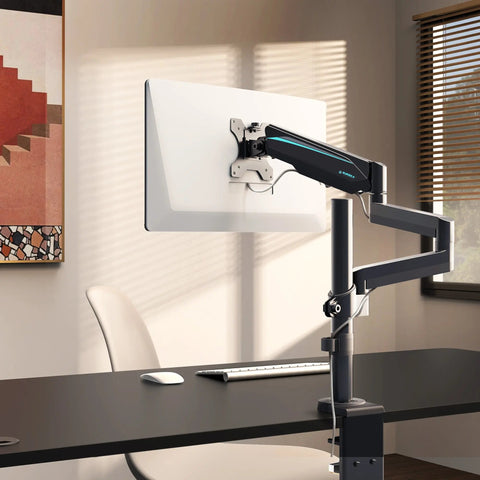
According to the HSE guide on Display Screen Equipment (DSE), the top of the screen should be roughly at eye level. For a dynamic workstation, the Single Monitor Arm is essential. It allows for independent adjustment of screen height and tilt, ensuring postural benefits aren't negated by neck strain.

Practical Recommendations for Implementation
To maximize the ROI of your workstation investment, we suggest the following practical heuristics:
- The 1-2% Rule: Allocate a budget equivalent to 1–2% of an engineer's annual salary ($1,000–$2,000) for their workstation. This is a one-time cost that pays dividends in focus.
- The 20-8-2 Rhythm: Follow the Cornell University Ergonomics recommendation: 20 minutes of sitting, 8 minutes of standing, and 2 minutes of moving/stretching.
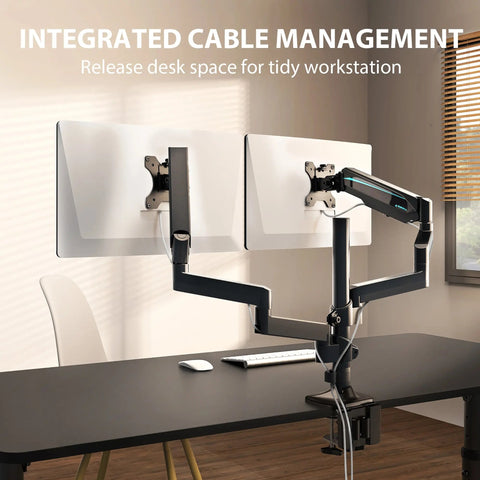
- Cable Management: Messy cables are a cognitive distraction and safety hazard. Choose desks with integrated management, like the Standing Desk with Drawers (55''), to maintain a focused environment.
- Prioritize Stability: High-speed typing on a wobbly desk at standing height is a major source of frustration. Dual-motor systems with reinforced legs are a baseline requirement for professional use.
Safety and Compliance Standards
Ensure your selections align with these benchmarks for durability and safety:
- ANSI/BIFMA X5.5: The gold standard for desk stability and durability.
- UL 962: Safety certification for the electrical components of height-adjustable desks.
- FSC Certification: For teams prioritizing sustainability, FSC-certified wood ensures responsible sourcing.
For a deeper dive into the intersection of science and office design, refer to The 2026 Workstation White Paper.
Scaling with Intent
Investing in high-quality furniture like the Ark X Executive Standing Desk (60"x26") signals to your team that you value their long-term performance. By moving away from "disposable furniture" toward evidence-based ergonomics, startups can build a culture of health that pays dividends in talent retention.
Appendix: Anthropometric Gap Analysis This table illustrates the "fit" problem for a tall male developer (185cm) using ANSI/HFES 100-2007 ratios.
| Metric | Value | Unit |
|---|---|---|
| Recommended Sit Desk Height | 76.5 | cm |
| Recommended Stand Desk Height | 113.5 | cm |
| Standard Fixed Desk Height | 73.6 (29") | cm |
| Ergonomic Gap (Sitting) | -2.9 | cm (Too Low) |
Note: Fixed desks are systematically too low for taller users, often forcing a slumped posture even while seated.
Disclaimer: This article is for informational purposes only and does not constitute professional medical, legal, or financial advice. Individuals with pre-existing musculoskeletal conditions should consult a qualified physiotherapist before making significant changes to their workstation habits.
References
- BIFMA G1-2013 Ergonomics Guideline for Furniture.
- Garrett, G., et al. (2016). "Call Center Productivity Over 6 Months Following a Standing Desk Intervention." Texas A&M Health Science Center.
- Cochrane: Workplace interventions for reducing sitting at work (2018).
- Cornell University Ergonomics Web — Workstation Guides.
- OSHA eTools: Computer Workstations - Neutral Working Postures.
- WHO 2020 Guidelines on Physical Activity & Sedentary Behaviour.




Leave a comment